• Fri frakt över 249 kr
  • •
  • Snabba leveranser
  • •
  • Billiga böcker
Kundservice

Du är på sajten för privatpersoner.

Företag, bibliotek eller offentlig verksamhet?

Du handlar på classic.bokus.com, där alla dina funktioner finns intakta.
Till classic.bokus.com
Bokus logotyp. Gå till startsidan.
  • Erbjudanden
  • Nyheter
  • Student
  • Topplistor
  • Barn & ungdom
  • Bokus Play
  • E-böcker
  • Pocketböcker
  • Spel & pussel

10% rabatt på allt med kod: NYSTART10 →

Sidfot

Mina sidor

    Hjälp

    • Kundservice
    • Vanliga frågor och svar
    • Frakt och leverans
    • Retur vid ångerrätt
    • Reklamera vara
    • Betalning
    • Köpvillkor
    • Allmänna villkor
    • Information om webbplatsens tillgänglighet

    Om Bokus

    • Om oss
    • Pressrum
    • För studenter
    • För företag
    • För bibliotek och offentlig verksamhet
    • För leverantörer
    • Hållbarhet

    Populärt

    • Aktuella erbjudanden
    • Presentkort
    • Studentlitteratur
    • Nya böcker
    • Topplistor
    • Signerade böcker
    • Engelska böcker

    Inspiration

    • Boktips
    • BookTok
    • Populära bokserier
    • Barnbokskaraktärer
    • Populära författare
    Logotyp för Bokus
    Följ oss på Facebook (extern länk)Följ oss på Instagram (extern länk)Följ oss på YouTube (extern länk)Följ oss på TikTok (extern länk)
    bokus @ CookiesAnpassa cookiesIntegritetspolicyKöpvillkor
    Till Citymail hemsida (extern länk)Till Budbee hemsida (extern länk)Till Postnord hemsida (extern länk)Till Schenker hemsida (extern länk)Till Early Bird hemsida (extern länk)Till Walleys hemsida (extern länk)
    1. Ekonomi och Ledarskap
    2. Företagsekonomi
    3. Redovisning och finansiering
    4. Finansiering

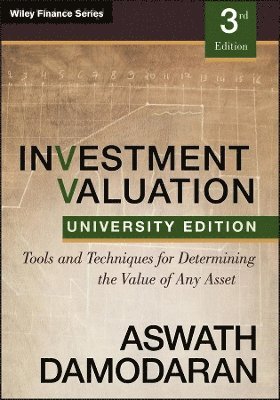
    Investment Valuation

    Tools and Techniques for Determining the Value of any Asset, University Edition

    AvAswath Damodaran

    Häftad, Engelska, 2012

    933 kr

    Tillfälligt slut

    Fler format och utgåvor

    E-bok

    1 219 kr

    E-bok

    1 219 kr

    E-bok

    1 015 kr

    E-bok

    1 015 kr

    Inbunden

    1 443 kr

    E-bok

    1 772 kr

    E-bok

    1 772 kr

    Inbunden

    Tillf. slut

    Beskrivning

    The definitive source of information on all topics related to investment valuation tools and techniques Valuation is at the heart of any investment decision, whether that decision is buy, sell or hold. But the pricing of many assets has become a more complex task in modern markets, especially after the recent financial crisis. In order to be successful at this endeavor, you must have a firm understanding of the proper valuation techniques. One valuation book stands out as withstanding the test of time among students of financial markets and investors, Aswath Damodaran'sInvestment Valuation.Now completely revised and updated to reflect changing market conditions, this third edition comprehensively introduces students and investment professionals to the range of valuation models available and how to chose the right model for any given asset valuation scenario. This edition includes valuation techniques for a whole host of real options, start-up firms, unconventional assets, distressed companies and private equity, and real estate. All examples have been updated and new material has been added. An expansion of ancillaries include updated online databases, spreadsheets, and other educational support toolsFully revised to incorporate valuation lessons learned from the last five years, from the market crisis and emerging markets to new types of equity investmentsRevised examples of company valuations such as companies from Eastern Europe and Africa, which stress the global nature of modern valuationAuthor Aswath Damodaran is regarded as one of the best educators and thinkers on the topic of investment valuationThis indispensable guide is a must read for students wishing to gain a better understanding of investment valuation and its methods. With it, you can take the insights and advice of a recognized authority on the valuation process and immediately put them to work for you.

    Produktinformation

    • Utgivningsdatum:2012-04-20
    • Mått:175 x 254 x 56 mm
    • Vikt:1 657 g
    • Format:Häftad
    • Språk:Engelska
    • Antal sidor:992
    • Upplaga:3
    • Förlag:John Wiley & Sons Inc
    • ISBN:9781118130735

    Utforska kategorier

    • Finansiering inom Ekonomi och Ledarskap
    • Projektledning inom Ekonomi och Ledarskap

    Mer om författaren

    ASWATH DAMODARAN is Professor of Finance at New York University's Leonard N. Stern School of Business. He has been the recipient of numerous awards for outstanding teaching, including the NYU university-wide Distinguished Teaching Award, and was named one of the nation's top business school teachers by BusinessWeek in 1994. In addition, Damodaran teaches training courses in corporate finance and valuation at many leading investment banks. His publications include Damodaran on Valuation: Security Analysis for Investment and Corporate Finance; Investment Valuation; Corporate Finance; Investment Management; and Applied Corporate Finance, all published by Wiley, and The Dark Side of Valuation.

    Innehållsförteckning

    • Chapter 1 Introduction to Valuation 1A Philosophical Basis for Valuation 1Generalities about Valuation 2The Role of Valuation 6Conclusion 9Questions and Short Problems 9Chapter 2 Approaches to Valuation 11Discounted Cash Flow Valuation 11Relative Valuation 19Contingent Claim Valuation 23Conclusion 25Questions and Short Problems 25Chapter 3 Understanding Financial Statements 27The Basic Accounting Statements 27Asset Measurement and Valuation 29Measuring Financing Mix 36Measuring Earnings and Profitability 42Measuring Risk 47Other Issues in Analyzing Financial Statements 53Conclusion 55Questions and Short Problems 55Chapter 4 The Basics of Risk 58What is Risk? 58Equity Risk and Expected Return 59Alternative Models for Equity Risk 71A Comparative Analysis of Equity Risk Models 76Models of Default Risk 77Conclusion 81Questions and Short Problems 82Chapter 5 Option Pricing Theory and Models 87Basics of Option Pricing 87Determinants of Option Value 89Option Pricing Models 90Extensions of Option Pricing 107Conclusion 109Questions and Short Problems 109Chapter 6 Market Efficiency—Definition, Tests, and Evidence 111Market Efficiency and Investment Valuation 111What Is an Efficient Market? 112Implications of Market Efficiency 112Necessary Conditions for Market Efficiency 114Propositions about Market Efficiency 114Testing Market Efficiency 116Cardinal Sins in Testing Market Efficiency 120Some Lesser Sins That Can Be a Problem 121Evidence on Market Efficiency 122Time Series Properties of Price Changes 122Market Reaction to Information Events 130Market Anomalies 134Evidence on Insiders and Investment Professionals 142Conclusion 149Questions and Short Problems 150Chapter 7 Riskless Rates and Risk Premiums 154The Risk-Free Rate 154Equity Risk Premium 159Default Spreads on Bonds 177Conclusion 180Questions and Short Problems 180Chapter 8 Estimating Risk Parameters and Costs of Financing 182The Cost of Equity and Capital 182Cost of Equity 183From Cost of Equity to Cost of Capital 210Best Practices at Firms 221Conclusion 222Questions and Short Problems 223Chapter 9 Measuring Earnings 229Accounting versus Financial Balance Sheets 229Adjusting Earnings 230Conclusion 247Questions and Short Problems 249Chapter 10 From Earnings to Cash Flows 250The Tax Effect 250Reinvestment Needs 258Conclusion 268Questions and Short Problems 269Chapter 11 Estimating Growth 271The Importance of Growth 272Historical Growth 272Analyst Estimates of Growth 282Fundamental Determinants of Growth 285Qualitative Aspects of Growth 301Conclusion 302Questions and Short Problems 302Chapter 12 Closure in Valuation: Estimating Terminal Value 304Closure in Valuation 304The Survival Issue 318Closing Thoughts on Terminal Value 320Conclusion 321Questions and Short Problems 321Chapter 13 Dividend Discount Models 323The General Model 323Versions of the Model 324Issues in Using the Dividend Discount Model 344Tests of the Dividend Discount Model 345Conclusion 348Questions and Short Problems 349Chapter 14 Free Cash Flow to Equity Discount Models 351Measuring What Firms Can Return to Their Stockholders 351FCFE Valuation Models 357FCFE Valuation versus Dividend Discount Model Valuation 372Conclusion 376Questions and Short Problems 376Chapter 15 Firm Valuation: Cost of Capital and Adjusted Present Value Approaches 380Free Cash flow to the Firm 380Firm Valuation: The Cost of Capital Approach 383Firm Valuation: The Adjusted Present Value Approach 398Effect of Leverage on Firm Value 402Adjusted Present Value and Financial Leverage 415Conclusion 419Questions and Short Problems 419Chapter 16 Estimating Equity Value per Share 423Value of Nonoperating Assets 423Firm Value and Equity Value 440Management and Employee Options 442Value per Share When Voting Rights Vary 448Conclusion 450Questions and Short Problems 451Chapter 17 Fundamental Principles of Relative Valuation 453Use of Relative Valuation 453Standardized Values and Multiples 454Four Basic Steps to Using Multiples 456Reconciling Relative and Discounted Cash Flow Valuations 466Conclusion 467Questions and Short Problems 467Chapter 18 Earnings Multiples 468Price-Earnings Ratio 468The PEG Ratio 487Other Variants on the PE Ratio 497Enterprise Value to EBITDA Multiple 500Conclusion 508Questions and Short Problems 508Chapter 19 Book Value Multiples 511Price-to-Book Equity 511Applications of Price–Book Value Ratios 521Use in Investment Strategies 530Value-to-Book Ratios 532Tobin’s Q: Market Value/Replacement Cost 537Conclusion 539Questions and Short Problems 539Chapter 20 Revenue Multiples and Sector-Specific Multiples 542Revenue Multiples 542Sector-Specific Multiples 571Conclusion 577Questions and Short Problems 577Chapter 21 Valuing Financial Service Firms 581Categories of Financial Service Firms 581What is Unique about Financial Service Firms? 582General Framework for Valuation 583Discounted Cash Flow Valuation 584Asset-Based Valuation 599Relative Valuation 599Issues in Valuing Financial Service Firms 605Conclusion 607Questions and Short Problems 608Chapter 22 Valuing Firms with Negative or Abnormal Earnings 611Negative Earnings: Consequences and Causes 611Valuing Negative Earnings Firms 615Conclusion 639Questions and Short Problems 639Chapter 23 Valuing Young or Start-Up Firms 643Information Constraints 643New Paradigms or Old Principles:A Life Cycle Perspective 644Venture Capital Valuation 646General Framework for Analysis 648Value Drivers 659Estimation Noise 661Implications for Investors 662Implications for Managers 663The Expectations Game 663Conclusion 665Questions and Short Problems 666Chapter 24 Valuing Private Firms 667What Makes Private Firms Different? 667Estimating Valuation Inputs at Private Firms 668Valuation Motives and Value Estimates 688Valuing Venture Capital and Private Equity Stakes 693Relative Valuation of Private Businesses 695Conclusion 699Questions and Short Problems 699Chapter 25 Aquisitions and Takeovers 702Background on Acquisitions 702Empirical Evidence on the Value Effects of Takeovers 705Steps in an Acquisition 705Takeover Valuation: Biases and Common Errors 724Structuring the Acquisition 725Analyzing Management and Leveraged Buyouts 730Conclusion 734Questions and Short Problems 735Chapter 26 Valuing Real Estate 739Real versus Financial Assets 739Discounted Cash Flow Valuation 740Comparable/Relative Valuation 759Valuing Real Estate Businesses 761Conclusion 763Questions and Short Problems 763Chapter 27 Valuing Other Assets 766Cash-Flow-Producing Assets 766Non-Cash-Flow-Producing Assets 775Assets with Option Characteristics 777Conclusion 778Questions and Short Problems 779Chapter 28 The Option to Delay and Valuation Implications 781The Option to Delay a Project 781Valuing a Patent 789Natural Resource Options 796Other Applications 802Conclusion 802Questions and Short Problems 803Chapter 29 The Options to Expand and to Abandon: Valuation Implications 805The Option to Expand 805When Are Expansion Options Valuable? 812Valuing a Firm with the Option to Expand 815Value of Financial Flexibility 817The Option to Abandon 820Reconciling Net Present Value and Real Option Valuations 823Conclusion 823Questions and Short Problems 824Chapter 30 Valuing Equity in Distressed Firms 826Equity in Highly Levered Distressed Firms 826Implications of Viewing Equity as an Option 828Estimating the Value of Equity as an Option 831Consequences for Decision Making 836Conclusion 839Questions and Short Problems 839Chapter 31 Value Enhancement: A Discounted Cash Flow Valuation Framework 841Value-Creating and Value-Neutral Actions 841Ways of Increasing Value 842Value Enhancement Chain 859Closing Thoughts on Value Enhancement 864Conclusion 865Questions and Short Problems 865Chapter 32 Value Enhancement: Economic Value Added, Cash Flow Return on Investment, and Other Tools 869Economic Value Added 870Cash Flow Return on Investment 884A Postscript on Value Enhancement 890Conclusion 891Questions and Short Problems 891Chapter 33 Probabilistic Approaches in Valuation: Scenario Analysis, Decision Trees, and Simulations 894Scenario Analysis 894Decision Trees 899Simulations 908An Overall Assessment of Probabilistic Risk-Assessment Approaches 919Conclusion 921Questions and Short Problems 921Chapter 34 Overview and Conclusion 925Choices in Valuation Models 925Which Approach Should You Use? 926Choosing the Right Discounted Cash Flow Model 929Choosing the Right Relative Valuation Model 933When Should You Use the Option Pricing Models? 937Conclusion 938References 939Index 954

    Betyg & recensioner

    3.3/5