• Fri frakt över 249 kr
  • •
  • Snabba leveranser
  • •
  • Billiga böcker
Kundservice

Du är på sajten för privatpersoner.

Företag, bibliotek eller offentlig verksamhet?

Du handlar på classic.bokus.com, där alla dina funktioner finns intakta.
Till classic.bokus.com
Bokus logotyp. Gå till startsidan.
  • Erbjudanden
  • Nyheter
  • Student
  • Topplistor
  • Barn & ungdom
  • Bokus Play
  • E-böcker
  • Pocketböcker
  • Spel & pussel

10% rabatt på allt med kod: NYSTART10 →

Sidfot

Mina sidor

    Hjälp

    • Kundservice
    • Vanliga frågor och svar
    • Frakt och leverans
    • Retur vid ångerrätt
    • Reklamera vara
    • Betalning
    • Köpvillkor
    • Allmänna villkor
    • Information om webbplatsens tillgänglighet

    Om Bokus

    • Om oss
    • Pressrum
    • För studenter
    • För företag
    • För bibliotek och offentlig verksamhet
    • För leverantörer
    • Hållbarhet

    Populärt

    • Aktuella erbjudanden
    • Presentkort
    • Studentlitteratur
    • Nya böcker
    • Topplistor
    • Signerade böcker
    • Engelska böcker

    Inspiration

    • Boktips
    • BookTok
    • Populära bokserier
    • Barnbokskaraktärer
    • Populära författare
    Logotyp för Bokus
    Följ oss på Facebook (extern länk)Följ oss på Instagram (extern länk)Följ oss på YouTube (extern länk)Följ oss på TikTok (extern länk)
    bokus @ CookiesAnpassa cookiesIntegritetspolicyKöpvillkor
    Till Citymail hemsida (extern länk)Till Budbee hemsida (extern länk)Till Postnord hemsida (extern länk)Till Schenker hemsida (extern länk)Till Early Bird hemsida (extern länk)Till Walleys hemsida (extern länk)
    1. Ekonomi och Ledarskap
    2. Företagsekonomi
    3. Redovisning och finansiering
    4. Finansiering

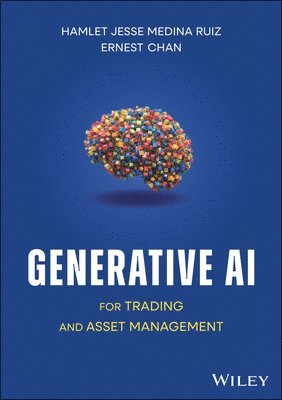
    Generative AI for Trading and Asset Management

    AvHamlet Jesse Medina Ruiz,Ernest P. Chan

    Inbunden, Engelska, 2025

    404 kr

    Beställningsvara. Skickas inom 5-8 vardagar. Fri frakt över 249 kr.

    Beskrivning

    Expert guide on using AI to supercharge traders' productivity, optimize portfolios, and suggest new trading strategies Generative AI for Trading and Asset Management is an essential guide to understand how generative AI has emerged as a transformative force in the realm of asset management, particularly in the context of trading, due to its ability to analyze vast datasets, identify intricate patterns, and suggest complex trading strategies. Practically, this book explains how to utilize various types of AI: unsupervised learning, supervised learning, reinforcement learning, and large language models to suggest new trading strategies, manage risks, optimize trading strategies and portfolios, and generally improve the productivity of algorithmic and discretionary traders alike. These techniques converge into an algorithm to trade on the Federal Reserve chair's press conferences in real time. Written by Hamlet Medina, chief data scientist Criteo, and Ernie Chan, founder of QTS Capital Management and Predictnow.ai, this book explores topics including: How large language models and other machine learning techniques can improve productivity of algorithmic and discretionary traders from ideation, signal generations, backtesting, risk management, to portfolio optimizationThe pros and cons of tree-based models vs neural networks as they relate to financial applications. How regularization techniques can enhance out of sample performanceComprehensive exploration of the main families of explicit and implicit generative models for modeling high-dimensional data, including their advantages and limitations in model representation and training, sampling quality and speed, and representation learning.Techniques for combining and utilizing generative models to address data scarcity and enhance data augmentation for training ML models in financial applications like market simulations, sentiment analysis, risk management, and more.Application of generative AI models for processing fundamental data to develop trading signals.Exploration of efficient methods for deploying large models into production, highlighting techniques and strategies to enhance inference efficiency, such as model pruning, quantization, and knowledge distillation.Using existing LLMs to translate Federal Reserve Chair's speeches to text and generate trading signals.Generative AI for Trading and Asset Management earns a well-deserved spot on the bookshelves of all asset managers seeking to harness the ever-changing landscape of AI technologies to navigate financial markets.

    Produktinformation

    • Utgivningsdatum:2025-05-08
    • Mått:183 x 257 x 25 mm
    • Vikt:635 g
    • Format:Inbunden
    • Språk:Engelska
    • Antal sidor:320
    • Förlag:John Wiley & Sons Inc
    • ISBN:9781394266975

    Utforska kategorier

    • Finansiering inom Ekonomi och Ledarskap
    • Artificiell intelligens inom Data och IT

    Mer om författaren

    HAMLET JESSE MEDINA RUIZ holds the position of Chief Data Scientist at Criteo. He specializes in time series forecasting, machine learning, deep learning, and Generative AI. He actively explores the potential of cutting-edge AI technologies, such as Generative AI across diverse applications. He holds an electronic engineering degree from Universidad Rafael Belloso Chacin in Venezuela, as well as two master’s degrees with honors in mathematics and machine learning from the Institut Polytechnique de Paris and Université Paris-Saclay. Additionally, he earned a PhD in physics from Université Paris-Saclay. Hamlet has consistently achieved first place and top ten rankings in global machine learning contests, earning the titles of Kaggle Expert and Numerai Expert for these challenges. Recently, he also earned a MicroMaster’s in finance from MIT’s Sloan School of Management. ERNEST CHAN (ERNIE) is the Founder and Chief Scientific Officer of PredictNow.ai (www.predictnow.ai), which offers AI-driven adaptive optimization solutions to the finance industry and beyond. He is also the Founder and Non-executive Chairperson of QTS Capital Management (www.qtscm.com), a quantitative CTA/CPO since 2011. He started his career as a machine learning researcher at IBM’s T.J. Watson Research Center’s language modeling group, which produced some of the best-known quant fund managers. Ernie is the acclaimed author of three previous books, Quantitative Trading (2nd Edition), Algorithmic Trading, and Machine Trading, all published by Wiley. More about these books and Ernie’s workshops on topics in quantitative investing and machine learning can be found at www.epchan.com. He obtained his PhD in physics from Cornell University and his BS in physics from the University of Toronto.

    Innehållsförteckning

    • Preface xvAcknowledgments xixAbout the Authors xxiPart I Generative AI for Trading and Asset Management: A No-code Introduction 1Chapter 1 No-code Generative AI for Basic Quantitative Finance 31.1 Retrieving Historical Market Data 41.2 Computing Sharpe Ratio 71.3 Data Formatting and Analysis 81.4 Translating Matlab Codes to Python Codes 111.5 Conclusion 16Chapter 2 No-code Generative AI for Trading Strategies Development 172.1 Creating Codes from a Strategy Specification 192.2 Summarizing a Trading Strategy Paper and Creating Backtest Codes from It 342.3 Searching for a Portfolio Optimization Algorithm Based on Machine Learning 452.4 Explore Options Term Structure Arbitrage Strategies 502.5 Conclusion 642.6 Exercises 662A.1 Computing Next-day’s Return 672A.2 Uploading the Fama-French Factors 682A.3 Combining Fama-French Factors with Next-day’s Returns 68Chapter 3 Whirlwind Tour of ML in Asset Management 713.1 Unsupervised Learning 723.2 Supervised Learning 773.3 Deep Reinforcement Learning 993.4 Data Engineering 1003.5 Feature Engineering 1023.6 Conclusion 106Part II Deep Generative Models for Trading and Asset Management 107Chapter 4 Understanding Generative AI 1094.1 Why Generative Models 1104.2 Difference with Discriminative Models 1104.3 How Can We Use Them? 1114.4 Illustrating Generative Models with ChatGPT 1134.5 Hybrid Modeling: Combining Generative and Discriminative Models 1194.6 Taxonomy of Generative Models 1234.7 Conclusion 124Chapter 5 Deep Autoregressive Models for Sequence Modeling 1255.1 Representation Complexity 1265.2 Representation and Complexity Reduction 1275.3 A Short Tour of Key Model Families 1285.4 Model Fitting 1555.5 Conclusions 157Chapter 6 Deep Latent Variable Models 1596.1 Introduction 1606.2 Latent Variable Models 1626.3 Examples of Traditional Latent Variable Models 1626.4 Learning 1716.5 Variational Autoencoder (VAE) 1766.6 VAEs for Sequential Data and Time Series 1776.7 Conclusion 181Chapter 7 Flow Models 1837.1 Introduction 1837.2 Model Training 1857.3 Linear Flows 1857.4 Designing Nonlinear Flows 1877.5 Coupling Flows 1887.6 Autoregressive Flows 1957.7 Continuous Normalizing Flows 1957.8 Modeling Financial Time Series with Flow Models 1967.9 Conclusion 199Chapter 8 Generative Adversarial Networks 2018.1 Introduction 2028.2 Training 2048.3 Some Theoretical Insight in GANs 2088.4 Why Is GAN Training Hard? Improving GAN Training Techniques 2098.5 Wasserstein GAN (WGAN) 2118.6 Extending GANs for Time Series 2148.7 Conclusion 215Chapter 9 Leveraging LLMs for Sentiment Analysis in Trading 2179.1 Sentiment Analysis in Fed Press Conference Speeches Using Large Language Models 2179.2 Data: Video + Market Prices 2219.3 Speech-to-text Conversion 2219.4 Sentiment Analysis 2259.5 Experiment Results 2329.6 Conclusion 234Chapter 10 Efficient Inference 23510.1 Introduction 23510.2 Scaling Large Language Models: High Performance, High Computational Cost, and Emergent Abilities 23610.3 Making FinBERT Faster 24010.4 Model Quantization 24710.5 Customizing Your LLM: Adapting Models to Your Needs 25210.6 Conclusions 256Chapter 11 Afterword 25711.1 Diffusion Models 26011.2 Combining Generative Model Variants 26011.3 LLMs as Financial Advisors 261References 263Appendix 271A.1 Retrieving Adjusted Closing Prices and Computing Daily Returns 271A.2 Installing Python 273A.2.1 Step 1: Download Python 273A.2.2 Step 2: Install Python 274A.2.3 Step 3: Set Up a Virtual Environment (Optional but Recommended) 274A.2.4 Step 4: Install Packages with pip 274A.2.5 Step 5: Consider an Integrated Development Environment (IDE) 274A.2.6 Additional Tips 275A.3 Plotting the Risk-free-rate over the Years 276A.4 Computing the Sharpe Ratio of SPY 278A.5 Matlab Code for Computing Efficient Frontier and Finding the Tangency Portfolio 280Index 283