• Fri frakt över 249 kr
  • •
  • Snabba leveranser
  • •
  • Billiga böcker
Kundservice

Du är på sajten för privatpersoner.

Företag, bibliotek eller offentlig verksamhet?

Du handlar på classic.bokus.com, där alla dina funktioner finns intakta.
Till classic.bokus.com
Bokus logotyp. Gå till startsidan.
  • Erbjudanden
  • Nyheter
  • Student
  • Topplistor
  • Barn & ungdom
  • Bokus Play
  • E-böcker
  • Pocketböcker
  • Spel & pussel

10% rabatt på allt med kod: NYSTART10 →

Sidfot

Mina sidor

    Hjälp

    • Kundservice
    • Vanliga frågor och svar
    • Frakt och leverans
    • Retur vid ångerrätt
    • Reklamera vara
    • Betalning
    • Köpvillkor
    • Allmänna villkor
    • Information om webbplatsens tillgänglighet

    Om Bokus

    • Om oss
    • Pressrum
    • För studenter
    • För företag
    • För bibliotek och offentlig verksamhet
    • För leverantörer
    • Hållbarhet

    Populärt

    • Aktuella erbjudanden
    • Presentkort
    • Studentlitteratur
    • Nya böcker
    • Topplistor
    • Signerade böcker
    • Engelska böcker

    Inspiration

    • Boktips
    • BookTok
    • Populära bokserier
    • Barnbokskaraktärer
    • Populära författare
    Logotyp för Bokus
    Följ oss på Facebook (extern länk)Följ oss på Instagram (extern länk)Följ oss på YouTube (extern länk)Följ oss på TikTok (extern länk)
    bokus @ CookiesAnpassa cookiesIntegritetspolicyKöpvillkor
    Till Citymail hemsida (extern länk)Till Budbee hemsida (extern länk)Till Postnord hemsida (extern länk)Till Schenker hemsida (extern länk)Till Early Bird hemsida (extern länk)Till Walleys hemsida (extern länk)
    1. Data och IT
    2. Systemvetenskap och AI

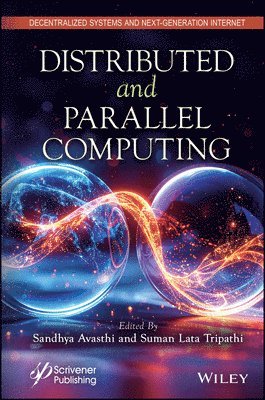
    Distributed and Parallel Computing

    AvSandhya Avasthi,Suman Lata Tripathi

    Inbunden, Engelska, 2025

    2 140 kr

    Beställningsvara. Skickas inom 5-8 vardagar. Fri frakt över 249 kr.

    Beskrivning

    Master the growing field of distributed and parallel computing with this essential guide, offering expert insights into the fundamentals and real-world applications for intelligent and collaborative systems. Distributed computing, or running programs across multiple computers over a network, is becoming a popular solution for addressing the demands for increased performance across industries, including scientific computing, oil exploration, biotechnology, and medicine. Distributed computing enables seamless communication and collaboration by allowing users from different locations to access and interact with their digital twin simultaneously. Distributed computing enhances the capabilities of digital twins by providing scalability, parallel processing, real-time data integration, collaboration support, resource optimization, fault tolerance, and security features. Distributed and Parallel Computing explores the fundamentals and innovations in intelligent and distributed computing systems and applications, including adaptivity and learning, agents and multi-agent systems, argumentation, case-based reasoning, and collaborative systems. Through expert insights, readers will discover promising real-world applications for this emerging technology.

    Produktinformation

    • Utgivningsdatum:2025-11-12
    • Mått:238 x 159 x 29 mm
    • Vikt:744 g
    • Format:Inbunden
    • Språk:Engelska
    • Antal sidor:368
    • Förlag:John Wiley & Sons Inc
    • ISBN:9781394288007

    Utforska kategorier

    • Systemvetenskap och AI inom Data och IT

    Mer om författaren

    Sandhya Avasthi, PhD is an assistant professor in the Computer Science and Engineering Department at ABES Engineering College at Dr. Abdul Kalam Technical University with over 18 years of teaching experience. She has published numerous research articles in refereed international journals, conference proceedings, and book chapters. Her research interests include natural language processing, information extraction, information retrieval, data science, and business intelligence. Suman Lata Tripathi, PhD is a professor at Lovely Professional University with more than 22 years of experience in academics and research. She has published more than 19 books, 125 research papers in refereed science journals, conference proceedings, 13 Indian patents, and four copyrights. Her area of expertise includes microelectronics device modeling and characterization, low-power VLSI circuit design, VLSI design testing, and advanced FET design for IoT.

    Innehållsförteckning

    • Preface xvii1 Introduction to Distributed Systems 1K. Karthikeyan, S. Hemalatha and S. Vignesh1.1 Introduction 22 Topology in Network Technologies 39Mohit Malik, Varun Dogra, Ramandeep Sandhu, Ratesh Kumar and Deepika Ghai2.1 Introduction 402.2 Related Work 412.3 Network Topology Design 442.4 Advantages of Network Topologies 472.5 Case Studies of Network Topologies 482.6 Distributed and Parallel Computing in Network Topology 492.7 Conclusion 533 Distributed Processing Technology and Advancements 57Saranya. N., Shermy. R.P., Sindhu. V., Karthika Renuka. D. and Renugadevi. G.3.1 Introduction 583.2 Distributed Processing in Modern Computing 603.3 Evolution of Distributed Processing 613.4 Key Concepts and Technologies Driving the Evolution of Distributed Processing 633.5 Recent Advancements in Distributed Processing 643.6 Changing Landscape of Computing 653.7 Security and Privacy Considerations 683.8 Opportunities and Challenges in Distributed Computing 713.9 Conclusion 734 Distributed System Architecture and Computing Models 77Sandhya Avasthi and Suman Lata Tripathi4.1 Introduction 774.2 Distributed System Architecture 784.3 Middleware in Distributed Systems 854.4 Distributed Cloud Architecture 884.5 Distributed Machine Learning 904.6 Conclusion 915 Parallel Computing Models and Architecture 95Aastha Sharma, Swati Sharma and Divya Mishra5.1 Introduction 965.2 Evolution of Parallel Computing Models 985.3 Parallel Computing Models 1006 Network Issues and High-Level Communication Tools in Distributed Computing 115Sandhya Avasthi and Sachin Kumar Vishwakarma6.1 Introduction 1166.2 Latency in Distributed and Parallel Computing 1186.3 Straggler Effect 1226.4 Packet Loss in the Distributed Network 1256.5 Network Congestion 1286.6 Communication Load 1296.7 Conclusion 1327 Infinite Horizons: Empowering Business Education Through Metaverse 135Shikha Mishra and Sujit S. Nair7.1 Introduction 1367.2 Challenges and Concerns 1377.3 Rules of Law–Based Governance 1397.4 Possible Implementations in Educational Framework of Metaverse Technology 1407.5 Understanding Metaverse 1417.6 Explore the Transformational Potential of Metaverse for Business Education 1427.7 Innovation and Design Ideas Forum 1457.8 Continuing Education and Career Development 1477.9 Takeaways 1477.10 Ethical and Legal Issues 1487.11 Future Prospects and Innovations 1497.12 Conclusion 1498 Paradigm Shifts and Future Directions in Distributed Data Management for Decentralized Networks 153Bishnu Kant Shukla, Bhupender Parashar, Vikas Kumar Singla and Shivam Verma8.1 Introduction 1548.2 Paradigm Shifts in Distributed Data Management 1558.3 Emergent Architectures and Frameworks 1568.4 Integration of IoT 1608.5 Edge Computing and Big Data Analytics 1638.6 Data Aggregation and Summarization Techniques 1648.7 Advanced Applications and Case Studies 1688.8 Future Directions in Distributed Data Management 1728.9 Conclusion 1749 Autonomy and Adaptive Architectures in Distributed Systems 183Bishnu Kant Shukla, Bhupender Parashar, Vikas Kumar Singla and Shivam Verma9.1 Introduction 1849.2 Conceptual Framework 1859.3 Architectural Models 1879.4 Adaptive Strategies in Distributed Systems 1889.5 Case Studies 1919.6 Application of MASs 1959.7 Autonomous Navigation Systems 1999.8 Collision Avoidance Algorithms 2029.9 Network Properties in Distributed Systems 2069.10 Challenges and Future Directions 2079.11 Conclusion 21010 Distributed Consensus Frequency Control in Networked Microgrid 219Jeevitha Kandasamy, J. Jenitha, M.R. Mohanraj, Jenifer Amla. L., G. Mahalakshmi and Ponrekha M.10.1 Introduction 22010.2 System Model 22410.3 Distributed Control Technique 22510.4 Results and Discussion 22810.5 Conclusion 23111 Navigating Trust in Distributed Systems 235Pooja Dehankar and Susanta Das11.1 Introduction 23611.2 Transparency Basics 24011.3 Heterogeneous and Homogeneous DSs 24011.4 Trust Management 24211.5 Components' Roles 24311.6 User Authentication and Access Control 24411.7 Trust Framework Pillars 24411.8 Trust Metrics 24411.9 Trust Models and Mechanisms 24511.10 Trust in Sensor Networks 24711.11 Apps of TMSs 24811.12 DSs Advantages and Challenges 24911.13 Artificial Intelligence for Trust Management 25011.14 Conclusion 25112 Trust in Distributed Systems, Distributed Ledger, Blockchain, and Related Technologies 257Shikha Verma, Priya Mishra and Sandhya Avasthi12.1 Introduction 25712.2 Trust in Distributed Ledger 25812.3 Trust Management in Edge-Based IoT Systems 26012.4 A Taxonomy of Trust Computation Frameworks for Edge-Based IoT Systems 26112.5 Trust in Distributed Databases 26212.6 Trust in Blockchain 26312.7 Serverless Computing 26812.8 Trust in Cloud Computing 27312.9 Conclusion 27513 Strategy to Improve Psychological Elements and Customer Service in Intelligent Health Systems 281Mani Dublish, Anita Pati Mishra and Shikha Mittal13.1 Introduction 28213.2 Design with User in Mind 28413.3 Designing Networked Medication Equipment with a Human Center 28513.4 Testing Usability with End Users 28513.5 Framework Required in Healthcare Fiction for Human-Based Design 28713.6 A Necessary Step to Enable Quick Learning Processes 28713.7 Requirement for a Planned Approach Setup 28813.8 Limitations 29113.9 Conclusion 29214 New Age Techs Backbone: Role of Distributed Systems in Paving Path for a Durable Future 299Kadambri Agarwal and Saijal Dahiya14.1 Introduction 30014.2 Distributed Systems in Smart Grids 30314.3 Distributed Systems in IoT 30514.4 Distributed Systems in Blockchain 30814.5 Distributed Systems in Machine Learning 31014.6 Distributed Systems in AR 31314.7 Distributed Systems in Distributed Databases 31514.8 Distributed Systems in Metaverse 31714.9 Conclusion 32015 Power Optimization in 4Bit Comparator Architecture Through Precomputation Technique 323Adarsh Sharma, Suman Lata Tripathi, Deepika Ghai and Khilda Afifah15.1 Introduction 32415.2 Comparator 32715.3 Precomputation Technique 32815.4 Reported Precomputation Circuit 32915.5 Comparator Design with Cadence Virtuoso 33015.6 Future Scopes 33115.7 Conclusion 335Acknowledgement 335References 335Index 339