• Fri frakt över 249 kr
  • •
  • Snabba leveranser
  • •
  • Billiga böcker
Kundservice

Du är på sajten för privatpersoner.

Företag, bibliotek eller offentlig verksamhet?

Du handlar på classic.bokus.com, där alla dina funktioner finns intakta.
Till classic.bokus.com
Bokus logotyp. Gå till startsidan.
  • Erbjudanden
  • Nyheter
  • Student
  • Topplistor
  • Barn & ungdom
  • Bokus Play
  • E-böcker
  • Pocketböcker
  • Spel & pussel

10% rabatt på allt med kod: NYSTART10 →

Sidfot

Mina sidor

    Hjälp

    • Kundservice
    • Vanliga frågor och svar
    • Frakt och leverans
    • Retur vid ångerrätt
    • Reklamera vara
    • Betalning
    • Köpvillkor
    • Allmänna villkor
    • Information om webbplatsens tillgänglighet

    Om Bokus

    • Om oss
    • Pressrum
    • För studenter
    • För företag
    • För bibliotek och offentlig verksamhet
    • För leverantörer
    • Hållbarhet

    Populärt

    • Aktuella erbjudanden
    • Presentkort
    • Studentlitteratur
    • Nya böcker
    • Topplistor
    • Signerade böcker
    • Engelska böcker

    Inspiration

    • Boktips
    • BookTok
    • Populära bokserier
    • Barnbokskaraktärer
    • Populära författare
    Logotyp för Bokus
    Följ oss på Facebook (extern länk)Följ oss på Instagram (extern länk)Följ oss på YouTube (extern länk)Följ oss på TikTok (extern länk)
    bokus @ CookiesAnpassa cookiesIntegritetspolicyKöpvillkor
    Till Citymail hemsida (extern länk)Till Budbee hemsida (extern länk)Till Postnord hemsida (extern länk)Till Schenker hemsida (extern länk)Till Early Bird hemsida (extern länk)Till Walleys hemsida (extern länk)
    1. Samhälle och politik
    2. Sociologi och antropologi
    3. Sociologi

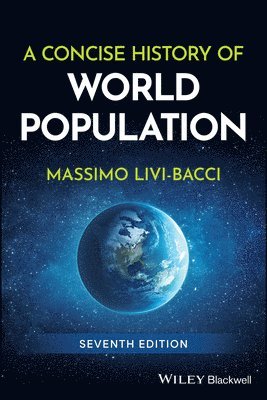
    Concise History of World Population

    AvMassimo Livi-Bacci

    Häftad, Engelska, 2025

    718 kr

    Skickas . Fri frakt över 249 kr.

    Fler format och utgåvor

    E-bok

    447 kr

    E-bok

    447 kr

    Häftad

    387 kr

    E-bok

    438 kr

    E-bok

    438 kr

    E-bok

    804 kr

    E-bok

    807 kr

    Beskrivning

    Explores the forces that have shaped global population growth over millennia Understanding the mechanisms that govern the size and trajectory of the human population is essential to navigating today's most pressing global challenges. A Concise History of World Population, offers a sweeping overview of the key demographic patterns that have defined human history and influenced the world's population structure. Drawing on disciplines as diverse as ecology, history, economics, and epidemiology, this new edition provides students and scholars with an interdisciplinary guide to the major forces—both natural and human-made—that have determined demographic growth, stagnation, or decline across civilizations. Acclaimed demographer Massimo Livi-Bacci addresses enduring questions about the balance between people, resources, and environment through careful analysis of catastrophic disruptions, technological revolutions, and slowly evolving reproductive behaviors. Reader-friendly chapters provide the intellectual tools needed to understand the shifting dynamics of global population—paying special attention to emerging demographic trends and the sustainability challenges they pose in the twenty-first century. The result is not just a concise history, but a rich framework for thinking critically about the demographic future. An essential resource for anyone seeking to understand how population and society co-evolve—and the delicate equilibrium they must maintain—A Concise History of World Population: Offers a clear and accessible narrative of global population history from pre-agricultural societies to the presentHighlights demographic mechanisms often overlooked in traditional population studiesIncludes in-depth analysis of catastrophic events and their demographic impact, including pandemics and climate shocksAddresses sustainability and future population trends in the context of limited global resourcesEngages with long-term patterns and short-term fluctuations in population-resource equilibriumEmploying an interdisciplinary approach that integrates history, anthropology, ecology, economics, and political science, A Concise History of World Population, Seventh Edition, is perfect for advanced undergraduate and graduate courses such as Population Studies, Demographic History, Global History, and Political Demography within degree programs in Sociology, Political Science, History, and Development Studies.

    Produktinformation

    • Utgivningsdatum:2025-12-11
    • Mått:150 x 224 x 25 mm
    • Vikt:476 g
    • Format:Häftad
    • Språk:Engelska
    • Antal sidor:384
    • Upplaga:7
    • Förlag:John Wiley & Sons Inc
    • ISBN:9781394295746

    Utforska kategorier

    • Sociologi inom Samhälle och politik
    • Historia: särskilda händelser och ämnen inom Historia och arkeologi

    Mer om författaren

    MASSIMO LIVI-BACCI is Emeritus Professor of Demography at the University of Florence. He is a former President of the International Union for the Scientific Study of Population (IUSSP) and served as a Senator of the Italian Republic. Livi-Bacci is widely recognized for his work on historical demography and migration, with notable publications including The Population of Europe: A History and A Short History of Migration.

    Innehållsförteckning

    • Preface ix1 The Space and Strategy of Demographic Growth 11.1 Humans and Animals 11.2 Divide and Multiply 51.3 Jacopo Bichi and Domenica Del Buono, Jean Guyon, and Mathurine Robin 81.4 Reproduction and Survival 111.4.1 The Frequency of Births 121.4.2 The Fecund Period Used for Reproduction 131.5 The Space of Growth 201.6 Environmental Constraints 221.7 A Few Figures 28Notes 32Further Reading 372 Demographic Growth: Between Choice and Constraint 392.1 Constraint, Choice, Adaptation 392.2 From Hunters to Farmers: The Neolithic Demographic Transition 422.3 Black Death and Demographic Decline in Europe 502.4 The Tragedy of the American Indios: Old Microbes and New Populations 562.5 Africa, America, and the Slave Trade 632.6 The French Canadians: A Demographic Success Story 682.7 Ireland and Japan: Two Islands, Two Histories 732.8 On the Threshold of the Contemporary World: China and Europe 80Notes 88Further Reading 993 Land, Labor, and Population 1013.1 Diminishing Returns and Demographic Growth 1013.2 Historical Confirmations 1063.3 Demographic Pressure and Economic Development 1123.4 More on Demographic Pressure and Development: Examples from the Stone Age to the Present Day 1163.5 Space, Land, and Development 1203.5.1 The Occupation of Uninhabited or Sparsely Populated Regions 1233.5.2 Transformation and Land Reclamation 1243.5.3 External Expansion 1253.6 Population Size and Prosperity 1283.7 Increasing or Decreasing Returns? 132Notes 134Further Reading 1394 Toward Order and Efficiency: The Demography of Europe and the Developed World 1414.1 From Waste to Economy 1414.2 From Disorder to Order: The Lengthening of Life 1474.3 From High to Low Fertility 1544.4 European Emigration: A Unique Phenomenon 1614.5 A Summing Up: The Results of the Transition 1674.6 Theoretical Considerations on the Relationship between Demographic and Economic Growth 1704.6.1 Purely Demographic Factors 1744.6.2 Factors of Scale and Dimensional Factors in General 1744.6.3 The Stock of Knowledge and Technological Progress 1754.7 More on the Relationship between Demographic and Economic Growth: Empirical Observations 176Notes 185Further Reading 1925 The Populations of Poor Countries 1955.1 An Extraordinary Phase 1955.2 The Conditions of Survival 2005.3 A Brief Geography of Fertility 2085.4 The Conditions and Prospects for Fertility Decline and Demographic Policy 2145.5 India and China 2225.6 Fertilia and Sterilia 2345.7 Explaining a Paradox 240Notes 246Further Reading 2576 Microbes, Food, and Space, and Sustainability of Population Change 2596.1 Moving Limits 2596.2 Microbes, Virus, and Longevity: Biological Sustainability 2646.2.1 Biological Sustainability 2656.2.2 AIDS Epidemic: Sustainable for the Rich, Unsustainable for the Poor 2666.2.3 COVID- 19: Unexpected Visitor 2716.3 Microbes, Virus, Longevity 2726.3.1 Political Sustainability 2726.4 Microbes, Virus, and Longevity: Economic Sustainability 2746.5 Food for All? 2776.5.1 First Topic: Food, Nutrition, and Hunger 2776.5.2 Second Topic: Productivity, Extension, and Intensification of Agricultural Systems 2806.5.3 Third Topic: Production, Consumption, and Greenhouse Gases 2836.6 Nonrenewable Resources and the Parable of Pauperia and Tycoonia 2846.7 Space and Environment in a Smaller Planet 2896.7.1 First Critical Issue: Deforestation and Intrusion in the Pluvial Forests 2926.7.2 Second Critical Issue: Increasing Human Settlement in the Coastal Areas 2956.7.3 Third Critical Issue: Megacities Energy Consumption and Pollution Champions 2976.7.4 Population and Environment: Adaptation and Mitigation 298Notes 300Further Reading 3057 The Future 3077.1 Population and Self- Regulation 3077.2 The Numbers of the Future 3097.3 The North- South Divide and International Migration 3157.3.1 Demographic Inequalities 3217.3.2 Economic Inequalities 3217.3.3 Migration Policies 3227.3.4 Climate Change 3237.3.5 Geography and Migratory Systems 3247.4 Downward Fertility and the Role of Policies 3267.5 Geodemography 3287.6 A Different World 3337.7 Calculations and Values 335Notes 339Further Reading 341Index 343