• Fri frakt över 249 kr
  • •
  • Snabba leveranser
  • •
  • Billiga böcker
Kundservice

Du är på sajten för privatpersoner.

Företag, bibliotek eller offentlig verksamhet?

Du handlar på classic.bokus.com, där alla dina funktioner finns intakta.
Till classic.bokus.com
Bokus logotyp. Gå till startsidan.
  • Erbjudanden
  • Nyheter
  • Student
  • Topplistor
  • Barn & ungdom
  • Bokus Play
  • E-böcker
  • Pocketböcker
  • Spel & pussel

10% rabatt på allt med kod: NYSTART10 →

Sidfot

Mina sidor

    Hjälp

    • Kundservice
    • Vanliga frågor och svar
    • Frakt och leverans
    • Retur vid ångerrätt
    • Reklamera vara
    • Betalning
    • Köpvillkor
    • Allmänna villkor
    • Information om webbplatsens tillgänglighet

    Om Bokus

    • Om oss
    • Pressrum
    • För studenter
    • För företag
    • För bibliotek och offentlig verksamhet
    • För leverantörer
    • Hållbarhet

    Populärt

    • Aktuella erbjudanden
    • Presentkort
    • Studentlitteratur
    • Nya böcker
    • Topplistor
    • Signerade böcker
    • Engelska böcker

    Inspiration

    • Boktips
    • BookTok
    • Populära bokserier
    • Barnbokskaraktärer
    • Populära författare
    Logotyp för Bokus
    Följ oss på Facebook (extern länk)Följ oss på Instagram (extern länk)Följ oss på YouTube (extern länk)Följ oss på TikTok (extern länk)
    bokus @ CookiesAnpassa cookiesIntegritetspolicyKöpvillkor
    Till Citymail hemsida (extern länk)Till Budbee hemsida (extern länk)Till Postnord hemsida (extern länk)Till Schenker hemsida (extern länk)Till Early Bird hemsida (extern länk)Till Walleys hemsida (extern länk)
    1. Filosofi och religion
    2. Religion och tro
    3. Religion: allmänt

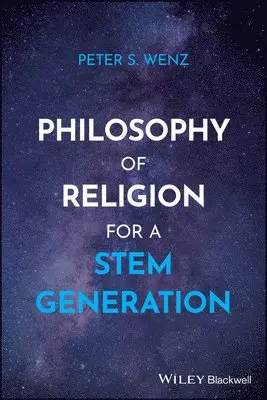
    Philosophy of Religion for a STEM Generation

    AvPeter S. Wenz

    Häftad, Engelska, 2025

    608 kr

    Skickas . Fri frakt över 249 kr.

    Fler format och utgåvor

    E-bok

    696 kr

    E-bok

    694 kr

    Beskrivning

    A Fresh and Engaging Introduction to Philosophy of Religion for STEM Students Philosophy of Religion for a STEM Generation applies a new cross-disciplinary approach to the age-old questions of religion and science. Written by philosopher and educator Peter S. Wenz, this innovative textbook combines the rigor of scientific reasoning with the depth of theological inquiry, creating a unique bridge between STEM students and philosophy of religion. Using humor, pop culture, and personal narratives, Wenz considers philosophical questions surrounding the existence of God, the nature of the universe, free will, the problem of evil, and other key philosophical arguments. Fully integrating scientific theories and methods into discussions of traditional religious topics, the book not only considers the scientific worldview but also examines how science and theology can complement one another. Student-friendly chapters offer fascinating insights into how philosophical analysis and scientific evidence can converge while providing a balanced examination that makes complex ideas relatable and thought-provoking, without taking a stance on whether or not God actually exists. Philosophy of Religion for a STEM Generation is ideal for students in undergraduate Philosophy of Religion or Philosophy of Science courses, as well as all students seeking to understand religion’s role in a scientific world and explore life’s biggest questions at the intersection of science, faith, and philosophy.

    Produktinformation

    • Utgivningsdatum:2025-03-28
    • Mått:229 x 151 x 18 mm
    • Vikt:454 g
    • Format:Häftad
    • Språk:Engelska
    • Antal sidor:256
    • Förlag:John Wiley & Sons Inc
    • ISBN:9781394314225

    Utforska kategorier

    • Religion: allmänt inom Filosofi och religion

    Mer om författaren

    PETER S. WENZ is Emeritus Professor of Philosophy and University Scholar at the University of Illinois Springfield. With over 50 years of teaching experience, he has authored ten books on environmental ethics, political philosophy, and the philosophy of religion. His academic work is widely respected for its depth and interdisciplinary approach, and he has contributed extensively to both philosophy and public discourse.

    Innehållsförteckning

    • Acknowledgments xiPreface xiiiIntroduction 1I Didn’t Do It, Did You? 1Preview of Chapters 8Part 1 Ways of Knowing 131 How Do You Know? 15Logic Isn’t Everything – The Limits of Coherence 15The Ontological Argument 17Foundationalism 20Error Theories 21The Crossword Puzzle Approach to Truth 24The Crossword Approach in Science 262 How Can Evolution Explain Human Knowledge? 31Evolution and Knowledge 31Is Evolution Real? 35God of the Gaps 37Evolutionary Epistemology 40Intelligent Design and the Accuracy of Human Knowledge 44Virtual Reality and Conspiracy Theories 473 Can Faith Be Knowledge? 51The Will to Believe 51Theism and Verification 54Faith as Metaphysics 55Theistic Faith 58Vindication of the Will to Believe 61Part 2 Secular Substitutes for Theism 654 Was There a Beginning? 67The Denial of a Beginning of Time 68Does Time Pass? 68The Denial of Time’s Passage Is Self-defeating 72An Error Theory for the Denial of Time’s Passage 74The Arrow of Time 76Mathematical Infinity and the Beginning of Time 80Could Time Have Had a Beginning? 83Similar Weaknesses of Astrophysics and Theism 845 Is This a Designer Universe? 89Scientific Recourse to Inexplicable Random Events 89Did Something Emerge from Nothing? 95Why Does Matter Exist Rather Than Pure Energy? 99The Fine-tuning Argument 101Many Common Events Are Equally Improbable 102Our Universe May Be Only One Among Many 104Fine-tuning May Not Be Necessary 106An Inefficiency Argument Against Fine-tuning 107A Futility Argument Against Fine-tuning 109Summing Up About Creation 1116 What Do You Have in Mind? 115Introduction 115Mind-Body Dualism 115The Mind-Body Problem 117Materialism: Behaviorism and Mind-Brain Identity 118Scientism and the Elimination of Consciousness 123Reductionism and Weak Emergence 127Epiphenomenalism and Other Problems with Searle’s View 129Machine Consciousness – Thinking Computers 130The Strong Emergence of Consciousness 133Panpsychism 136Downward Causation 137Brains as Radios – Minds as Radio Waves 139Mysterions 140What About Immortality? 1407 Do We Have Freedom to Do Evil? 145The Problem of Evil 145Determinism and Free Will 148Against Determinism 154Randomness and Agent-centered Free Will 158Part 3 The Case for and Against Theism 1618 Does Morality Depend on God? 163Is Morality from God Unchanging and Universal? 163An Evolutionary Account of Morality 167God as Guarantor of Morality 171Does Theism Do More Good Than Harm? 1739 Do Miracles Show that God Exists? 177What Is a Miracle? 177Medical Miracles and Prayers for Healing 180Personal Benefits from Religious Participation 18310 Do Special Experiences Show that God Exists? 187Special and Personal Revelations 187Mysticism 188Verification After Death 192Is Our Sense of God a Delusion? 193Summing Up 19711 Is God an Underachiever? 199Introduction 199Natural Evil and the Uniformity of Nature 200The Free-Will Defense 201Atheistic Gripes and Theistic Replies 204Three Entries into the Cosmic Suggestion Box 206What If God Isn’t Omnipotent? 213Conclusion: Nobody Knows? 215It’s Mostly a Tie 215My Lingering Doubts about Theism 217Notes 221Bibliography 231Index 237