• Fri frakt över 249 kr
  • •
  • Snabba leveranser
  • •
  • Billiga böcker
Kundservice

Du är på sajten för privatpersoner.

Företag, bibliotek eller offentlig verksamhet?

Du handlar på classic.bokus.com, där alla dina funktioner finns intakta.
Till classic.bokus.com
Bokus logotyp. Gå till startsidan.
  • Erbjudanden
  • Nyheter
  • Student
  • Topplistor
  • Barn & ungdom
  • Bokus Play
  • E-böcker
  • Pocketböcker
  • Spel & pussel

10% rabatt på allt med kod: NYSTART10 →

Sidfot

Mina sidor

    Hjälp

    • Kundservice
    • Vanliga frågor och svar
    • Frakt och leverans
    • Retur vid ångerrätt
    • Reklamera vara
    • Betalning
    • Köpvillkor
    • Allmänna villkor
    • Information om webbplatsens tillgänglighet

    Om Bokus

    • Om oss
    • Pressrum
    • För studenter
    • För företag
    • För bibliotek och offentlig verksamhet
    • För leverantörer
    • Hållbarhet

    Populärt

    • Aktuella erbjudanden
    • Presentkort
    • Studentlitteratur
    • Nya böcker
    • Topplistor
    • Signerade böcker
    • Engelska böcker

    Inspiration

    • Boktips
    • BookTok
    • Populära bokserier
    • Barnbokskaraktärer
    • Populära författare
    Logotyp för Bokus
    Följ oss på Facebook (extern länk)Följ oss på Instagram (extern länk)Följ oss på YouTube (extern länk)Följ oss på TikTok (extern länk)
    bokus @ CookiesAnpassa cookiesIntegritetspolicyKöpvillkor
    Till Citymail hemsida (extern länk)Till Budbee hemsida (extern länk)Till Postnord hemsida (extern länk)Till Schenker hemsida (extern länk)Till Early Bird hemsida (extern länk)Till Walleys hemsida (extern länk)
    1. Naturvetenskap och teknik
    2. Matematik och naturvetenskap
    3. Astronomi

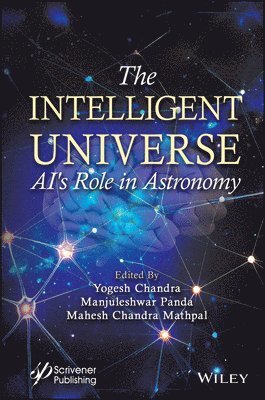
    Intelligent Universe

    AI's Role in Astronomy

    AvYogesh Chandra,Manjuleshwar Panda

    Inbunden, Engelska, 2025

    2 078 kr

    Beställningsvara. Skickas inom 5-8 vardagar. Fri frakt över 249 kr.

    Beskrivning

    Uncover the universe’s secrets with this essential guide that provides a comprehensive exploration of how artificial intelligence is revolutionizing modern astronomical research. Artificial intelligence (AI) is revolutionizing astronomy, enabling researchers to process vast datasets, uncover hidden patterns, and enhance observational precision like never before. This book explores this transformative synergy, bringing together insights from experts across the globe. Covering a wide spectrum of topics, including AI-driven data mining, exoplanet discovery, gravitational wave detection, and autonomous observatories, this book highlights the impact of machine learning, computer vision, and big data analytics on modern astrophysical research. From detecting transient celestial events to refining cosmic evolution models, this volume delves into the ways AI is reshaping our understanding of the cosmos. As we enter a new era of discovery, this guide serves as both a foundational reference and a forward-looking exploration of AI’s expanding role in space science. Whether you are a student, researcher in astronomy or space science, or an AI practitioner, this book offers an invaluable resource on the frontiers of AI-driven astronomical research. Readers will find this volume: Provides a balanced mix of fundamental concepts, practical applications, and future perspectives;Designed to be informative and approachable, combining scientific insights, high-quality images, and detailed analyses to enhance understanding;Explores how AI is transforming space exploration, telescope automation, and cosmic data processing, providing readers a future-focused perspective.Audience Academics, researchers, astronomers, astrophysicists, and industry professionals interested in the transformative power of AI for astrological applications.

    Produktinformation

    • Utgivningsdatum:2025-10-10
    • Mått:239 x 158 x 35 mm
    • Vikt:1 021 g
    • Format:Inbunden
    • Språk:Engelska
    • Antal sidor:528
    • Förlag:John Wiley & Sons Inc
    • ISBN:9781394355488

    Utforska kategorier

    • Astronomi inom Naturvetenskap och teknik

    Mer om författaren

    Yogesh Chandra, PhD is an assistant professor of physics at the Government Post Graduate College, Bazpur, Kumaun University, India. He has published several journal articles, mentored many students, and attended a number of conferences and workshops. He specializes in astronomy, astrophysics, and atmospheric science, with a focus on AI applications in these fields. Manjuleshwar Panda is an independent astronomy researcher in New Delhi, India, with an M.Sc. in Physics from Kumaun University, Nainital, India. He has contributed to national and international research programs and has completed two specialized courses with the Indian Space Research Organization. He has a keen interest in observational and extragalactic astronomy, high-energy astrophysics, and the role of AI in astronomy. Mahesh Chandra Mathpal, PhD is a lecturer in physics at Govt. IC Lohali, Uttarakhand, India. He has published over ten research papers in international journals and is actively engaged in advancing AI-driven astrophysical studies. His research focuses on astrophysics and solar physics, with a specialization in applying artificial neural networks (ANN) to these fields.

    Innehållsförteckning

    • Foreword xxvPreface xxviiAcknowledgement xxxiPart I: Foundations and Core Applications of AI in Astronomy 11 Introduction to AI in Astronomy 3Rahul Barnwal, Aman Kumar, Kala S. and Sree Ranjani Rajendran1.1 Introduction 41.2 Understanding AI: Key Concepts and Techniques 61.3 Fundamentals of Deep Learning 81.4 AI Algorithms Shaping Astronomical Research 141.5 Revolutionizing Data Analysis: AI in Astronomical Surveys 181.6 Machine Learning Models for Celestial Object Classification 211.7 AI in Observational Astronomy: Transforming Telescopic Data 241.8 Harnessing AI for Space Exploration and Planetary Science 261.9 AI-Driven Discoveries: Case Studies in Astronomy 291.10 Challenges and Limitations of AI in Astronomy 321.11 The Future of AI in Astronomy: Opportunities and Horizons 341.12 Conclusion 412 Data Mining and Machine Learning in Astrophysics 47Gissmol Saji and Sanjay Singh Bisht2.1 Introduction 482.2 Foundations of Data Mining and Machine Learning 502.3 Machine Learning Applications in Astrophysics 552.4 Role of Machine Learning in Key Astrophysical Research Areas 582.5 Challenges in the Era of Big Data 752.6 Bridging Observations and Theory 772.7 The Future: Autonomous Observatories and Predictive Models 792.8 Conclusion 813 The Role of Artificial Intelligence in the Discovery and Characterization of Exoplanets 87Shraddha. Biswas, D. Bisht and Ing-Guey Jiang3.1 Introduction 883.2 Exoplanet Discovery 893.3 Naming Rules/Nomenclature 923.4 Types of Exoplanets 923.5 Detection Methods 983.6 Missions Launched to Detect Exoplanets 1123.7 Role of Artificial Intelligence in Exoplanetary Science 1173.8 Conclusion 1234 Cosmology and Dark Matter Research 129Arun Kumar Rathore, B. C. Chanyal and Sirley Marques-Bonham4.1 Introduction 1304.2 Role of Dark Matter in the Cosmos 1334.3 Future Cosmological Observations 1334.4 Evidence of Dark Matter 1344.5 Theoretical Models of Dark Matter 1494.6 ΛCDM and MOND 1564.7 Sterile Neutrinos 1614.8 Method of Direct Detection 1634.9 Indirect Detection 1664.10 Role of Artificial Intelligence in Dark Matter and Cosmology 1694.11 AI's Role in Quantum Simulations of Dark Matter 1724.12 Challenges and Future Prospects 1724.13 Enhancing Analysis and Interpretation of Astronomical Data 1734.14 AI in Theory Development and Hypothesis Generation 1744.15 Challenges and Future Prospects 1744.16 Conclusion 1745 Gravitational Wave Detection 181Muhammad Zeshan Ashraf, Farhat Shakeel and Tahira Saeed5.1 Introduction 1825.2 Gravitational Wave Observatories and Detection Techniques 1855.3 Multi-Messenger Astronomy and Astrophysical Sources 1895.4 Artificial Intelligence in Gravitational Wave Detection 1925.5 Challenges and Future Prospects 1945.6 Conclusion 1976 Harmonizing the Cosmos: Radio Astronomy and AI Integration 201Manjuleshwar Panda, Aadarsh Kumar Chaudhri and Mukesh Kumar Pandey6.1 Introduction: The Synergy of Radio Astronomy and AI 2026.2 Foundations of Radio Astronomy: Unlocking the Invisible Universe 2046.3 The Evolution of AI in Radio Astronomy 2086.4 AI-Powered Signal Processing: Detecting the Weakest Cosmic Signals 2116.5 Fast Radio Bursts and AI: Solving One of Astronomy's Biggest Mysteries 2136.6 AI in Pulsar and SETI Research: Searching for Cosmic Beacons 2166.7 AI in Very Long Baseline Interferometry and Image Reconstruction 2196.8 AI and Large Radio Surveys: Managing the Data Tsunami 2236.9 Future Prospects: AI and Next-Generation Radio Astronomy 2266.10 Conclusion: The Future of AI-Driven Radio Astronomy 229Part II: Advanced Techniques, Observatories, and Future Prospects 2337 Image Processing and Computer Vision in Astronomy 235Deepak Pandey, Garima Punetha and Chetna Tewari7.1 Introduction to Image Processing in Astronomy 2367.2 Applications of Image Processing in Astronomy 2387.3 Processing Techniques for Detecting Transient Events 2477.4 Specific Techniques for Detecting Key Transients 2517.5 Role of Computer Vision in Astronomy 2557.6 Advantages of Using Computer Vision in Astronomy 2587.7 Applications 2617.8 Challenges in Astronomical Image 2637.9 Challenges in Interpretability for Astronomy 2687.10 Future Directions 2717.11 Conclusion 2728 Astroinformatics and Big Data Challenges 279Kanthavel R., Adline Freeda R. and Dhaya R.8.1 Introduction to Astroinformatics 2808.2 Big Data in Astronomy 2838.3 Data Management in Astroinformatics 2858.4 Data Processing Techniques 2928.5 Data Visualization in Astroinformatics 2958.6 Statistical Challenges in Astroinformatics 3018.7 Time-Domain Astronomy 3058.8 Future Directions in Astroinformatics and Big Data 3088.9 Conclusion 3099 Autonomous Telescopes and Observatories 313Himani Mehta, Shakti Singh, V.S. Pandey, Preeti Verma and Anagha Antony9.1 Introduction 3149.2 Historical Background of Telescopes 3159.3 The Evolution of Telescopes 3169.4 Types of Telescopes and Their Uses 3219.5 The Role of AI in Autonomous Telescopes 3329.6 Detecting Techniques and Instruments 3369.7 AI's Role in Robotic Telescopes 3439.8 Challenges in Autonomous Astronomy 3469.9 The Future of Autonomous Astronomy 3489.10 Conclusion 35210 Beyond Earth's Horizon: AI's Contribution to Space Exploration 359Bhumika Sharma, Anil C. Mathur, Rama Sharma and Pratibha Antil10.1 Introduction 36010.2 The Evolution of AI in Space Exploration 36210.3 Applications of AI in Modern Space Missions 36410.4 AI-Driven Space Robotics 36810.5 AI in Deep Space Missions and Exploration 37110.6 AI in Spacecraft Autonomy and Navigation 37410.7 Challenges and Limitations of AI in Space Science 37810.8 Future of AI in Space Exploration: Possibilities and Promises 38010.9 Conclusion 38311 Exploring Astrobiology and the Search for Extraterrestrial Intelligence (SETI) 391Yamini Rani and Anurag Kasana11.1 Introduction to Astrobiology and Search for Extraterrestrial Intelligence 39211.2 The Role of SETI in the Search for Extraterrestrial Intelligence 39611.3 The Origin of Astrobiology 39711.4 Understanding the Universe: A Foundation for Astrobiology 39911.5 The Search for Life in the Solar System 40211.6 Venus and the Possibility of Aerial Biospheres 40511.7 The Role of Space Telescopes (Kepler, TESS, JWST) 40911.8 The Search for Extraterrestrial Intelligence 41211.9 The Fermi Paradox and the Great Silence 41911.10 Ethical and Philosophical Implications of Contacting Extraterrestrial Life 42211.11 Conclusion 42612 Anticipating the Unseen: AI's Promise in Illuminating Astronomy's Future 431Ritika Joshi and Pratibha Fuloria12.1 Introduction 43212.2 Modern Issues in Astronomy 43812.3 AI's Transformative Role in Astronomy 44212.4 Classification of Images and Its Application in Astronomy 44712.5 Cosmological Simulations 45012.6 The Future: AI and Quantum Computing in Astronomy 45612.7 Challenges and the Path Forward 45912.8 Strategies for Mitigating Challenges in AI-Driven Astronomy 46312.9 Conclusion: Embracing the Future of Astronomical Discovery 470Data Availability 471Acknowledgement 472References 472Index 475