• Fri frakt över 249 kr
  • •
  • Snabba leveranser
  • •
  • Billiga böcker
Kundservice

Du är på sajten för privatpersoner.

Företag, bibliotek eller offentlig verksamhet?

Du handlar på classic.bokus.com, där alla dina funktioner finns intakta.
Till classic.bokus.com
Bokus logotyp. Gå till startsidan.
  • Erbjudanden
  • Nyheter
  • Student
  • Topplistor
  • Barn & ungdom
  • Bokus Play
  • E-böcker
  • Pocketböcker
  • Spel & pussel

10% rabatt på allt med kod NYSTART10 →

Sidfot

Mina sidor

    Hjälp

    • Kundservice
    • Vanliga frågor och svar
    • Frakt och leverans
    • Retur vid ångerrätt
    • Reklamera vara
    • Betalning
    • Köpvillkor
    • Allmänna villkor
    • Information om webbplatsens tillgänglighet

    Om Bokus

    • Om oss
    • Pressrum
    • För studenter
    • För företag
    • För bibliotek och offentlig verksamhet
    • För leverantörer
    • Hållbarhet

    Populärt

    • Aktuella erbjudanden
    • Presentkort
    • Studentlitteratur
    • Nya böcker
    • Topplistor
    • Signerade böcker
    • Engelska böcker

    Inspiration

    • Boktips
    • BookTok
    • Populära bokserier
    • Barnbokskaraktärer
    • Populära författare
    Logotyp för Bokus
    Följ oss på Facebook (extern länk)Följ oss på Instagram (extern länk)Följ oss på YouTube (extern länk)Följ oss på TikTok (extern länk)
    bokus @ CookiesAnpassa cookiesIntegritetspolicyKöpvillkor
    Till Citymail hemsida (extern länk)Till Budbee hemsida (extern länk)Till Postnord hemsida (extern länk)Till Schenker hemsida (extern länk)Till Early Bird hemsida (extern länk)Till Walleys hemsida (extern länk)
    1. Språk och ordböcker
    2. Språkvetenskap och lingvistik

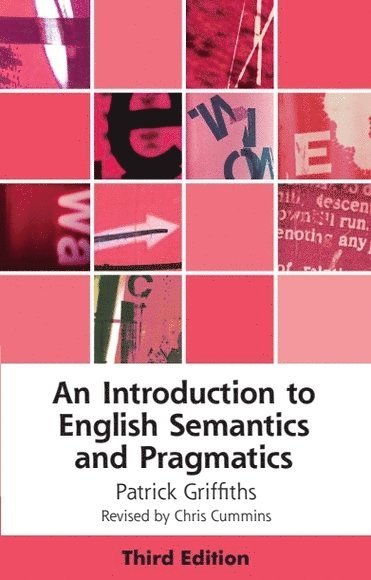
    Introduction to English Semantics and Pragmatics

    AvPatrick Griffiths,Chris Cummins

    Inbunden, Engelska, 2023

    Del i serien Edinburgh Textbooks on the English Language

    1 880 kr

    Beställningsvara. Skickas inom 3-6 vardagar. Fri frakt över 249 kr.

    Fler format och utgåvor

    Häftad

    251 kr

    E-bok

    305 kr

    E-bok

    305 kr

    Beskrivning

    A classic introduction to the study of meaning, revitalised for a new generation of linguistsIdeal for undergraduate students exploring English linguistics for the first time, the new edition of this successful textbook is compact and self-contained, offering:Expanded coverage of topic areas such as figurative language, compositional meaning and quantificationUp-to-date, real-life examples drawn from a wide range of sources to clearly illustrate key concepts, such as how speakers use novel metaphors and metonymsAdditional exercises to further reinforce and develop key conceptsThorough signposting to contemporary research publications in semantics and pragmaticsThis clear and accessible textbook introduces the crucial concepts essential to your study of the semantics and pragmatics of English. Coverage is wide-ranging, taking you from word meaning to the level of discourse, and explaining how these topics are treated in contemporary linguistic research. Chapters cover adjective, noun and verb meanings, situation types, figurative language, tense, aspect, modality, quantification, topic and focus. Explanations of entailment, compositionality and scope provide a foundation for subsequent study of formal semantics.Supported by chapter summaries and with plenty of usage examples, exercises and discussion questions, you will not only gain a systematic overview of meaning in English but be equipped with the tools to argue for specific analyses as well.

    Produktinformation

    • Utgivningsdatum:2023-03-03
    • Mått:138 x 216 x 17 mm
    • Vikt:342 g
    • Format:Inbunden
    • Språk:Engelska
    • Serie:Edinburgh Textbooks on the English Language
    • Antal sidor:186
    • Upplaga:3
    • Förlag:Edinburgh University Press
    • ISBN:9781399504607

    Utforska kategorier

    • Språkvetenskap och lingvistik inom Språk och ordböcker

    Mer om författaren

    Patrick Griffiths was a professor of English at Beppu University, Japan. He taught courses on semantics, the structure of English, psycholinguistics and general linguistics at a number of universities, including Beppu, the University of the South Pacific, and in the UK at York University and York St John. Chris Cummins is Reader in Linguistics and English Language at the University of Edinburgh. His other works include Pragmatics (EUP, 2019) and Constraints on Numerical Expressions (2015), and he co-edited the Oxford Handbook of Experimental Semantics and Pragmatics (2019) with Napoleon Katsos.

    Innehållsförteckning

    • CONTENTSPrefacePreface to the third edition1. Studying meaningOverview1.1 Sentences and utterances1.2 Types of meaning1.2.1 Denotation, sense, reference and deixis1.3 Semantics vs. pragmatics1.3.1 A first outline of semantics1.3.2 A first outline of pragmaticsSummaryExercises2. Sense relationsOverview2.1 Propositions and entailment2.2 Compositionality2.3 Synonymy2.4 Complementarity, antonymy, converseness and incompatibility2.5 Hyponymy2.5.1 Hierarchies of hyponymsSummaryExercisesRecommendations for readingNotes3. NounsOverview3.1 The has-relation3.1.1 Inferring existence from the has-relation3.1.2 Hyponymy, prototypes, and the has-relation3.1.3 Parts can have parts3.1.4 Spatial parts3.1.5 Ends and beginnings3.1.6 Body part terms, metaphor and has-relations3.2 Count nouns and mass nounsSummaryExercisesRecommendations for reading4. AdjectivesOverview4.1 Gradability4.1.1 Non-gradable adjectives4.2 Combining adjective meanings with noun meanings4.2.1 Non-intersective adjectives with broader denotations4.2.2 Privative adjectives4.2.3 Relative adjective meaningsSummaryExercisesRecommendations for reading5. VerbsOverview5.1 Verb types and arguments5.1.1 Other kinds of arguments5.2 Causative verbs5.2.1 Identifying embedded situations5.3 Thematic relationsSummaryExercisesRecommendations for readingNotes6. Tense and aspectOverview6.1 Talking about events in time6.2 Tense6.2.1 Preliminaries6.2.2 Present, Past and Future6.2.3 Tense and adverbials6.3 Aspect6.3.1 Habituality and simple aspect6.3.2 Progressive aspect6.3.3 Perfect aspect6.3.4 Perfect aspect or tense?SummaryExercisesRecommendations for reading7. Modality, scope and quantificationOverview7.1 Modality7.1.1 Modal verbs and tense7.1.2 Epistemic and deontic modality7.2 Semantic scope7.3 Quantification7.3.1 Some basics about sets7.3.2 Simple quantifiers in terms of sets7.3.3 Proportional quantifiers7.3.4 Distributivity and collectivity7.3.5 Quantifier scopeSummaryExercisesRecommendations for reading8. Pragmatic inferenceOverview8.1 Some ways of conveying additional meanings8.2 The Gricean maxims8.2.1 Quantity implicatures8.2.2 Scalar implicatures8.2.3 Relevance implicatures8.2.4 Manner implicatures8.3 Relevance Theory8.4 PresuppositionsSummaryExercisesRecommendations for reading9. Figurative languageOverview9.1 Literal and figurative usage9.2 Metaphor9.3 Metonymy9.4 Simile9.5 Irony9.6 HyperboleSummaryExercisesRecommendations for reading10. Utterances in contextOverview10.1 Tailoring utterances to the audience10.2 Definiteness10.3 Given and new material10.3.1 Pseudo-clefts10.3.2 It-clefts10.3.3 Passives10.3.4 Lexical and syntactic converses10.3.5 Focal stress10.4 The Question Under DiscussionSummaryExercisesRecommendations for reading11. Doing things with wordsOverview11.1 Speech acts11.2 Indicators of speech acts11.2.1 Syntactic cues and indirect speech acts11.2.2 Lexical cues11.2.3 Cues based on conversation structure11.2.4 Integrating the informationSummaryExercisesRecommendations for readingSuggested answers to the exercisesBibliographyIndex