• Fri frakt över 249 kr
  • •
  • Snabba leveranser
  • •
  • Billiga böcker
Kundservice

Du är på sajten för privatpersoner.

Företag, bibliotek eller offentlig verksamhet?

Du handlar på classic.bokus.com, där alla dina funktioner finns intakta.
Till classic.bokus.com
Bokus logotyp. Gå till startsidan.
  • Erbjudanden
  • Nyheter
  • Student
  • Topplistor
  • Barn & ungdom
  • Bokus Play
  • E-böcker
  • Pocketböcker
  • Spel & pussel

10% rabatt på allt med kod NYSTART10 →

Sidfot

Mina sidor

    Hjälp

    • Kundservice
    • Vanliga frågor och svar
    • Frakt och leverans
    • Retur vid ångerrätt
    • Reklamera vara
    • Betalning
    • Köpvillkor
    • Allmänna villkor
    • Information om webbplatsens tillgänglighet

    Om Bokus

    • Om oss
    • Pressrum
    • För studenter
    • För företag
    • För bibliotek och offentlig verksamhet
    • För leverantörer
    • Hållbarhet

    Populärt

    • Aktuella erbjudanden
    • Presentkort
    • Studentlitteratur
    • Nya böcker
    • Topplistor
    • Signerade böcker
    • Engelska böcker

    Inspiration

    • Boktips
    • BookTok
    • Populära bokserier
    • Barnbokskaraktärer
    • Populära författare
    Logotyp för Bokus
    Följ oss på Facebook (extern länk)Följ oss på Instagram (extern länk)Följ oss på YouTube (extern länk)Följ oss på TikTok (extern länk)
    bokus @ CookiesAnpassa cookiesIntegritetspolicyKöpvillkor
    Till Citymail hemsida (extern länk)Till Budbee hemsida (extern länk)Till Postnord hemsida (extern länk)Till Schenker hemsida (extern länk)Till Early Bird hemsida (extern länk)Till Walleys hemsida (extern länk)
    1. Skönlitteratur
    2. Litteraturvetenskap
    3. Litteraturvetenskap

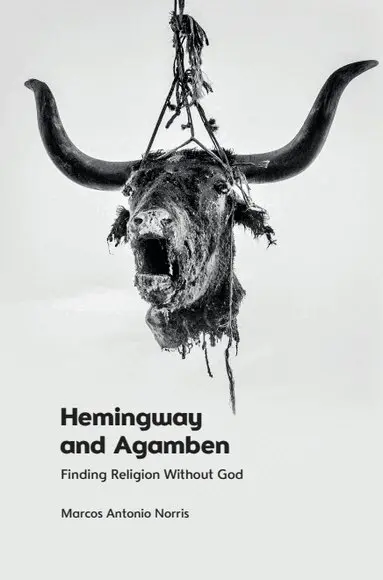
    Hemingway and Agamben

    Finding Religion Without God

    AvMarcos Antonio Norris

    Häftad, Engelska, 2025

    349 kr

    Skickas . Fri frakt över 249 kr.

    Fler format och utgåvor

    Inbunden

    2 179 kr

    Beskrivning

    Marcos Antonio Norris implements Giorgio Agamben's notion of 'secularized theism' to resolve a critical disagreement among Hemingway scholars who have portrayed the writer as either a Roman Catholic or a secular existentialist. He argues that Hemingway is, properly speaking, neither a secularist nor a theist, but a 'secularised theist', whose 'religion' is practiced through sovereign decision making, which, in its most extreme form, includes the act of killing. This book resolves an important debate in Hemingway studies and uncovers fundamental similarities between theism and atheism, building upon the theoretical undertaking first introduced by Agamben and the Existentialists (EUP, 2021). Bringing Ernest Hemingway, Jean-Paul Sartre and Giorgio Agamben into close conversation, the author reconceptualises existentialism, issues a posthumanist critique of moral authoritarianism and advances an original interpretation of Hemingway as a secularised theist.

    Produktinformation

    • Utgivningsdatum:2025-08-01
    • Mått:156 x 234 x 19 mm
    • Vikt:454 g
    • Format:Häftad
    • Språk:Engelska
    • Antal sidor:288
    • Förlag:Edinburgh University Press
    • ISBN:9781399516792

    Utforska kategorier

    • Litteraturvetenskap inom Skönlitteratur

    Mer om författaren

    Marcos Antonio Norris is a lecturer in the School of Writing, Literature and Film at Oregon State University. He is the author of Hemingway and Agamben: Finding Religion Without God (2023) and the co-editor of Agamben and the Existentialists (2021). Norris has authored more than a dozen peer-reviewed articles, most recently including 'Reading ‘On the Quai at Smyrna’ and ‘A Natural History of the Dead’ in Consideration of Hemingway’s Anti-Humanism' with The Hemingway Review and 'Francis Macomber, the Matador: Reading Hemingway’s ‘The Short Happy Life of Francis Macomber’' with Studies in the American Short Story.

    Recensioner i media

    Norris uses Agamben to offer a very welcome and original response to a long-standing critical impasse. Smart, insightful, and persuasive, this study ranges widely across Hemingway’s work and has important implications for how we understand Hemingway’s treatment of religion, the sovereign individual, gender, morality, and the human/animal divide.

    Innehållsförteckning

    • PART I: HEMINGWAY, SARTRE, AND THE SECULARAn IntroductionA Word on SecularizationHemingway as Religious BelieverSartre as Religious BelieverReturning to HemingwayBook SummaryPART II: SOVEREIGN DECISIONISM AND THE IMAGO DEIThe Failed Atheism of Jean-Paul SartreThe Biographical Origins of Sartre’s Failed AtheismAgamben and the Creation of MankindLooking at Sartre Through Agamben’s EyesHemingway’s Youth as an Oak Park CongregationalistA Change in Hemingway’s Religious TemperamentHemingway the ExistentialistHemingway the CatholicHemingway the Un/BelieverPART III: THE PROBLEM WITH HUMAN EXCEPTIONALISMApproaching the Masculine in Hemingway’s FictionOn the Quai at SmyrnaDeath in the AfternoonHemingway’s Stance on Animal EqualityPART IV: HEMINGWAY’S MASCULINE HEROThere Are No Happy EndingsOn the Use of RitualSuicide as CowardiceThe Faena, Or Becoming Like GodThe Masculine, Existential HeroCause for Question in Hemingway’s Posthumous WorksConclusion: The Death of God, The Death of ManBIBLIOGRAPHYINDEX