• Fri frakt över 249 kr
  • •
  • Snabba leveranser
  • •
  • Billiga böcker
Kundservice

Du är på sajten för privatpersoner.

Företag, bibliotek eller offentlig verksamhet?

Du handlar på classic.bokus.com, där alla dina funktioner finns intakta.
Till classic.bokus.com
Bokus logotyp. Gå till startsidan.
  • Erbjudanden
  • Nyheter
  • Student
  • Topplistor
  • Barn & ungdom
  • Bokus Play
  • E-böcker
  • Pocketböcker
  • Spel & pussel

10% rabatt på allt med kod: NYSTART10 →

Sidfot

Mina sidor

    Hjälp

    • Kundservice
    • Vanliga frågor och svar
    • Frakt och leverans
    • Retur vid ångerrätt
    • Reklamera vara
    • Betalning
    • Köpvillkor
    • Allmänna villkor
    • Information om webbplatsens tillgänglighet

    Om Bokus

    • Om oss
    • Pressrum
    • För studenter
    • För företag
    • För bibliotek och offentlig verksamhet
    • För leverantörer
    • Hållbarhet

    Populärt

    • Aktuella erbjudanden
    • Presentkort
    • Studentlitteratur
    • Nya böcker
    • Topplistor
    • Signerade böcker
    • Engelska böcker

    Inspiration

    • Boktips
    • BookTok
    • Populära bokserier
    • Barnbokskaraktärer
    • Populära författare
    Logotyp för Bokus
    Följ oss på Facebook (extern länk)Följ oss på Instagram (extern länk)Följ oss på YouTube (extern länk)Följ oss på TikTok (extern länk)
    bokus @ CookiesAnpassa cookiesIntegritetspolicyKöpvillkor
    Till Citymail hemsida (extern länk)Till Budbee hemsida (extern länk)Till Postnord hemsida (extern länk)Till Schenker hemsida (extern länk)Till Early Bird hemsida (extern länk)Till Walleys hemsida (extern länk)
    1. Språk och ordböcker
    2. Språkvetenskap och lingvistik

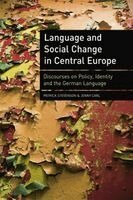
    Language and Social Change in Central Europe

    Discourses on Policy, Identity and the German Language

    AvPatrick Stevenson,Jenny Carl

    Häftad, Engelska, 2026

    312 kr

    Kommande

    Beskrivning

    This book explores the dynamics of language and social change in central Europe in the context of the end of the Cold War and eastern expansion of the European Union. One outcome of the profound social transformations in central Europe since the Second World War has been the reshaping of the relationship between particular languages and linguistic varieties, especially between 'national' languages and regional or ethnic minority languages. Previous studies have investigated these transformed relationships from the macro perspective of language policies, while others have taken more fine-grained approaches to individual experiences with language. Combining these two perspectives for the first time - and focusing on the German language, which has a uniquely complex and problematic history in the region - the authors offer an understanding of the complex constellation of language politics in central Europe.Stevenson and Carl's analysis draws on a range of theoretical, conceptual and analytical approaches - language ideologies, language policy, positioning theory, discourse analysis, narrative analysis and life histories - and a wide range of data sources, from European and national language policies to individual language biographies. The authors demonstrate how the relationship between German and other languages has played a crucial role in the politics of language and processes of identity formation in the recent history of central Europe.

    Produktinformation

    • Utgivningsdatum:2026-11-30
    • Mått:156 x 234 x undefined mm
    • Format:Häftad
    • Språk:Engelska
    • Antal sidor:288
    • Förlag:Edinburgh University Press
    • ISBN:9781399572941

    Utforska kategorier

    • Språkvetenskap och lingvistik inom Språk och ordböcker

    Mer om författaren

    Patrick Stevenson is Professor of German and Linguistic Studies at the University of Southampton. His current research interests include the politics of language, multilingualism, language and migration, and language biographies. He has published widely in the field of German sociolinguistics and his recent book publications include: Language and German Disunity: A sociolinguistic history of East and West 1945-2000 (OUP, 2002); (ed., with Clare Mar-Molinero) Language Ideologies, Policies and Practices: Language and the future of Europe (Palgrave, 2006); (ed., with Jenny Carl) Language, Discourse and Identity in Central Europe: The German language in a multilingual space (Palgrave, 2009); and (ed., with Gabrielle Hogan-Brun and Clare Mar-Molinero) Testing Regimes: Critical perspectives on language, migration and citizenship in Europe (Benjamins, 2009).. Jenny Carl completed her doctorate on representations of European identities in parliamentary discourses in Scotland, Wales and Northern Ireland at the University of Osnabrück, Germany. She is currently working as a Research Fellow at the University of Southampton and in the EU research network LINEE (Languages in a Network of European Excellence). She is co-editor (with Patrick Stevenson) of Language, Discourse and Identity in Central Europe: The German language in a multilingual space (Palgrave, 2009).

    Innehållsförteckning

    • 1. Introduction2. The sociolinguistics of globalisation: theoretical orientations3. Language in central Europe: the footprint of German4. Sociolinguistic histories: Hungary and the Czech Republic5. Interventions and intersections6. Language and belonging7. Language in time, place and space8. Conclusions