• Fri frakt över 249 kr
  • •
  • Snabba leveranser
  • •
  • Billiga böcker
Kundservice

Du är på sajten för privatpersoner.

Företag, bibliotek eller offentlig verksamhet?

Du handlar på classic.bokus.com, där alla dina funktioner finns intakta.
Till classic.bokus.com
Bokus logotyp. Gå till startsidan.
  • Erbjudanden
  • Nyheter
  • Student
  • Topplistor
  • Barn & ungdom
  • Bokus Play
  • E-böcker
  • Pocketböcker
  • Spel & pussel

10% rabatt på allt med kod NYSTART10 →

Sidfot

Mina sidor

    Hjälp

    • Kundservice
    • Vanliga frågor och svar
    • Frakt och leverans
    • Retur vid ångerrätt
    • Reklamera vara
    • Betalning
    • Köpvillkor
    • Allmänna villkor
    • Information om webbplatsens tillgänglighet

    Om Bokus

    • Om oss
    • Pressrum
    • För studenter
    • För företag
    • För bibliotek och offentlig verksamhet
    • För leverantörer
    • Hållbarhet

    Populärt

    • Aktuella erbjudanden
    • Presentkort
    • Studentlitteratur
    • Nya böcker
    • Topplistor
    • Signerade böcker
    • Engelska böcker

    Inspiration

    • Boktips
    • BookTok
    • Populära bokserier
    • Barnbokskaraktärer
    • Populära författare
    Logotyp för Bokus
    Följ oss på Facebook (extern länk)Följ oss på Instagram (extern länk)Följ oss på YouTube (extern länk)Följ oss på TikTok (extern länk)
    bokus @ CookiesAnpassa cookiesIntegritetspolicyKöpvillkor
    Till Citymail hemsida (extern länk)Till Budbee hemsida (extern länk)Till Postnord hemsida (extern länk)Till Schenker hemsida (extern länk)Till Early Bird hemsida (extern länk)Till Walleys hemsida (extern länk)
    1. Naturvetenskap och teknik
    2. Matematik och naturvetenskap
    3. Matematik
    4. Matematikens grunder

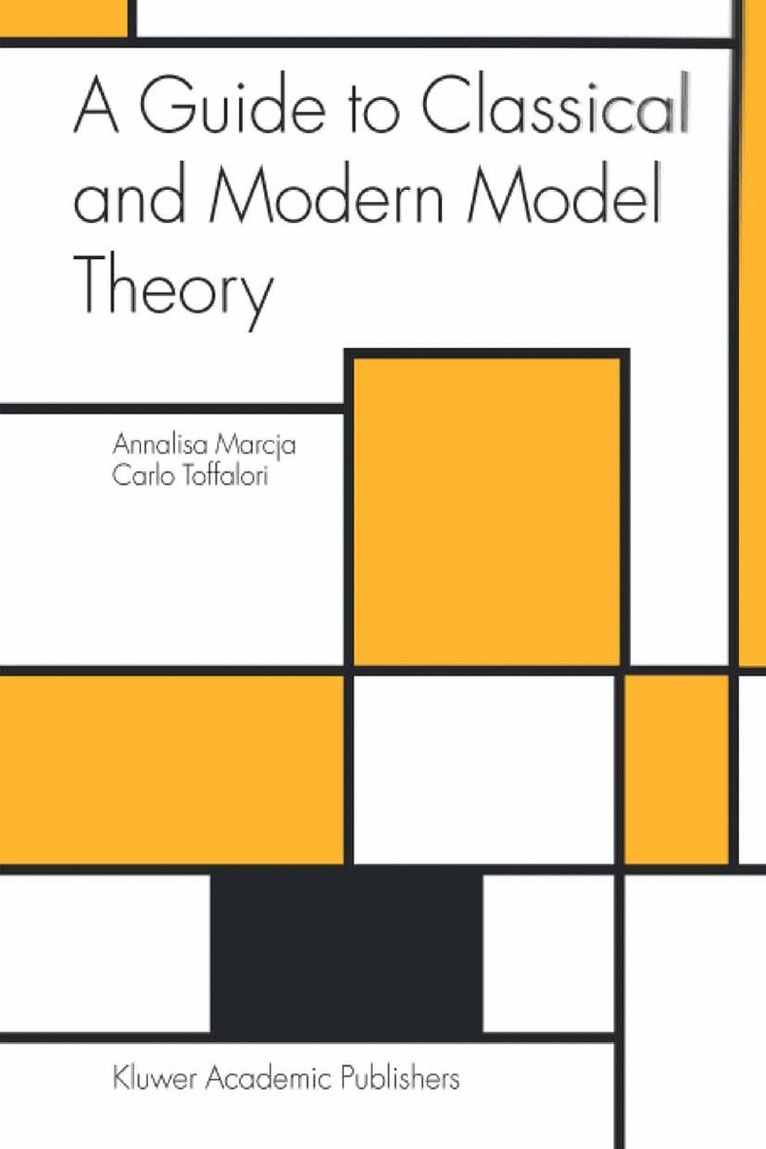
    Guide to Classical and Modern Model Theory

    AvAnnalisa Marcja,Carlo Toffalori

    Häftad, Engelska, 2003

    Del i serien Trends in Logic

    1 408 kr

    Beställningsvara. Skickas inom 10-15 vardagar. Fri frakt över 249 kr.

    Beskrivning

    Since its birth, Model Theory has been developing a number of methods and concepts that have their intrinsic relevance, but also provide fruitful and notable applications in various fields of Mathematics. It is a lively and fertile research area which deserves the attention of the mathematical world.This volume: -is easily accessible to young people and mathematicians unfamiliar with logic; -gives a terse historical picture of Model Theory; -introduces the latest developments in the area; -provides 'hands-on' proofs of elimination of quantifiers, elimination of imaginaries and other relevant matters.A Guide to Classical and Modern Model Theory is for trainees and professional model theorists, mathematicians working in Algebra and Geometry and young people with a basic knowledge of logic.

    Produktinformation

    • Utgivningsdatum:2003-06-30
    • Mått:160 x 240 x 21 mm
    • Vikt:576 g
    • Format:Häftad
    • Språk:Engelska
    • Serie:Trends in Logic
    • Antal sidor:371
    • Upplaga:2003
    • Förlag:Kluwer Academic Publishers
    • ISBN:9781402013317

    Utforska kategorier

    • Matematikens grunder inom Naturvetenskap och teknik

    Innehållsförteckning

    • Structures.- 1.1 Structures.- 1.2 Sentences.- 1.3 Embeddings.- 1.4 The Compactness Theorem.- 1.5 Elementary classes and theories.- 1.6 Complete theories.- 1.7 Definable sets.- 1.8 References.- Quantifier Elimination.- 2.1 Elimination sets.- 2.2 Discrete linear orders.- 2.3 Dense linear orders.- 2.4 Algebraically closed fields (and Tarski).- 2.5 Tarski again: Real closed fields.- 2.6 pp-elimination of quantifiers and modules.- 2.7 Strongly minimal theories.- 2.8 o-minimal theories.- 2.9 Computational aspects of q. e.- 2.10 References.- Model Completeness.- 3.1 An introduction.- 3.2 Abraham Robinson’s test.- 3.3 Model completeness and Algebra.- 3.4 p-adic fields and Artin’s Conjecture.- 3.5 Existentially closed structures.- 3.6 DCF0.- 3.7 SCFp and DCFp.- 3.8 ACFA.- 3.9 References.- Elimination of imaginaries.- 4.1 Interpretability.- 4.2 Imaginary elements.- 4.3 Algebraically closed fields.- 4.4 Real closed fields.- 4.5 The elimination of imaginaries sometimes fails.- 4.6 References.- Morley rank.- 5.1 A tale of two chapters.- 5.2 Definable sets.- 5.3 Types.- 5.4 Saturated models.- 5.5 A parenthesis: pure injective modules.- 5.6 Omitting types.- 5.7 The Morley rank, at last.- 5.8 Strongly minimal sets.- 5.9 Algebraic closure and definable closure.- 5.10 References.- ? -stability.- 6.1 Totally transcendental theories.- 6.2 ?-stable groups.- 6.3 ?-stable fields.- 6.4 Prime models.- 6.5 DCF0 revisited.- 6.6 Ryll-Nardzewski’s Theorem, and other things.- 6.7 References.- Classifying.- 7.1 Shelah’s Classification Theory.- 7.2 Simple theories.- 7.3 Stable theories.- 7.4 Superstable theories.- 7.5 ?-stable theories.- 7.6 Classifiable theories.- 7.7 Shelah’s Uniqueness Theorem.- 7.8 Morley’s Theorem.- 7.9 Biinterpretability and Zilber Conjecture.- 7.10 Two algebraicexamples.- 7.11 References.- Model Theory and Algebraic Geometry.- 8.1 Introduction.- 8.2 Algebraic varieties, ideals, types.- 8.3 Dimension and Morley rank.- 8.4 Morphisms and definable functions.- 8.5 Manifolds.- 8.6 Algebraic groups.- 8.7 The Mordell-Lang Conjecture.- 8.8 References.- O-minimality.- 9.1 Introduction.- 9.2 The Monotonicity Theorem.- 9.3 Cells.- 9.4 Cell decomposition and other theorems.- 9.5 Their proofs.- 9.6 Definable groups in o-minimal structures.- 9.7 O-minimality and Real Analysis.- 9.8 Variants on the o-minimal theme.- 9.9 No rose without thorns.- 9.10 References.