1 061 kr
Beställningsvara. Skickas inom 10-15 vardagar. Fri frakt över 249 kr.
Fler format och utgåvor
Beskrivning
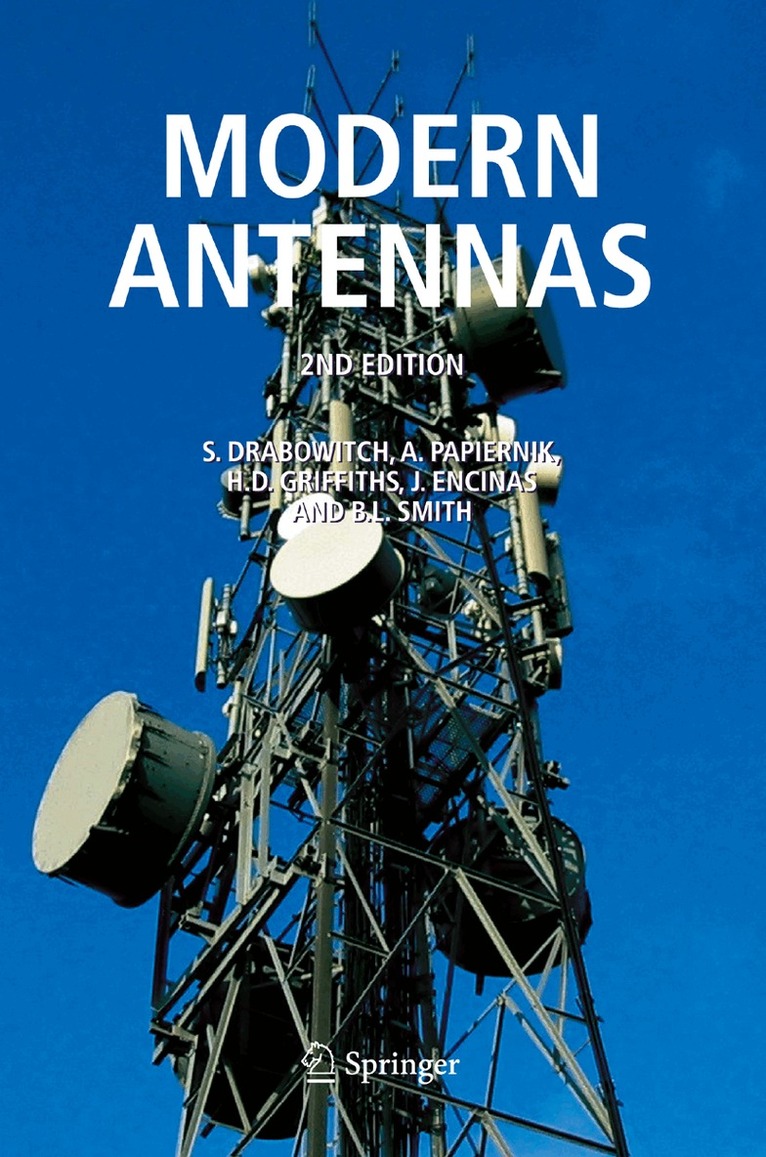
Written to serve the needs both of professional engineers and advanced and postgraduate students, Modern Antennas, Second Edition, is an essential handbook for any engineer involved in the field. It provides a thorough treatment of the theory and practice of modern antenna design and use. Written by a team of experienced engineers, the text is presented in a simple and understandable manner, which guides the reader progressively through the stages of the design process.
Produktinformation
- Utgivningsdatum:2005-12-31
- Mått:155 x 235 x 44 mm
- Vikt:1 221 g
- Format:Inbunden
- Språk:Engelska
- Antal sidor:690
- Upplaga:2
- Förlag:Springer-Verlag New York Inc.
- ISBN:9781402032165
Utforska kategorier
Mer om författaren
Dr. Serge Drabowitch is professor at Ecole Supérieure d'Electronique de Paris, FranceDr. Hugh Griffiths is professor at University College London, UK, and Head of Department of Electronic and Electrical EngineeringDr. Albert Papiernik is professor at University of Nice, Sophia Antipolis, FranceMr. Bradford Lee Smith is Senior IP Counsel at Alcatel Space Division, Paris, France
Innehållsförteckning
- List of contributors. Foreword. Acknowledgements. Electromagnetism and antennas – a historical perspective. 1 Fundamentals of electromagnetism. 1.1 Maxwell’s equations. 1.2 Power and energy. 1.3 Plane waves in linear media. Further reading. Exercises. 2 Radiation. 2.1 Plane wave spectrum. 2.2 Kirchhoff’s formulation. Further reading. Exercises. 3 Antennas in transmission. 3.1 Far field radiation. 3.2 Field radiated from an antenna. 3.3 Directivity, gain, radiation pattern. Further reading. Exercises. 4 Receiving antennas. 4.1 Antenna reciprocity theorem. 4.2 Antenna effective receiving area. 4.3 Energy transmission between two antennas. 4.4 Antenna behaviour in the presence of noise. Further reading. Exercises. 5 Antennas of simple geometry. 5.1 Aperture antennas. 5.2 Wire antennas. Further reading. Exercises. 6 Printed antennas. 6.1 Introduction. 6.2 Different types of printed radiating elements. 6.3 Field analysis methods. 6.4 Input impedance, bandwidth and radiation pattern. 6.5 Low profile, wideband or multiband antennas for mobile communications and short-range applications. Further reading. Exercises. 7 Large antennas and microwave antennas. 7.1 Introduction. 7.2 Structures and applications. 7.3 Fundamental propagation laws. 7.4 Antennas as radiating apertures. Appendix 7A Deduction of the Huygens-Fresnel principle from the Kirchhoff integral. Further reading. Exercises. 8 Primary feeds. 8.1 General properties. 8.2 Horns. 8.3 Hybrid modes and corrugated horns. 9 Axially symmetric systems. 9.1 Introduction. 9.2 Symmetry properties - propagation of polarization, radiation patterns. 9.3 Principal surface. 9.4 Transfer function. 9.5 System gain.9.6 Radiation patterns. 9.7 Aberrations in axially-symmetric systems. 9.8 Axially symmetric systems considered in reception: diffraction pattern. 9.9 System considered in reception: transfer of the energy contained in the diffraction pattern to theprimary aperture. 9.10 Radiation in the Fresnel zone of a Gaussian illumination - application to the transport of energy by radiation (Goubeau’s waves). Further reading. Exercises. 10 Focused systems. 10.1 Introduction. 10.2 The Cassegrain antenna. 10.3 Tracking systems. 10.4 Non axially-symmetric systems. Further reading. Exercises. 11 Arrays. 11.1 Introduction. 11.2 General structure of a phased array (examples). 11.3 Linear array theory. 11.4 Variation of gain as a function of direction. 11.5 Effects of phase quantization. 11.6 Frequency-scanned arrays. 11.7 Analogue beamforming matrices. 11.8 Further topics. Appendix 11A Comparison of linear and circular arrays. Further reading. Exercises. 12 Fundamentals of polarimetry. 12.1 Introduction. 12.2 Fully polarized waves. 12.3 Partially polarized waves. 12.4 Polarimetric representation of radar targets. 12.5 Partially polarized waves: The Mueller Matrix. 12.6 Polarizers and polarization separators for telecommunications antennas and polarimetric radars. 13 Antennas and signal theory. 13.1 Introduction. 13.2 Equivalence of an aperture and a spatial frequency filter. 13.3 Synthesis of an aperture to radiate a given radiation pattern. 13.4 Superdirective antennas.13.5 The antenna as a filter of angular signals. Further reading. Exercises. 14 Signal processing antennas. 14.1 Introduction. 14.2 Synthetic antennas in radar and sonar. 14.3 Imaging of coherent sources. 14.4 Imaging of incoherent sources. 14.5 High resolution imagery and the maximum entropy method. 14.6 Other methods of spectral estimation. 14.7 Spatial filtering. Appendix 14A Entropy and probability. Further reading. Exercises. 15 Antenna measurements. 15.1 Introduction. 15.2 Gain measurements. 15.3 Radiation pattern measurements. 15.4 Time-domain gating. 15.5 Antenna noise temperature and G/T. 15.6 Impedance and bandwidth. Further reading. Exercises. Index.
Hoppa över listan


Du kanske också är intresserad av
Micro-Doppler Radar and its Applications
Francesco, Fioranelli, Francesco Fioranelli, Hugh Griffiths, Matthew Ritchie, Alessio Balleri
Inbunden
1 683 kr
Radar Automatic Target Recognition (ATR) and Non-Cooperative Target Recognition (NCTR)
David Blacknell, Hugh Griffiths
Inbunden
2 076 kr
- Signerad!
Del 11