Inbunden, Engelska, 2007
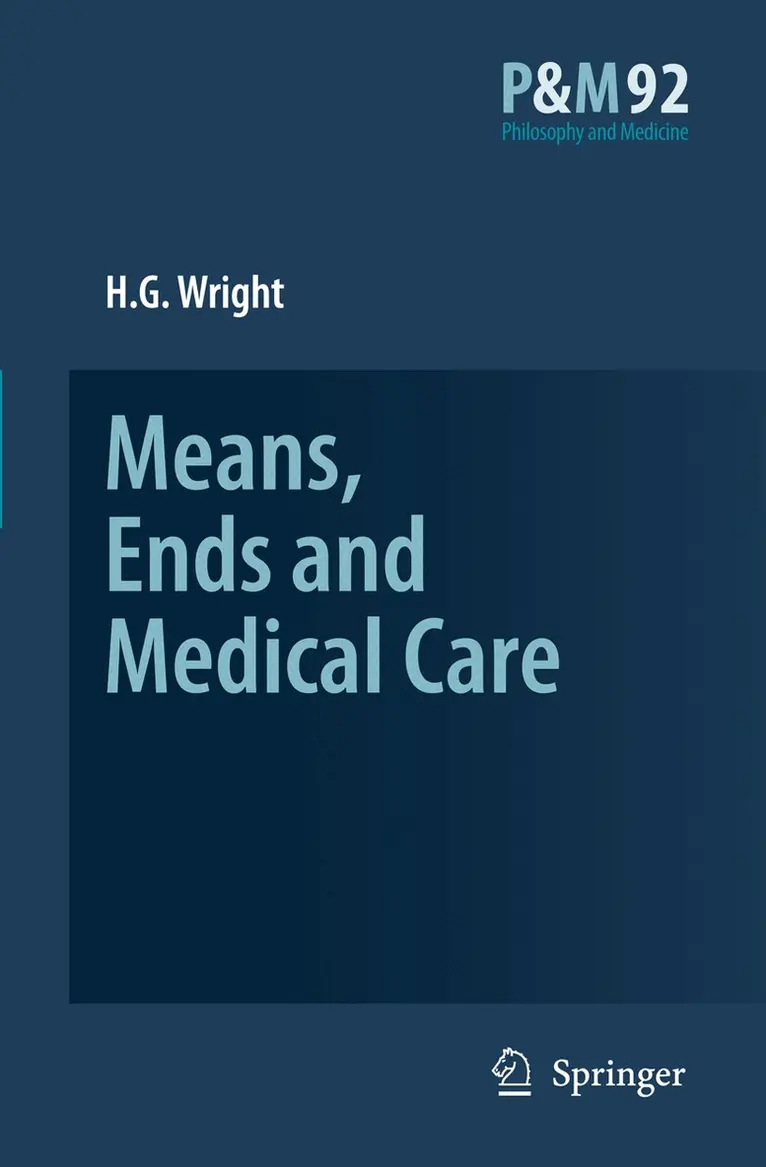
Means, Ends and Medical Care
Av H.G. Wright
1126 kr
Beställningsvara. Skickas inom 10-15 vardagar. Fri frakt över 249 kr.
Beskrivning
In this remarkable book, Gary Wright brings his thirty years of experience as a physician in pediatric and family medicine together with his Ph.D. in philosophy to address the important problem of the nature of good medical reasoning. His intimate experiential knowledge of the founding assumptions of managed health care in America today is abundantly evident in his powerful critique of the overly simplistic models of medical judgment that ground most of our health programs. Writing with exceptional clarity, heart-felt compassion for the physical and emotional suffering of patients, and deep philosophical insight into the nature of human cognition, Wright uses the conceptual tools of recent cognitive science to analyze and critique some of the most basic underlying conceptions of contemporary medical care. To make it clear why we desperately need a richer, more nuanced account of medical reasoning, Wright gives a brilliant analysis of the complex internal structure of our concepts of health and disease, showing that our present models are wholly incapable of dealing with the realities of actual human disease. He then shows the error of assuming that we always know in advance what the medical and moral ends are for any medical situation. This leads to a radical questioning of so-called "rational actor" or "economic" models of rationality that are popular in medicine today. However, Wright’s project is not merely critical. More constructively, he draws extensively on empirical research coming out of the cognitive sciences concerning the nature of concepts, reasoning, and judgment, and he then appropriates this research into a broader pragmatist philosophical framework developed by the American philosopher John Dewey. Wright finds in Dewey’s theories of mind, thought, and experience a comprehensive account of human thinking that adequately captures the complexity of actual human conceptualization and reasoning. At the heart of this new view lies anacknowledgment of the central role of imagination and values in all of our thinking. He shows how we actually make sense of our experience by employing cognitive prototypes, metaphorically-defined concepts, radially structured categories, and other processes of imaginative reflection and evaluation. The result of Wright’s alternative view of mind and medical judgment is a practically useful model of medical reasoning that, although not specifiable by a set of fixed rules, can yet give realistic guidance for medical decisions. It is a sensitive model that each of us would want our own physicians to adopt.Prof. Mark Johnson, Department of Philosophy, University of Oregon'This is one of the best books I have read that addresses Dewey's method of intelligence in the context of practical, including clinical, decision-making. I loved it.'Prof. Griffin Trotter, Center for Health Care Ethics, Saint Louis University, USA
Produktinformation
- Utgivningsdatum: 2007-04-07
- Mått: 155 x 235 x 16 mm
- Vikt: 407 g
- Format: Inbunden
- Språk: Engelska
- Serie: Philosophy and Medicine
- Antal sidor: 184
- Förlag: Springer-Verlag New York Inc.
- ISBN: 9781402052910
Utforska kategorier
Betyg & recensioner
0 recensioner
Inga recensioner tillgängliga.