• Fri frakt över 249 kr
  • •
  • Snabba leveranser
  • •
  • Billiga böcker
Kundservice

Du är på sajten för privatpersoner.

Företag, bibliotek eller offentlig verksamhet?

Du handlar på classic.bokus.com, där alla dina funktioner finns intakta.
Till classic.bokus.com
Bokus logotyp. Gå till startsidan.
  • Erbjudanden
  • Nyheter
  • Student
  • Topplistor
  • Barn & ungdom
  • Bokus Play
  • E-böcker
  • Pocketböcker
  • Spel & pussel

10% rabatt på allt med kod NYSTART10 →

Sidfot

Mina sidor

    Hjälp

    • Kundservice
    • Vanliga frågor och svar
    • Frakt och leverans
    • Retur vid ångerrätt
    • Reklamera vara
    • Betalning
    • Köpvillkor
    • Allmänna villkor
    • Information om webbplatsens tillgänglighet

    Om Bokus

    • Om oss
    • Pressrum
    • För studenter
    • För företag
    • För bibliotek och offentlig verksamhet
    • För leverantörer
    • Hållbarhet

    Populärt

    • Aktuella erbjudanden
    • Presentkort
    • Studentlitteratur
    • Nya böcker
    • Topplistor
    • Signerade böcker
    • Engelska böcker

    Inspiration

    • Boktips
    • BookTok
    • Populära bokserier
    • Barnbokskaraktärer
    • Populära författare
    Logotyp för Bokus
    Följ oss på Facebook (extern länk)Följ oss på Instagram (extern länk)Följ oss på YouTube (extern länk)Följ oss på TikTok (extern länk)
    bokus @ CookiesAnpassa cookiesIntegritetspolicyKöpvillkor
    Till Citymail hemsida (extern länk)Till Budbee hemsida (extern länk)Till Postnord hemsida (extern länk)Till Schenker hemsida (extern länk)Till Early Bird hemsida (extern länk)Till Walleys hemsida (extern länk)
    1. Psykologi och pedagogik
    2. Pedagogik

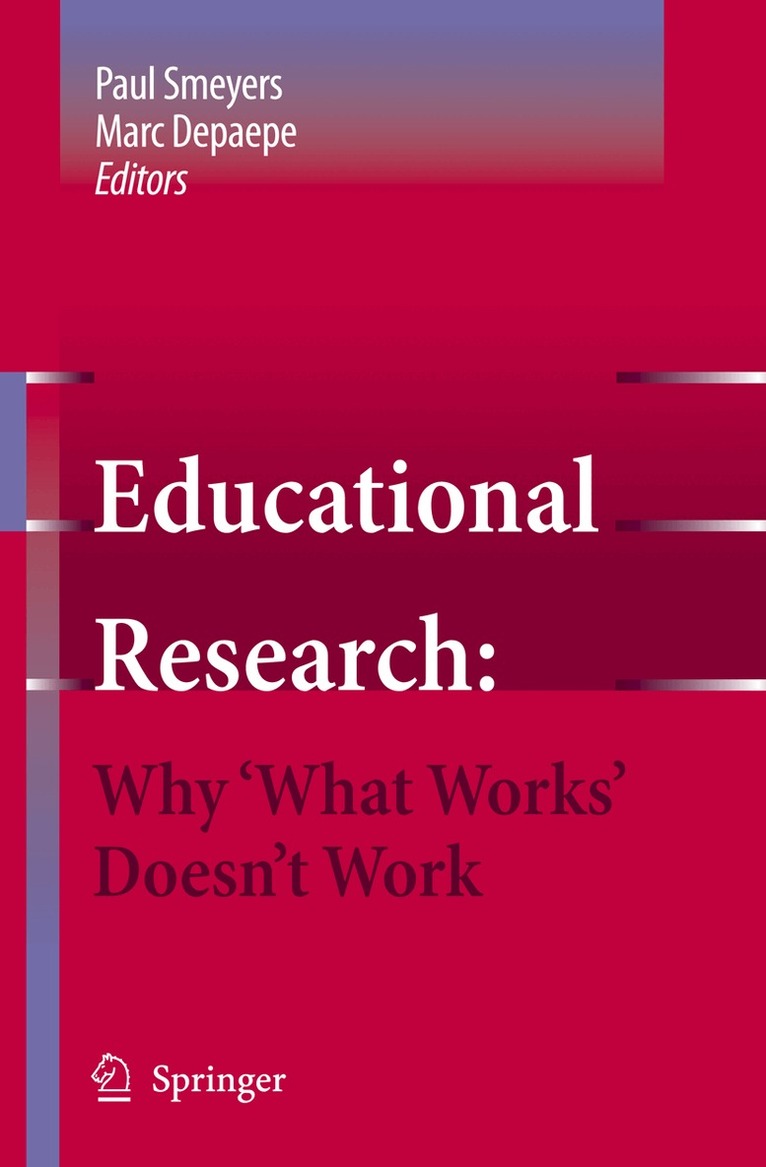
    Educational Research: Why 'What Works' Doesn't Work

    AvPaul Smeyers,Marc Depaepe

    Inbunden, Engelska, 2006

    Del 1 i serien Educational Research

    1 055 kr

    Beställningsvara. Skickas inom 10-15 vardagar. Fri frakt över 249 kr.

    Beskrivning

    Education and educational research, according to the current fashion, are supposed to be concerned with ‘what works’, to the exclusion of all other considerations. All over the world, and particularly in the English-speaking countries, governments look for means of improving ‘student achievement’ as measured by standardized test scores. Although such improvements are often to be welcomed, they do not answer all significant questions about what constitutes good education. Also the research on which they are based is not the only legitimate way to do educational research. Social research, and therefore educational research, cannot ignore the distinctive nature of what it studies: a social activity where questions of meaning and value cannot be eliminated, and where interpretation and judgment play a crucial role.In this book distinguished philosophers and historians of education from 6 countries focus on the problematical nature of the search for ‘what works’ in educational contexts, in practice as well as in theory. Beginning with specific problems, they move on to more general and theoretical considerations, seeking to go beyond over-simple ideas about cause and effect and the rhetoric of performativity that currently has educational thinking in its grip. ‘Freedom of inquiry in educational research can no longer be taken for granted. Narrow definitions of what constitutes ‘scientific’ research, funding criteria that enforce particular research methods, and policy decision processes that ignore any research that is not narrowly utilitarian, create a context in many countries that discourages scholarship of a more speculative, exploratory, or critical sort. This book brings together an exceptional combination of international and cross-disciplinary scholars who bring the perspectives of history and philosophy of science to ask, ‘How did we arrive at this place? and ‘Where is educational research heading? Thebook illuminates the anti-intellectual consequences of a ‘what works’ mentality in education, and shows that the ostensibly ‘scientific’ revolution in educational research in fact reflects an ahistorical and conceptually muddled understanding of what actually constitutes ‘science.’ This book could not be more timely and important.’Nicholas C. Burbules, Grayce Wicall Gauthier Professor, University of Illinois‘With research increasingly tied to State policies with the instrumental purpose of guiding school reforms, the volume provides an important historical and philosophical questioning of the possibilities, limitations and challenges of education research. Internationally leading scholars engage in a significant conversation that is sophisticated and nuanced for understanding contemporary debates.’ Thomas S. Popkewitz, the University of Wisconsin-Madison, USAThis publication is realized by the Research Community (FWO-Vlaanderen / Research Foundation Flanders, Belgium) Philosophy and History of the Discipline of Education. Evaluation and Evolution of the Criteria for Educational Reseach.

    Produktinformation

    • Utgivningsdatum:2006-11-10
    • Mått:155 x 235 x 17 mm
    • Vikt:477 g
    • Format:Inbunden
    • Språk:Engelska
    • Serie:Educational Research
    • Antal sidor:196
    • Upplaga:2006
    • Förlag:Springer-Verlag New York Inc.
    • ISBN:9781402053078

    Utforska kategorier

    • Pedagogik inom Psykologi och pedagogik

    Recensioner i media

    "Freedom of inquiry in educational research can no longer be taken for granted. Narrow definitions of what constitutes 'scientific' research, funding criteria that enforce particular research methods, and policy decision processes that ignore any research that is not narrowly utilitarian, create a context in many countries that discourages scholarship of a more speculative, exploratory, or critical sort. This book brings together an exceptional combination of international and cross-disciplinary scholars who bring the perspectives of history and philosophy of science to ask, 'How did we arrive at this place? and 'Where is educational research heading? The book illuminates the anti-intellectual consequences of a 'what works' mentality in education, and shows that the ostensibly 'scientific' revolution in educational research in fact reflects an ahistorical and conceptually muddled understanding of what actually constitutes 'science.' This book could not be more timely and important." Nicholas C. Burbules, Grayce Wicall Gauthier Professor, University of Illinois "With research increasingly tied to State policies with the instrumental purpose of guiding school reforms, the volume provides an important historical and philosophical questioning of the possibilities, limitations and challenges of education research. Internationally leading scholars engage in a significant conversation that is sophisticated and nuanced for understanding contemporary debates." Thomas S. Popkewitz, the University of Wisconsin-Madison, USA

    Innehållsförteckning

    • The ‘Good Practices’ of Jozef Emiel Verheyen – Schoolman and Professor of Education at the Ghent University.- Ovide Decroly, A Hero of Education.- Why Generalizability is not Generalizable.- The New Languages and Old Institutions: Problems of Implementing New School Governance.- Problematization or Methodology.- The Relevance of Irrelevant Research; The Irrelevance of Relevant Research.- Expectations of What Scientific Research could (not) Do.- Kuhnian Science and Education Research: Analytics of Practice and Training.- The International and the Excellent in Educational Research.- Technical Difficulties: The Workings of Practical Judgement.- The Science of Education – Disciplinary Knowledge on Non-Knowledge/Ignorance?.