• Fri frakt över 249 kr
  • •
  • Snabba leveranser
  • •
  • Billiga böcker
Kundservice

Du är på sajten för privatpersoner.

Företag, bibliotek eller offentlig verksamhet?

Du handlar på classic.bokus.com, där alla dina funktioner finns intakta.
Till classic.bokus.com
Bokus logotyp. Gå till startsidan.
  • Erbjudanden
  • Nyheter
  • Student
  • Topplistor
  • Barn & ungdom
  • Bokus Play
  • E-böcker
  • Pocketböcker
  • Spel & pussel

10% rabatt på allt med kod: NYSTART10 →

Sidfot

Mina sidor

    Hjälp

    • Kundservice
    • Vanliga frågor och svar
    • Frakt och leverans
    • Retur vid ångerrätt
    • Reklamera vara
    • Betalning
    • Köpvillkor
    • Allmänna villkor
    • Information om webbplatsens tillgänglighet

    Om Bokus

    • Om oss
    • Pressrum
    • För studenter
    • För företag
    • För bibliotek och offentlig verksamhet
    • För leverantörer
    • Hållbarhet

    Populärt

    • Aktuella erbjudanden
    • Presentkort
    • Studentlitteratur
    • Nya böcker
    • Topplistor
    • Signerade böcker
    • Engelska böcker

    Inspiration

    • Boktips
    • BookTok
    • Populära bokserier
    • Barnbokskaraktärer
    • Populära författare
    Logotyp för Bokus
    Följ oss på Facebook (extern länk)Följ oss på Instagram (extern länk)Följ oss på YouTube (extern länk)Följ oss på TikTok (extern länk)
    bokus @ CookiesAnpassa cookiesIntegritetspolicyKöpvillkor
    Till Citymail hemsida (extern länk)Till Budbee hemsida (extern länk)Till Postnord hemsida (extern länk)Till Schenker hemsida (extern länk)Till Early Bird hemsida (extern länk)Till Walleys hemsida (extern länk)
    1. Medicin
    2. Andra medicinska specialiteter
    3. Olycksfalls- och akutmedicin

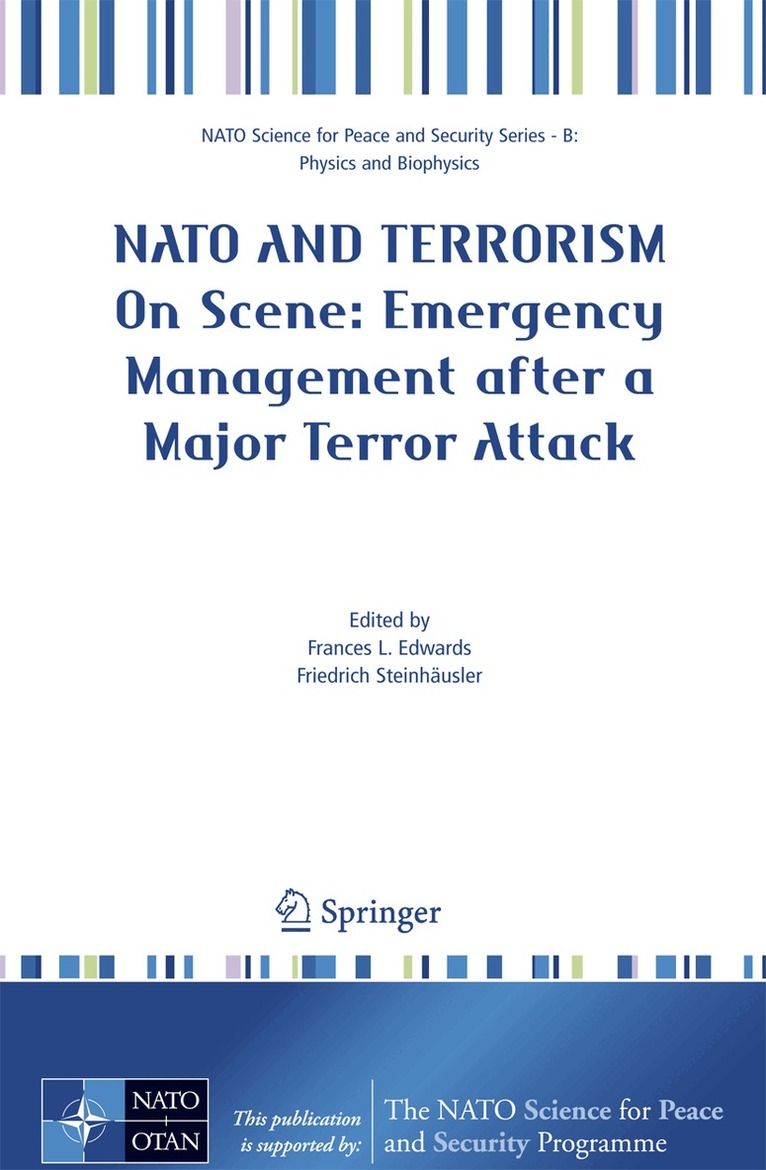
    NATO And Terrorism

    On Scene: New Challenges for First Responders and Civil Protection

    AvFrances L. Edwards,Friedrich Steinhäusler

    Inbunden, Engelska, 2007

    Del i serien NATO Science for Peace and Security Series B: Physics and Biophysics

    1 119 kr

    Beställningsvara. Skickas inom 10-15 vardagar. Fri frakt över 249 kr.

    Beskrivning

    International terrorism remains a significant threat to the peace of the world. Weapons using various materials and delivery systems have been directed against cities and infrastructure, and other materials are postulated to be usable within the near future. Some of these materials are unusual or exotic, while some are modifications of materials used daily for other purposes: biological, chemical, radiological, nuclear and explosive. These materials pose a safety challenge for first responders, slowing the response and potentially killing scarce trained personnel. This book provides information about how leading agencies across the NATO membership are preparing to confront and respond to terrorists deploying Weapons of Mass Destruction (WMD), Weapons of Mass Killing (WMK) and Weapons of Mass Disruption (WMDi). Based on contributions by experts from NATO member states, Israel and the Russian Federation, this book offers information on fourth generation warfare as a new challenge to first responders. It also provides a variety of insights into methods for preparing for and responding to WMD-, WMK-, and WMDi-events, using new technologies and strategies. Furthermore, the book offers solution for restoring the community to functioning after such a major terror attack. Topics include preparing, planning, operations, equipment, training and unique applications of existing technologies for countering terrorist attacks against cities and their infrastructure.

    Produktinformation

    • Utgivningsdatum:2007-08-02
    • Mått:155 x 235 x 27 mm
    • Vikt:552 g
    • Format:Inbunden
    • Språk:Engelska
    • Serie:NATO Science for Peace and Security Series B: Physics and Biophysics
    • Antal sidor:262
    • Upplaga:2007
    • Förlag:Springer-Verlag New York Inc.
    • ISBN:9781402062759

    Utforska kategorier

    • Olycksfalls- och akutmedicin inom Medicin

    Innehållsförteckning

    • Foreword. Preface. Acknowledgements. Contributors. Introduction. Overview. The issue. Emergency planning and terrorism. The framework. Security threat assessment. Preparing for natural hazards vs. terror attack: a matter of risk. The new risk environment. Unconventional use of conventional explosives. Radiological weapons. Weapons of mass destruction. Emergency management challenges. Challenges to law enforcement due to a major terror attack. Challenges due to NRBC threats. Covert versus overt terror attack. Response by law enforcement agents. Prevention and disruption by law enforcement agents. General indicators of CBRNE terrorist activities. Legal aspects of emergency situations. The importance of legal measures during pre- and post-attack periods. Terrorism versus catastrophic terrorism. Criminal justices responses. Tort law as a societal mechanism to protect the innocent injured. Tort lawsuits in a post-9/11 world. Breaking the mold. Distributive justice model and its limitations. Not unusual policy. Fund replacement of tort action for victims of WMVs. Policy correction needed. Legal issues for emergency management planning. Protection against terrorism through emergency management structures. Structures for managing alerting and warning. Public Alerting and Warning. Public Warning Technical Systems. Post Event Messages.Role of Government versus Responsibility of Individual. Emergency Management Structures for Managing Response. Local, State and Federal Structures. Evacuation or Shelter in Place. Federal Structures for Rendering Aid. Non-Governmental Organizations’ Role. Using Technology to Aid Planning and Response. Air Modeling. Land Use-Based Modeling. Structural Engineering as Mitigation. Cross Border Interoperability Across Systems. Communications Systems. Interoperable Equipment. Coordination/Command and Control Systems. Receiving External Help – Existing Systems. Special Challenges for Cross-Border Law Enforcement. International disaster response.United Kingdom National Overview. Overview of UK Preparedness. Training and Exercises. Case Study: London Bombings July 2005. National emergency preparedness in the Netherlands: Uncertainty in doing the right things. Change In Risk Awareness. The Dutch Crisis Control Organization. A Scientific Approach to Emergency Management. German Civil Protection. Federal Risk Assessment and Central Emeregency response. The Level of Capacity of First Responders. Protection Against Terrorism through Emergency Management Structures in Norway. Justification and Rationale for Emergency Preparedness. Norwegian Emergency Preparedness – Principles and Priorities. Norwegian Legislation and Regulations on Emergency Preparedness. Structural Framework. First Responder Community in Norway. Danish Emergency Preparedness. Principles and Priorities. Danish Legislation and Regulations on Emergency Preparedness. Structural Framework. First Responders in Denmark. Norwegian and Danish Emergency Preparedness Compared. Emergency Preparedness in Portugal. The U.S. Response to Catastrophic Urban Disasters. Preparatory Phase. Command and Control. Phases of Response. Search Concept of Operations. The Role of Specialists. Special Search Operations. Conclusion. National Emergency preparedness in case of terrorism in Russia. EMERCOM Organization.Operational Plans within EMERCOM. Management Actions. Action Plan. The Beslan School Terror Attack. Response to Unconventional Terrorist Attacks in Israel. Homefront Command. Terrorism Response Planning and Training. Phased response to a terror attack. NATO and consequence management: The Euro-Atlantic Disaster Response Coordination Centre. Introduction. The Role of NATO and EADRCC. The International staff: Ops Division organization. Steps taken after a request for assistance.I nventory of national chemical, biological and radiological capabilities. Examples of NATO response capabilities. Training and Exercises. NATO SHAPE/Allied Command Operations. EuropeanUnion Civil Protection Mechanism. Maintaining preparedness. Lessons learned. Organization for the prevention of chemical weapons. Roles and expertise. Intervention capabilities. The Way Forward. Research and development needs in field response to terrorism. Introduction. The catastrophic risk model as a basis for R&D on emergency management. R&D into Urban Warfare and Terrorist Capability. Strategic operations model for scientific innovation. Timelines for deliverables. Short-term challenges for R&D. Mid-term challenges for R&D. Long-term challenges for R&D. Conclusions and recommendations.International challenges in cooperation against terrorism.Conclusions of the workshop. Research and improvement program for NATO member states. Security Threat Assessment. Protection against terrorism through emergency management structures. Research and development needs in field response to terrorism. International disaster response. Managing a radiological attack. Conclusions and next steps. Appendix 1: List of Participants.Appendix 2: Fourth Generation Warfare. Appendix 3: Review of the Brazilian Emergency Management After The Radiological Incident in Goiania in 1987. Appendix 4: Review of the US Emergency Management After the Terror Attacks in New York City on September 11, 2001. Appendix 5: Review of the US Emergency Management After the Hurricane "Katrina," August 29 – September 1, 2005. References. Acronyms. Index.