• Fri frakt över 249 kr
  • •
  • Snabba leveranser
  • •
  • Billiga böcker
Kundservice

Du är på sajten för privatpersoner.

Företag, bibliotek eller offentlig verksamhet?

Du handlar på classic.bokus.com, där alla dina funktioner finns intakta.
Till classic.bokus.com
Bokus logotyp. Gå till startsidan.
  • Erbjudanden
  • Nyheter
  • Student
  • Topplistor
  • Barn & ungdom
  • Bokus Play
  • E-böcker
  • Pocketböcker
  • Spel & pussel

10% rabatt på allt med kod: NYSTART10 →

Sidfot

Mina sidor

    Hjälp

    • Kundservice
    • Vanliga frågor och svar
    • Frakt och leverans
    • Retur vid ångerrätt
    • Reklamera vara
    • Betalning
    • Köpvillkor
    • Allmänna villkor
    • Information om webbplatsens tillgänglighet

    Om Bokus

    • Om oss
    • Pressrum
    • För studenter
    • För företag
    • För bibliotek och offentlig verksamhet
    • För leverantörer
    • Hållbarhet

    Populärt

    • Aktuella erbjudanden
    • Presentkort
    • Studentlitteratur
    • Nya böcker
    • Topplistor
    • Signerade böcker
    • Engelska böcker

    Inspiration

    • Boktips
    • BookTok
    • Populära bokserier
    • Barnbokskaraktärer
    • Populära författare
    Logotyp för Bokus
    Följ oss på Facebook (extern länk)Följ oss på Instagram (extern länk)Följ oss på YouTube (extern länk)Följ oss på TikTok (extern länk)
    bokus @ CookiesAnpassa cookiesIntegritetspolicyKöpvillkor
    Till Citymail hemsida (extern länk)Till Budbee hemsida (extern länk)Till Postnord hemsida (extern länk)Till Schenker hemsida (extern länk)Till Early Bird hemsida (extern länk)Till Walleys hemsida (extern länk)
    1. Ekonomi och Ledarskap
    2. Nationalekonomi
    3. Miljöekonomi

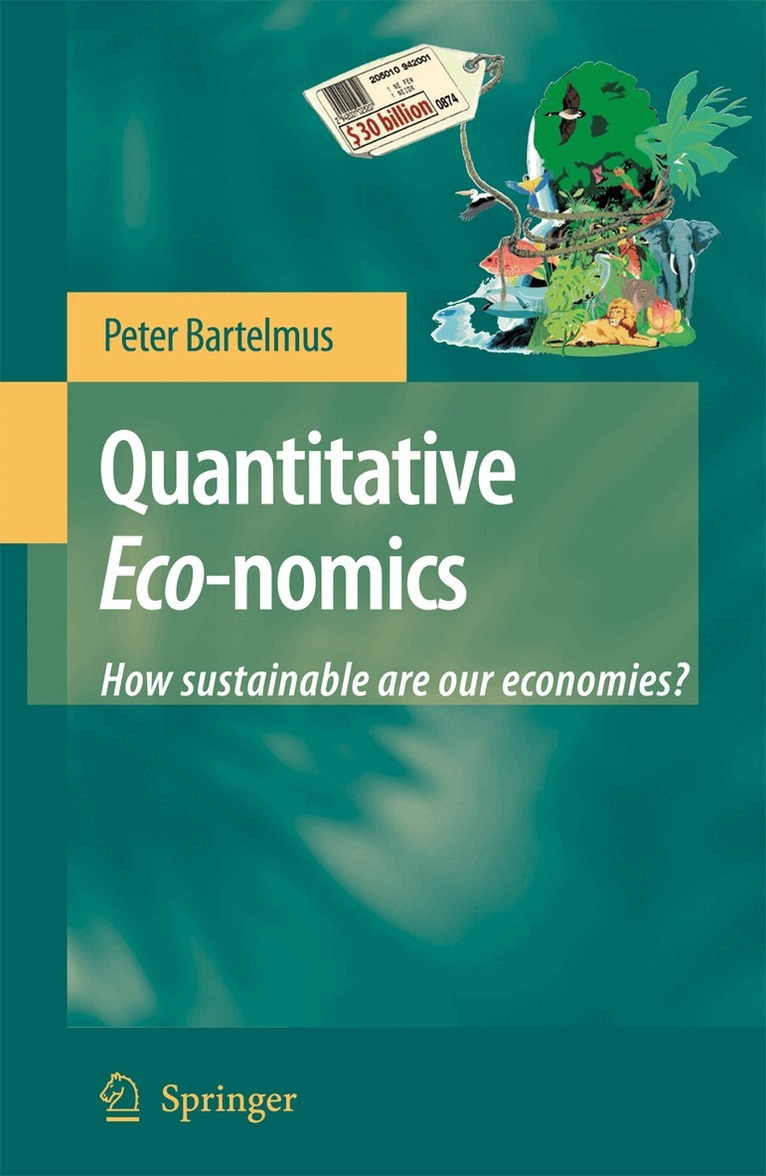
    Quantitative Eco-nomics

    How sustainable are our economies?

    AvPeter Bartelmus

    Inbunden, Engelska, 2008

    1 119 kr

    Beställningsvara. Skickas inom 10-15 vardagar. Fri frakt över 249 kr.

    Fler format och utgåvor

    E-bok

    1 420 kr

    Häftad

    1 086 kr

    Beskrivning

    “Quantitative Eco-nomics” cuts through the fog of vision and advocacy by comparing and applying new quantitative tools of both environmental and ecological economics. Environmental accounts and empirical analyses provide operational concepts and measures of the sustainability of economic performance and growth. They facilitate rational and compatible environmental and economic policies.This thought-provoking text raises doubts, however, about the measurability of sustainable development. Has the paradigm run its course? The answer is a guarded ‘yes’ – guarded because the concept still carries considerable environmental goodwill. At the same time the opaque concept fosters contradictory policy advice, or worse, inaction. Do we need zero- or accelerated economic growth? Should we reduce conspicuous consumption or enjoy spending as we see fit? Will rules and regulation or adjusted markets prevent environmental disaster?

    Produktinformation

    • Utgivningsdatum:2008-05-09
    • Mått:155 x 235 x 24 mm
    • Vikt:705 g
    • Format:Inbunden
    • Språk:Engelska
    • Antal sidor:329
    • Upplaga:2008
    • Förlag:Springer-Verlag New York Inc.
    • ISBN:9781402069659

    Utforska kategorier

    • Miljöekonomi inom Ekonomi och Ledarskap

    Innehållsförteckning

    • Part I: Questions, Questions, Questions.- 1. What on Earth is wrong?- 1:1 Paradise lost.- 1:2 Environmental doomsday and international reaction.- 1:3 Reaching the limits?- 2. What’s economics got to do with it?- 2:1 Economics out of sync?- 2:2 Schools of eco-nomic thought.- 2:3 Economic sustainability: maintaining capital and welfare.- 2:4 Ecological sustainability: dematerialisation.- 3. Sustainable development – blueprint or fig Leaf?- 3:1 What is development?- 3:2 Towards an operational definition of sustainable development.- 3:3 Normative economics for sustainable development?- Part II: Assessing the Physical Base of the Economy.- 4. Statistics and indicators.- 4:1 Statistical frameworks.- 4:2 From statistics to indicators ‘for’ sustainable development.- 4:3 Global warming: the indicator ‘of’ (non)sustainable development?- 5. Aggregation: From indicators to indices.- 5:1 Aggregation methods.- 5:2 Indices of environmental sustainability and sustainable development.- 5:3 Critique: towards a ‘balanced’ approach.- 6. Energy and material flow accounting.- 6:1 Rationale: social metabolism and environmental sustainability.- 6:2 Energy accounting.- 6:3 Material flow accounting.- Part III: Greening the Economic Accounts.- 7. Linking the physical and monetary accounts.- 7:1 Measures of economic welfare and wealth.- 7:2 Extending the national accounts: incorporating nature’s assets.- 7:3 Hybrid accounts: expanding the production boundary.- 8. SEEA – the System for Integrated Environmental and Economic Accounting.- 8:1 Pricing the priceless.- 8:2 SEEA objectives, structure and indicators.- 8:3 Case studies.- 8:4 SEEA revision.- 9. Corporate accounting: accounting for accountability.- 9:1 From accountability to accounting.- 9:2 From accounting to management.- Part IV: Analysis – Modelling Sustainability.- 10. Diagnosis: has the economy behaved sustainably?- 10:1 Welfaresecured? Dematerialised? Capital maintained?- 10:2 What are the causes? Structural analysis of environmental impact.- 11. Prediction: will economic growth be sustainable?- 11:1 Econometrics: the Environmental Kuznets Curve Hypothesis.- 11:2 Simulation of non-sustainability: the Limits-to-Growth model.- 12. Policy analysis: can we make growth sustainable?- 12:1 Environmental policy measures in general equilibrium and input-output analysis.- 12:2 Environmental constraints and optimality – a linear programming approach.- 12:3 Dynamic analysis: optimality and sustainability of economic growth.- Part V: Strategic Outlook.- 13. Strategies: tackling the limits to growth.- 13:1 Ignoring the limits: muddling through.- 13:2 Complying with limits: curbing economic activity.- 13:3 Pushing the limits: eco-efficiency.- 13:4 Adopting limits: sufficiency, corporate social responsibility, environmental ethics.- 14. Globalisation and global governance.- 14:1 Sustainability effects of globalisation.- 14:2 Global governance for sustainable development.- 15. Questions, questions, questions – and some answers.- 15:1 What’s the problem?- 15:2 What’s economics got to do with it?- 15:3 How bad is it?- 15:4 What can be done?- 15:5 Some non-conclusive answers.- Annexes.- I. Market failure and environmental cost internalisation – a primer.- II. Economic rent and natural resource depletion.- III. SEEA Germany – a pilot case study.- References.- Index.- Colour Plates.