• Fri frakt över 249 kr
  • •
  • Snabba leveranser
  • •
  • Billiga böcker
Kundservice

Du är på sajten för privatpersoner.

Företag, bibliotek eller offentlig verksamhet?

Du handlar på classic.bokus.com, där alla dina funktioner finns intakta.
Till classic.bokus.com
Bokus logotyp. Gå till startsidan.
  • Erbjudanden
  • Nyheter
  • Student
  • Topplistor
  • Barn & ungdom
  • Bokus Play
  • E-böcker
  • Pocketböcker
  • Spel & pussel

10% rabatt på allt med kod NYSTART10 →

Sidfot

Mina sidor

    Hjälp

    • Kundservice
    • Vanliga frågor och svar
    • Frakt och leverans
    • Retur vid ångerrätt
    • Reklamera vara
    • Betalning
    • Köpvillkor
    • Allmänna villkor
    • Information om webbplatsens tillgänglighet

    Om Bokus

    • Om oss
    • Pressrum
    • För studenter
    • För företag
    • För bibliotek och offentlig verksamhet
    • För leverantörer
    • Hållbarhet

    Populärt

    • Aktuella erbjudanden
    • Presentkort
    • Studentlitteratur
    • Nya böcker
    • Topplistor
    • Signerade böcker
    • Engelska böcker

    Inspiration

    • Boktips
    • BookTok
    • Populära bokserier
    • Barnbokskaraktärer
    • Populära författare
    Logotyp för Bokus
    Följ oss på Facebook (extern länk)Följ oss på Instagram (extern länk)Följ oss på YouTube (extern länk)Följ oss på TikTok (extern länk)
    bokus @ CookiesAnpassa cookiesIntegritetspolicyKöpvillkor
    Till Citymail hemsida (extern länk)Till Budbee hemsida (extern länk)Till Postnord hemsida (extern länk)Till Schenker hemsida (extern länk)Till Early Bird hemsida (extern länk)Till Walleys hemsida (extern länk)
    1. Data och IT
    2. Systemvetenskap och AI

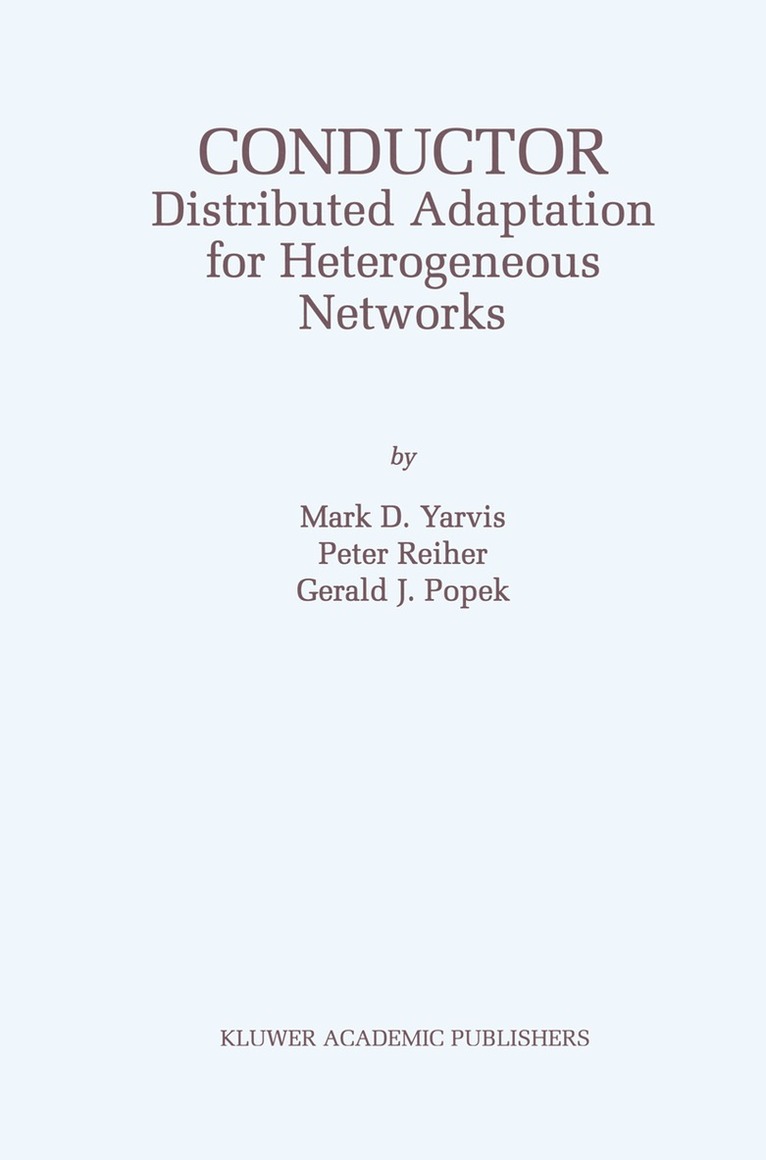
    Conductor: Distributed Adaptation for Heterogeneous Networks

    AvMark D. Yarvis,Peter Reiher

    Inbunden, Engelska, 2002

    Del i serien Springer International Series in Engineering and Computer Science

    1 117 kr

    Beställningsvara. Skickas inom 10-15 vardagar. Fri frakt över 249 kr.

    Fler format och utgåvor

    Häftad

    1 117 kr

    Beskrivning

    Internet heterogeneity provides a challenge for application development: adaptive software. Together with the increased Internet capacity and new access technologies, network congestion and the use of older technologies, wireless access, and peer-to-peer networking are increasing the heterogeneity of the Internet. Applications should provide gracefully degraded levels of service when network conditions are poor, and enhanced services when network conditions exceed expectations. Existing adaptive technologies, which are primarily end-to-end or proxy-based and often focus on a single deficient link, can perform poorly in heterogeneous networks. Instead, heterogeneous networks frequently require multiple, co-ordinated, and distributed remedial actions. This text describes an approach to graceful degradation in the face of network heterogeneity - distributed adaptation - in which adaptive code is deployed at multiple points within a network. The feasibility of this approach is demonstrated by conductor, a middleware framework that enables distributed adaptation of connection-oriented, application-level protocols.By adapting protocols, conductor provides application-transparent adaptation, supporting both existing applications and applications designed with adaptation in mind. The book introduces techniques that enable distributed adaptation, making it automatic, reliable, and secure. In particular, it introduces the notion of semantic segmentation, which maintains exactly-once delivery of the semantic elements of a data stream while allowing the stream to be arbitrarily adapted in transit. It also introduces a secure architecture for automatic adaptor selection, protecting user data from unauthorized adaptation. These techniques are described both in the context of conductor and in the broader context of distributed systems. Finally, this book presents empirical evidence from several case studies indicating that distributed adaptation can allow applications to degrade gracefully in heterogeneous networks, providing a higher quality of service to users than other adaptive techniques. Further, experimental results indicate that the proposed techniques can be employed without excessive cost.

    Produktinformation

    • Utgivningsdatum:2002-05-31
    • Mått:155 x 235 x 16 mm
    • Vikt:543 g
    • Format:Inbunden
    • Språk:Engelska
    • Serie:Springer International Series in Engineering and Computer Science
    • Antal sidor:232
    • Upplaga:2002
    • Förlag:Kluwer Academic Publishers
    • ISBN:9781402070877

    Utforska kategorier

    • Systemvetenskap och AI inom Data och IT
    • Nätverk och kommunikation inom Data och IT

    Innehållsförteckning

    • 1. Introduction.- 1.1 Distributed Adaptation.- 1.2 Assumptions.- 1.3 Terminology.- 1.4 Key Contributions of this Research.- 1.5 Roadmap.- 2. Conductor: A New Approach.- 2.1 The Conductor Approach.- 2.2 The Conductor Architecture.- 2.3 Key Challenges.- 2.4 Potential Pitfalls of Distributed Adaptation.- 2.5 Conclusions.- 3. Stream Interception and Identification.- 3.1 Interception in Conductor.- 3.2 Type Identification.- 3.3 An Example of Interception and Identification.- 3.4 Conclusions.- 4. Selecting and Deploying Distributed Adaptations.- 4.1 Properties of a Good Solution.- 4.2 Criteria for Adaptor Selection.- 4.3 Approaches to Distributed Adaptor Selection.- 4.4 Conductor’s Planning Architecture.- 4.5 Plan Formulation.- 4.6 The Cost of Automatic Planning.- 4.7 Conclusions.- 5. Securing Distributed Adaptation.- 5.1 Design of Conductor Security.- 5.2 Authentication Schemes.- 5.3 Attacks and Countermeasures.- 5.4 Multiple Security Schemes.- 5.5 Non-Enabled Client and Server.- 5.6 Applicability to Other Open Architectures.- 5.7 Implementation.- 5.8 Conclusions.- 6. Reliability for Distributed Adaptation.- 6.1 A New Model of Reliability.- 6.2 Semantic Segmentation.- 6.3 Preventing Data Loss Despite Adaptation.- 6.4 Protecting Adaptation from Failures.- 6.5 Handling Multiple Failures.- 6.6 Semantic Segmentation for Other Transport Protocols.- 6.7 Round-Trip Reliability.- 6.8 Conclusions.- 7. Adaptor Construction.- 7.1 Writing Conductor Adaptors.- 7.2 Sample Adaptations.- 7.3 Challenges in Adaptor Construction.- 7.4 Conclusions.- 8. External Interfaces.- 8.1 Control of Application-Transparent Adaptation.- 8.2 An API for Adaptation-Aware Applications.- 8.3 External Control of Adaptation-Aware Applications.- 8.4 Conclusions.- 9. Experiences with Conductor.- 9.1 ExperimentalSetup.- 9.2 Effectiveness of Conductor.- 9.3 Data Handling Overheads.- 9.4 The Cost of Automatic Planning.- 9.5 The Cost of Semantic Segmentation.- 9.6 The Cost of Failures.- 9.7 The Cost of Security.- 9.8 Initial Deployment.- 9.9 Conclusions.- 10. Related Work.- 10.1 Adaptation.- 10.2 Reliability.- 10.3 Security.- 10.4 Conclusions.- 11. Future Work.- 12. Conclusions.- 12.1 Summary of the Problem.- 12.2 The Conductor Solution.- 12.3 Research Contributions.- 12.4 Broad Lessons.- 12.5 Final Comments.- A. Data Tables.- Trademarks.- References.