• Fri frakt över 249 kr
  • •
  • Snabba leveranser
  • •
  • Billiga böcker
Kundservice

Du är på sajten för privatpersoner.

Företag, bibliotek eller offentlig verksamhet?

Du handlar på classic.bokus.com, där alla dina funktioner finns intakta.
Till classic.bokus.com
Bokus logotyp. Gå till startsidan.
  • Erbjudanden
  • Student
  • Topplistor
  • Barn & ungdom
  • Bokus Play
  • E-böcker
  • Ljudböcker
  • Pocketböcker
  • Spel och pussel

Pocketfynda! Hundratals böcker för 49 kr/st →

Sidfot

Mina sidor

    Hjälp

    • Kundservice
    • Vanliga frågor och svar
    • Frakt och leverans
    • Retur vid ångerrätt
    • Reklamera vara
    • Betalning
    • Köpvillkor
    • Allmänna villkor
    • Information om webbplatsens tillgänglighet

    Om Bokus

    • Om oss
    • Pressrum
    • För studenter
    • För företag
    • För bibliotek och offentlig verksamhet
    • För leverantörer
    • Hållbarhet

    Populärt

    • Aktuella erbjudanden
    • Presentkort
    • Studentlitteratur
    • Nya böcker
    • Topplistor
    • Signerade böcker
    • Engelska böcker

    Inspiration

    • Boktips
    • BookTok
    • Barnbokskaraktärer
    • Populära författare
    Logotyp för Bokus
    Följ oss på Facebook (extern länk)Följ oss på Instagram (extern länk)Följ oss på YouTube (extern länk)Följ oss på TikTok (extern länk)
    bokus @ CookiesAnpassa cookiesIntegritetspolicyKöpvillkor
    Till Citymail hemsida (extern länk)Till Budbee hemsida (extern länk)Till Postnord hemsida (extern länk)Till Schenker hemsida (extern länk)Till Early Bird hemsida (extern länk)Till Walleys hemsida (extern länk)
    1. Data och IT
    2. Människa – datorinteraktion

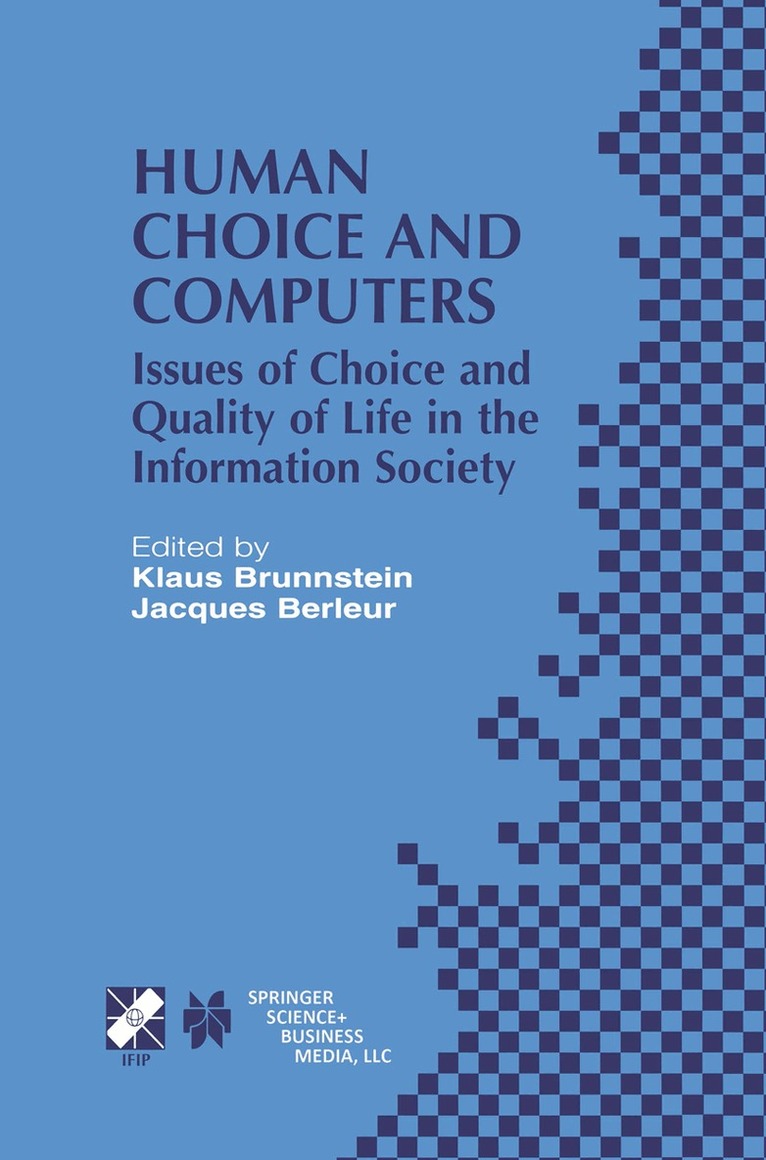
    Human Choice and Computers

    Issues of Choice and Quality of Life in the Information Society

    AvKlaus Brunnstein,Brunnstein

    Inbunden, Engelska, 2002

    Del i serien IFIP Advances in Information and Communication Technology

    1 110 kr

    Beställningsvara. Skickas inom 10-15 vardagar. Fri frakt över 249 kr.

    Beskrivning

    The developments of information and communication technologies (ICT) are not always continuous, but may be influenced and shaped by unforeseen events and are therefore difficult to predict and control. This applies especially to the events of September 11 2001 and how ICT is used in economic and public applications. But even under pressures of terrorist actions, it is essential that human choice dominate how information and communication technologies are shaped, applied and used. This text presents different views about how terrorist actions are influencing political and social discussions and decisions, and it covers questions related to legitimacy and power in the information society. Ethical principles are important guidelines for responsible behaviour of IT professionals. But even under strong external pressure, long ranging aspects such as education and the roles of developing countries in the information society are important to discuss, especially to enable all to actively participate in information processes.

    Produktinformation

    • Utgivningsdatum:2002-08-31
    • Mått:155 x 235 x 24 mm
    • Vikt:688 g
    • Format:Inbunden
    • Språk:Engelska
    • Serie:IFIP Advances in Information and Communication Technology
    • Antal sidor:336
    • Upplaga:2002
    • Förlag:Kluwer Academic Publishers
    • ISBN:9781402071850

    Utforska kategorier

    • Människa – datorinteraktion inom Data och IT

    Innehållsförteckning

    • Critical Professional Discourses About Information and Communications Technologies and Social Life in the U.S..- Does the Internet Promote Democracy?.- Theoretical Perspective on the Interplay Between ICT and Quality of Life.- Using Technology to Help the Citizen Enrollment.- Information and Communication Technology and the Home Environment.- Some Great Myths of the History of Computing.- Roots of Computing in Austria — Contributions of the IBM Vienna Laboratory and Changes of Paradigms and Priorities in Information Technology.- Self-regulation: Content, Legitimacy and Efficiency — Governance and Ethics.- Trust, Corruption, and Surveillance in the Electronic Workplace.- Ethics and Learning — From State Regulation towards Reflexive Self-Regulation of the Information Society.- Computer Augmented Research and Scientific Misconduct.- The Security Aspect of Information Society as a Global Biocultural System.- Choice and Responsibility: The Delegation of Decision Making to Intelligent Software Agents.- Responsibility and the Work of IT-Professionals: From Academia to Practice.- Is the Enemy Us? — New Threats to Privacy, Freedom of Information and Civil Liberties in the Age of Terrorism.- National Identification Schemes (Nids): A Remedy Against Terrorist Attack?.- A Classification of Biometric Applications Wanted by Politics: Passports, Person Tracking and Fight Against Terror.- Preventing Privacy Attacks and CyberCrime in the Mobile Internet?.- Towards a Framework for Sustainable Knowledge Management in Organisations in Developing Countries.- Adapting Global Practices Locally: A Perspective on IT Implementation in a Developing Country Context.- Technology and Learning Societies in the New Millennium (Indian Context): Content, Practice and Management.- Quality ofWorking Life, Knowledge-Intensive Work Processes and Creative Learning Organisations: Information Processing Paradigm versus Self-Organisation Theory.- Understanding the Process of Information Systems and ICT Curriculum Development. Three Models.- Cultural Differences of Female Enrollment in Tertiary Education in Computer Science.- A Radical Scandinavian (“ Øresundsk”) Approach to Inquiring Organizations — A Critique of ICT in Knowledge Management Martina.- Sustainable Development and the Information Society.- “Information for All” Programme.- Draft Recommendations “Concerning the Promotion and Use of Multilingualism and Universal Access to Cyberspace”.