• Fri frakt över 249 kr
  • •
  • Snabba leveranser
  • •
  • Billiga böcker
Kundservice

Du är på sajten för privatpersoner.

Företag, bibliotek eller offentlig verksamhet?

Du handlar på classic.bokus.com, där alla dina funktioner finns intakta.
Till classic.bokus.com
Bokus logotyp. Gå till startsidan.
  • Erbjudanden
  • Nyheter
  • Student
  • Topplistor
  • Barn & ungdom
  • Bokus Play
  • E-böcker
  • Pocketböcker
  • Spel & pussel

10% rabatt på allt med kod: NYSTART10 →

Sidfot

Mina sidor

    Hjälp

    • Kundservice
    • Vanliga frågor och svar
    • Frakt och leverans
    • Retur vid ångerrätt
    • Reklamera vara
    • Betalning
    • Köpvillkor
    • Allmänna villkor
    • Information om webbplatsens tillgänglighet

    Om Bokus

    • Om oss
    • Pressrum
    • För studenter
    • För företag
    • För bibliotek och offentlig verksamhet
    • För leverantörer
    • Hållbarhet

    Populärt

    • Aktuella erbjudanden
    • Presentkort
    • Studentlitteratur
    • Nya böcker
    • Topplistor
    • Signerade böcker
    • Engelska böcker

    Inspiration

    • Boktips
    • BookTok
    • Populära bokserier
    • Barnbokskaraktärer
    • Populära författare
    Logotyp för Bokus
    Följ oss på Facebook (extern länk)Följ oss på Instagram (extern länk)Följ oss på YouTube (extern länk)Följ oss på TikTok (extern länk)
    bokus @ CookiesAnpassa cookiesIntegritetspolicyKöpvillkor
    Till Citymail hemsida (extern länk)Till Budbee hemsida (extern länk)Till Postnord hemsida (extern länk)Till Schenker hemsida (extern länk)Till Early Bird hemsida (extern länk)Till Walleys hemsida (extern länk)
    1. Språk och ordböcker
    2. Språkvetenskap och lingvistik

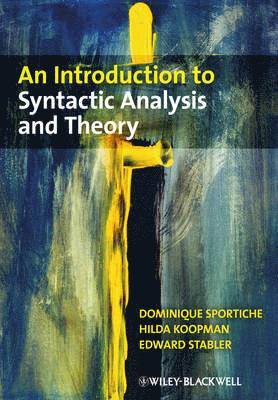
    Introduction to Syntactic Analysis and Theory

    AvDominique Sportiche,Hilda Koopman

    Inbunden, Engelska, 2013

    1 176 kr

    Beställningsvara. Skickas inom 5-8 vardagar. Fri frakt över 249 kr.

    Fler format och utgåvor

    Häftad

    542 kr

    Beskrivning

    An Introduction to Syntactic Analysis and Theory offers beginning students a comprehensive overview of and introduction to our current understanding of the rules and principles that govern the syntax of natural languages. Includes numerous pedagogical features such as 'practice' boxes and sidebars, designed to facilitate understanding of both the 'hows' and the 'whys' of sentence structureGuides readers through syntactic and morphological structures in a progressive mannerTakes the mystery out of one of the most crucial aspects of the workings of language – the principles and processes behind the structure of sentencesIdeal for students with minimal knowledge of current syntactic research, it progresses in theoretical difficulty from basic ideas and theories to more complex and advanced, up to date concepts in syntactic theory

    Produktinformation

    • Utgivningsdatum:2013-11-22
    • Mått:183 x 254 x 28 mm
    • Vikt:862 g
    • Format:Inbunden
    • Språk:Engelska
    • Antal sidor:472
    • Förlag:John Wiley and Sons Ltd
    • ISBN:9781405100168

    Utforska kategorier

    • Språkvetenskap och lingvistik inom Språk och ordböcker

    Mer om författaren

    Dominique Sportiche is Professor of Linguistics at the University of California, Los Angeles, École Normale Supérieure in Paris, and Institut Jean Nicod at the Paris Institut d’Étude de la Cognition. Specializing in theoretical syntax, he has published widely on the syntax and the properties of the syntax/semantics interface of English and French.Hilda Koopman is Professor of Linguistics at the University of California, Los Angeles. Her theoretical interests include theoretical syntax and morphology and comparative syntax. She has published on a wide range of topics covering many diverse languages. Her work is often based on original fieldwork.Edward Stabler is Professor of Linguistics at the University of California, Los Angeles. His specialty is in computational models of human syntactic analysis and learning, and he has published on a wide range of topics in mathematical and computational linguistics.

    Recensioner i media

    "All in all, therefore, this book should be recommended to students looking for a clear introduction to generative syntax, as well as to anyone interested in language structure. The exercises can also make it a good handbook to use as a complement to a course on syntax." (Cercles, 1 June 2014)

    Innehållsförteckning

    • Acknowledgments xv1 Introduction 11.1 Where to Start 11.2 What this Book is and is Not, and How to Use It 51.3 Further Reading 62 Morphology: Starting with Words 92.1 Words Come in Categories 102.2 Words are Made of Smaller Units: Morphemes 172.3 Morphemes Combine in Regular Ways 182.4 Apparent Exceptions to the RHHR 322.5 Morphological Atoms 352.6 Compositionality and Recursion 362.7 Conclusion 373 Syntactic Analysis Introduced 433.1 Word Order 443.2 Constituency 473.3 Syntactic Productivity 483.4 Substitution 503.5 Ellipsis 583.6 Coordination 623.7 Movement and Other Distortions 683.8 Some More Complex Distortion Experiments, Briefly 743.9 Some More Practice 753.10 Some Other Evidence of Constituency 763.11 Conclusion 784 Clauses 874.1 Full Clauses: CPs 874.2 Tense Phrase 944.3 Conclusion 985 Other Phrases: A First Glance 1055.1 Verb Phrases 1055.2 Determiner Phrases 1135.3 Noun Phrases 1165.4 Adjective Phrases 1195.5 Prepositional Phrases 1195.6 Ways to Talk About Tree Geometry 1195.7 Conclusion 1206 X-bar Theory and the Format of Lexical Entries 1276.1 Review: The Model of Morphology 1276.2 Building a Model of Syntax 1296.3 Headedness 1306.4 Internal Organization of Constituents 1316.5 Some Consequences 1346.6 Cross-categorial Symmetries 1376.7 Subjects Across Categories: Small Clauses 1386.8 Lexical Entries 1406.9 The Projection Principle and Locality 1466.10 Cross-linguistic Variation 1496.11 Conclusion 1517 Binding and the Hierarchical Nature of Phrase Structure 1577.1 Anaphors 1597.2 Pronouns 1697.3 Non-pronominal Expressions 1717.4 Binding Theory Summarized 1727.5 Small Clauses and Binding Theory 1737.6 Some Issues 1747.7 Cross-linguistic Variation 1787.8 Learning About Binding Relations 1817.9 Conclusion 1838 Apparent Violations of Locality of Selection 1878.1 Setting the Stage 1878.2 Topicalization: A First Case of Movement 1898.3 Head Movement 1918.4 Detecting Selection 2068.5 Phrasal Movements 2108.6 How Selection Drives Structure Building 2218.7 Addressing some Previous Puzzles 2258.8 Synthesis 2268.9 Terminology and Notation 2308.10 Conclusion 2309 Infinitival Complements: Raising and Control 2399.1 Subject Control 2409.2 Using the Theory: Control and Binding 2449.3 Interim Summary: Inventory of To-infinitival 2489.4 Raising to Object/ECM and Object Control 2499.5 Conclusion 25210 Wh-questions: Wh-movement and Locality 25910.1 Introduction 25910.2 The Landing Site or Target Position of Wh-Movement 26110.3 What Wh-movement Moves 26310.4 Locality I: The Problem 26610.5 Locality II: Theory of Constraints 28110.6 Special Cases 29310.7 Conclusion 29811 Probing Structures 30511.1 Introduction 30511.2 Probing Derived Structures 30511.3 Probing Underlying Structures 31211.4 Probing with Binding 31511.5 Conclusion 32412 Inward Bound: Syntax and Morphology Atoms 33112.1 The Size of Atoms 33212.2 Head Movement and the Head Movement Constraint 33212.3 Causative Affixes: Syntax or Morphology? 33512.4 VP Shells 33912.5 Ternary Branching 34812.6 Using VP Shells: VP Shells and Adjuncts 35712.7 Terminological Changes 36212.8 Raising to Object 36312.9 The Model of Morphosyntax 36412.10 Conclusion 36713 Advanced Binding and Some Binding Typology 37713.1 Basics: Reminders 37713.2 Reminder About Principle A 38013.3 Subjects of Tensed Clauses 38013.4 VP shells and the Binding Theory 38213.5 Binding Variation and Typology 38713.6 Conclusion 39714 Wh-constructions 40314.1 Diagnostic Properties of Wh-movement 40314.2 Relative Clauses 40514.3 Another Case of Null Operator Movement: Tough-Construction 41314.4 Topicalization and Left Dislocation 41514.5 Other Wh-movement Constructions 41714.6 Conclusion 41915 Syntactic Processes 42115.1 The Language Model: Defining Structure 42215.2 Selection, Movement, Locality 42315.3 Computational Properties of the Model 42715.4 Conclusion 433References 435Index