• Fri frakt över 249 kr
  • •
  • Snabba leveranser
  • •
  • Billiga böcker
Kundservice

Du är på sajten för privatpersoner.

Företag, bibliotek eller offentlig verksamhet?

Du handlar på classic.bokus.com, där alla dina funktioner finns intakta.
Till classic.bokus.com
Bokus logotyp. Gå till startsidan.
  • Erbjudanden
  • Nyheter
  • Student
  • Topplistor
  • Barn & ungdom
  • Bokus Play
  • E-böcker
  • Pocketböcker
  • Spel & pussel

10% rabatt på allt med kod: NYSTART10 →

Sidfot

Mina sidor

    Hjälp

    • Kundservice
    • Vanliga frågor och svar
    • Frakt och leverans
    • Retur vid ångerrätt
    • Reklamera vara
    • Betalning
    • Köpvillkor
    • Allmänna villkor
    • Information om webbplatsens tillgänglighet

    Om Bokus

    • Om oss
    • Pressrum
    • För studenter
    • För företag
    • För bibliotek och offentlig verksamhet
    • För leverantörer
    • Hållbarhet

    Populärt

    • Aktuella erbjudanden
    • Presentkort
    • Studentlitteratur
    • Nya böcker
    • Topplistor
    • Signerade böcker
    • Engelska böcker

    Inspiration

    • Boktips
    • BookTok
    • Populära bokserier
    • Barnbokskaraktärer
    • Populära författare
    Logotyp för Bokus
    Följ oss på Facebook (extern länk)Följ oss på Instagram (extern länk)Följ oss på YouTube (extern länk)Följ oss på TikTok (extern länk)
    bokus @ CookiesAnpassa cookiesIntegritetspolicyKöpvillkor
    Till Citymail hemsida (extern länk)Till Budbee hemsida (extern länk)Till Postnord hemsida (extern länk)Till Schenker hemsida (extern länk)Till Early Bird hemsida (extern länk)Till Walleys hemsida (extern länk)
    1. Psykologi och pedagogik
    2. Psykologi
    3. Socialpsykologi och gruppsykologi

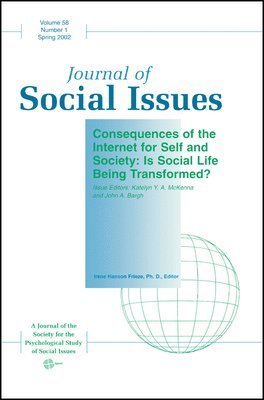
    Consequences of the Internet for Self and Society

    Is Social Life Being Transformed?

    AvMcKenna,Bargh JA

    Häftad, Engelska, 2002

    Del i serien Journal of Social Issues

    485 kr

    Beställningsvara. Skickas inom 5-8 vardagar. Fri frakt över 249 kr.

    Beskrivning

    The Internet is becoming a primary means of interpersonal communication, and with this comes implications for many aspects of social life. This book examines these from a variety of perspectives: psychological well-being, interpersonal relationships, social identity, group conflict, negotiation and bargaining, community involvement, and the development of democratic institutions. The authors present quantitative as well as qualitative methodological approaches, along with analyses reflecting the complexities of the 'Human-Internet interaction'. Examines the implications of the internet as the primary means of personal communicationPulls together current research by well established researchers on the social consequences of the Internet, from a variety of levels of analysis, producing a holographic, 3-D look at the Internet's impact on psychological functioning of the individual as well as on the social fabricPerspectives of this examination include: psychological well-being, interpersonal relationships, social identity, group conflict, negotiation and bargaining,community involvement, and the development of democratic institutions

    Produktinformation

    • Utgivningsdatum:2002-03-09
    • Mått:157 x 231 x 13 mm
    • Vikt:312 g
    • Format:Häftad
    • Språk:Engelska
    • Serie:Journal of Social Issues
    • Antal sidor:216
    • Förlag:John Wiley and Sons Ltd
    • ISBN:9781405100786

    Utforska kategorier

    • Socialpsykologi och gruppsykologi inom Psykologi och pedagogik
    • Informationsteknik: allmänt inom Data och IT
    • Digital livsstil och datorspel inom Data och IT

    Mer om författaren

    Katelyn Y. A. McKenna holds a PhD and is a Research Professor in the Department of Psychology, New York University. She received her B.A. with honors from Tulane University, and her PhD from Ohio University in 1998. Her research interests focus on relationship cognition and social identity processes, especially as these unfold over the Internet.John A. Bargh holds a PhD and is a Professor in the Department of Psychology, New York University. He received his Bachelors summa cum laude from University of Illinois in 1977, Ph.D. in Social Psychology from University of Michigan in 1981. Since 1981 he has been on the faculty of the New York University Psychology Department. He is the editor of four books, including Unintended Thought (Guilford, 1989), Psychology of Action (Guilford, 1996), The Use and Abuse of Power(Psychology Press, 2001), and Unraveling the Complexities of Social Life: A Festschrift in Honor of Robert B. Zajonc (American Psychological Association, 2001). His research focuses mainly on the role of nonconscious influences on emotion, judgment, and social behavior. He is a recipient of the Early Career Contribution Award from the American Psychological Association and a John Simon Guggenheim Memorial Foundation fellowship.

    Innehållsförteckning

    • Part I: Introduction:. 1. Introduction to the issue: John A. Bargh, Department of Psychology, New York University.Part II: The Internet and the Individual:.2.Relationship Formation on the Internet: What's the Big Attraction?: Katelyn Y. A. McKenna, Amie S. Green, & Marci E. J. Gleason, Department of Psychology, New York University.3. Can You See the Real Me? Activation and Expression of the ‘True self' on the Internet: John A. Bargh, Katelyn Y. A. McKenna, & Grainne M. Fitzsimons, Department of Psychology, New York University.4. Internet Paradox Revisited: Robert Kraut, Sara Kiesler, Bonka Boneva, Jonathon Cummings, Vicki Helgeson, & Anne Crawford, Department of Human-Computer.Interaction, Carnegie-Mellon University.5. Internet Use and Well-Being in Adolescence: Elisheva F. Gross, Jaana Juvonen, & Shelly L. Gable, Department of Psychology, University of California – Los Angeles.Part III: The Internet and the Organization:.6.When are Net Effects Gross Products? The Power of Influence and the Influence of Power in Computer-Mediated Communication: Russell Spears & Tom Postmes, Department of Social Psychology, University of Amsterdam; Martin Lea, Department of Psychology, Manchester University; Anka Wolbert, Department of Social Psychology, University of Amsterdam.7. Negotiating via Information Technology: Theory and Application: Leigh Thompson, Kellogg Graduate School of Business, Northwestern University, Janice Nadler, Northwestern University and American Bar Foundation.Part IV: The Internet and Government:.8.Civic Culture Meets the Digital Divide: The Role of Community: Electronic Networks: Eugene Borgida, John L. Sullivan, Alina Oxendine, Melinda S. Jackson, Eric Riedel, & Amy Gangl, Departments of Law and Psychology, University of Minnesota.9. Dark Guests and Great Firewalls: The Internet and Chinese Security Policy: Ronald J. Deibert, Department of Political Science, University of Toronto.Part V: Methodological Techniques and Issues:.10.eResearch: Ethics, Security, Design, and Control in Psychological Research on the Internet: Brian Nosek & Mahzarin R. Banaji, Department of Psychology, Yale University, Anthony G. Greenwald, Department of Psychology, University of Washington.11. Studying Hate Crime with the Internet: What Makes Racists Advocate Racial Violence? Jack Glaser & Jay Dixit, Goldman School of Public Policy, University of California – Berkeley; Donald Green, Department of Political Science, Yale University.Part VI: Concluding Perspective:.12.Is the Internet Changing Social Life? It Seems the More Things Change, the More They Stay the Same: Tom R. Tyler: Department of Psychology, New York University.