• Fri frakt över 249 kr
  • •
  • Snabba leveranser
  • •
  • Billiga böcker
Kundservice

Du är på sajten för privatpersoner.

Företag, bibliotek eller offentlig verksamhet?

Du handlar på classic.bokus.com, där alla dina funktioner finns intakta.
Till classic.bokus.com
Bokus logotyp. Gå till startsidan.
  • Erbjudanden
  • Nyheter
  • Student
  • Topplistor
  • Barn & ungdom
  • Bokus Play
  • E-böcker
  • Pocketböcker
  • Spel & pussel

10% studentrabatt med kod TERM26

Sidfot

Mina sidor

    Hjälp

    • Kundservice
    • Vanliga frågor och svar
    • Frakt och leverans
    • Retur vid ångerrätt
    • Reklamera vara
    • Betalning
    • Köpvillkor
    • Allmänna villkor
    • Information om webbplatsens tillgänglighet

    Om Bokus

    • Om oss
    • Pressrum
    • För studenter
    • För företag
    • För bibliotek och offentlig verksamhet
    • För leverantörer
    • Hållbarhet

    Populärt

    • Aktuella erbjudanden
    • Presentkort
    • Studentlitteratur
    • Nya böcker
    • Topplistor
    • Signerade böcker
    • Engelska böcker

    Inspiration

    • Boktips
    • BookTok
    • Populära bokserier
    • Barnbokskaraktärer
    • Populära författare
    Logotyp för Bokus
    Följ oss på Facebook (extern länk)Följ oss på Instagram (extern länk)Följ oss på YouTube (extern länk)Följ oss på TikTok (extern länk)
    bokus @ CookiesAnpassa cookiesIntegritetspolicyKöpvillkor
    Till Citymail hemsida (extern länk)Till Budbee hemsida (extern länk)Till Postnord hemsida (extern länk)Till Schenker hemsida (extern länk)Till Early Bird hemsida (extern länk)Till Walleys hemsida (extern länk)
    1. Kultur
    2. Arkitektur

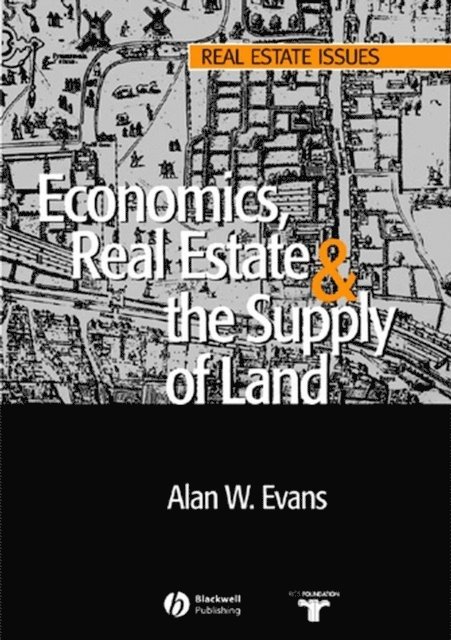
    Economics, Real Estate and the Supply of Land

    AvAlan W. Evans

    Häftad, Engelska, 2004

    Del 23 i serien Real Estate Issues

    1 635 kr

    Beställningsvara. Skickas inom 5-8 vardagar. Fri frakt över 249 kr.

    Fler format och utgåvor

    E-bok

    1 901 kr

    Beskrivning

    The book draws together the economic literature relating to the supply of land for development. The standard view appears to be that the owners of land have no interest other than to allow their land to be used for the activity which would yield the highest income. But in reality this is not so and the book's aim is to demonstrate this, to set out the reasons and to show the economic effects of the fact that landowners have other motives. The book covers the supply of land for urban development and shows how land has characteristics which differentiate it from other factors of production which will also affect its supply for some uses, e.g. land is fixed in location and its price and value are inseparable from where it is.New light is cast on the market for land (by concentrating on the supply side), and on land use planning (by taking an economic viewpoint).

    Produktinformation

    • Utgivningsdatum:2004-05-26
    • Mått:173 x 244 x 15 mm
    • Vikt:472 g
    • Format:Häftad
    • Språk:Engelska
    • Serie:Real Estate Issues
    • Antal sidor:276
    • Förlag:John Wiley and Sons Ltd
    • ISBN:9781405118620

    Utforska kategorier

    • Arkitektur inom Kultur

    Mer om författaren

    Alan Evans, Professor of Environmental Economics, Centre for Spatial and Real Estate Economics, School of Business, University of Reading

    Recensioner i media

    Excellent in the way it brings together in a coherent whole, various approaches to the analysis of the supply of land for development. The issues covered are pertinent for both practitioners and academics in providing a useful theoretical framework based on sound economics. The book is well written and enjoyable to read. Journal of Property Investment and Finance, September 2005. 'This is an ambitious and important contribution to the literature on the economic theory of land markets. I see this book as an outstanding contribution to urban economics.' Land Economics

    Innehållsförteckning

    • Chapter 1: Introduction: The Market for Land and Property. The supply of land.The demand for land.The development of a theory of the supply of land.Chapter 2: Land Values, Rents and Demand.Introduction.Ricardian rent theory.Neoclassical rent theory.Ricardian theory remembered.Planning controls and rent theory.Hierarchical planning systems.Urban rent theory.Rents, economic and commercial.Summary and conclusion.Chapter 3: Coping with Changes in Demand.Introduction.The extensive margins.The intensive margin.Capital longevity and the asymmetry of change.The process of change in the housing market.Summary and conclusions.Chapter 4: How Efficient is the Property Market?.Introduction.The economic concept of efficiency.Efficient markets.The evidence.Tests of market efficiency.Conclusions.Chapter 5: Market Inefficiency: Causes and Consequences.Introduction.Why the property market is imperfect and inefficient.Price determination and the theory of the core.The consequences.Conclusions.Chapter 6: The Supply of Land for a Particular Use: Speculation and Uncertainty.Introduction.Speculation.Uncertainty.Summary and conclusion.Chapter 7: The Supply of Land for a Particular Use: Occupier Performances and Residential Attachment.Introduction.Owner occupier attachment.Some empirical evidence.Summary and conclusions.Chapter 8: The Ownership of Land.Introduction.Tenants, owner occupiers, and the supply of land.Ownership and change.Summary and conclusions.Chapter 9: Land Ownership, Politics and Society.Introduction.Society and the ownership of land.Alternative forms of ownership and tenancy.A libertarian view.Summary.Chapter 10: Ownership and Control: Monopoly.Introduction.Monopoly rents and wine production.Monopoly rents and shopping centres.Summary and conclusions.Chapter 11: Ownership and Control: Minimum Rents.Introduction.Minimum rents.Minimum rents in an urban environment.Summary and conclusions.Chapter 12: Information, Uncertainty and the Property Market.Introduction.Modelling the search for information.Searching for housing in practice.The housing market.The developer and land supply restriction.Summary and conclusions.Chapter 13: Land Availability and Land Banking.Introduction.Land availability.Land banking by private firms.Public land banking.Summary and conclusions.Chapter 14: Contiguity: Site Assembly.Introduction.A game theory approach.A question of time.Conclusion.Chapter 15: Contiguity: Compulsory Purchase and the Scale of Development.Introduction.Compulsory purchase and the speed of acquisition.Scale economies, acquisition costs, and history.Summary and conclusion.Chapter 16: Contiguity: Land Reallocation and the Price of Land.Introduction.Land reallocation or adjustment.Size of site and the price of land.Summary and conclusions.Chapter 17: The Taxation of Land and Development Gains.Introduction.The undeserving landowner.Betterment.Economic theory and taxes on development.Land taxation in recent British history.Summary and conclusions.Chapter 18: Annual Taxation and the Nationalisation of Land.Introduction.Property taxes and the rates.Site value taxation.Land nationalisation.Summary and conclusions.Chapter 19: Themes and Changes in Perception.Recapitulation.Coda