• Fri frakt över 249 kr
  • •
  • Snabba leveranser
  • •
  • Billiga böcker
Kundservice

Du är på sajten för privatpersoner.

Företag, bibliotek eller offentlig verksamhet?

Du handlar på classic.bokus.com, där alla dina funktioner finns intakta.
Till classic.bokus.com
Bokus logotyp. Gå till startsidan.
  • Erbjudanden
  • Nyheter
  • Student
  • Topplistor
  • Barn & ungdom
  • Bokus Play
  • E-böcker
  • Pocketböcker
  • Spel & pussel

10% rabatt på allt med kod: NYSTART10 →

Sidfot

Mina sidor

    Hjälp

    • Kundservice
    • Vanliga frågor och svar
    • Frakt och leverans
    • Retur vid ångerrätt
    • Reklamera vara
    • Betalning
    • Köpvillkor
    • Allmänna villkor
    • Information om webbplatsens tillgänglighet

    Om Bokus

    • Om oss
    • Pressrum
    • För studenter
    • För företag
    • För bibliotek och offentlig verksamhet
    • För leverantörer
    • Hållbarhet

    Populärt

    • Aktuella erbjudanden
    • Presentkort
    • Studentlitteratur
    • Nya böcker
    • Topplistor
    • Signerade böcker
    • Engelska böcker

    Inspiration

    • Boktips
    • BookTok
    • Populära bokserier
    • Barnbokskaraktärer
    • Populära författare
    Logotyp för Bokus
    Följ oss på Facebook (extern länk)Följ oss på Instagram (extern länk)Följ oss på YouTube (extern länk)Följ oss på TikTok (extern länk)
    bokus @ CookiesAnpassa cookiesIntegritetspolicyKöpvillkor
    Till Citymail hemsida (extern länk)Till Budbee hemsida (extern länk)Till Postnord hemsida (extern länk)Till Schenker hemsida (extern länk)Till Early Bird hemsida (extern länk)Till Walleys hemsida (extern länk)
    1. Skönlitteratur
    2. Litteraturvetenskap

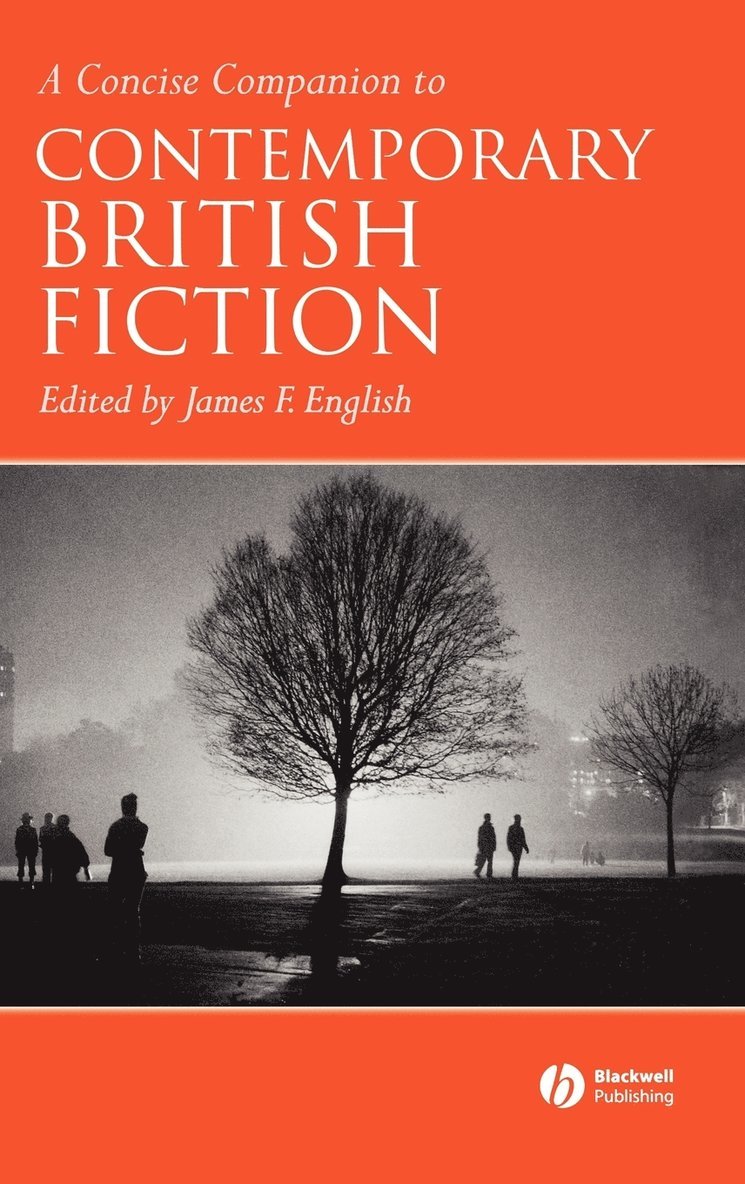
    Concise Companion to Contemporary British Fiction

    AvENGLISH,James F. English

    Inbunden, Engelska, 2005

    Del i serien Concise Companions to Literature and Culture

    1 715 kr

    Beställningsvara. Skickas inom 5-8 vardagar. Fri frakt över 249 kr.

    Fler format och utgåvor

    Häftad

    556 kr

    Beskrivning

    A Concise Companion to Contemporary British Fiction offers an authoritative overview of contemporary British fiction in its social, political, and economic contexts. Focuses on the fiction that has emerged since the late 1970s, roughly since the start of the Thatcher era.Comprises original essays from major scholars.Topics range from the rise and fall of the postcolonial novel to controversies over the celebrity author.The emphasis is on the whole fiction scene, from bookstores and prizes to the changing economics of film adaptation.Enables students to read contemporary works of British fiction with a much clearer sense of where they fit within British cultural life.

    Produktinformation

    • Utgivningsdatum:2005-12-02
    • Mått:200 x 250 x 15 mm
    • Vikt:567 g
    • Format:Inbunden
    • Språk:Engelska
    • Serie:Concise Companions to Literature and Culture
    • Antal sidor:304
    • Förlag:John Wiley and Sons Ltd
    • ISBN:9781405120005

    Utforska kategorier

    • Litteraturvetenskap inom Skönlitteratur
    • Litteraturvetenskap inom Skönlitteratur

    Mer om författaren

    James F. English is Professor and Chair of the English Department at the University of Pennsylvania. He is the author of Comic Transactions: Literature, Humor, and the Politics of Community in Twentieth-Century Britain (1994) and The Economy of Prestige: Prizes, Awards, and the Circulation of Cultural Value (2005).

    Recensioner i media

    "Blackwell's new Companion to contemporary British fiction is a delight to review. It delivers on its promises to be innovative, highly readable, lively and topical, and it warrants wholehearted endorsement as an essenital addition to any library that is seriously developing resources for undergraduate and taught postgraduate study."Reference Reviews "James English's companion contains a series of fresh, lively and insightful readings of the key figures in post-war British fiction from Martin Amis to Zadie Smith. Its coverage of the multiple, changing contexts - from globalization and the 'new ethnicities' to the rise of book groups and online retailing - in which that fiction is produced and consumed is generously wide-ranging and satisfyingly informative. This is an authoritative and approachable book." Michael Greaney, Lancaster University “James English's A Concise Companion to Contemporary British Fiction is a valuable addition to discussions of recent writing. The essays collected here are wide-ranging, well-informed, and critically astute. This book will make a strong contribution to our understanding of the contemporary British novel.” Andrzej Gasiorek, University of Birmingham

    Innehållsförteckning

    • Notes on Contributors ixIntroduction: British Fiction in a Global Frame 1James F. English The increasing importance since the 1970s of transnational markets and circuits of exchange, and the consequent repositioning of British fiction in “world literary space.”Part I Institutions of Commerce1 Literary Fiction and the Book Trade 19Richard Todd The triangulated relation between (i) authors and agents, (ii) publishers, and (iii) retail booksellers, andthe rise of the retailers to a position of dominance.2 Literary Authorship and Celebrity Culture 39James F. English and John Frow The phenomenon of literary celebrity and its new articulation of the authorial signature with the brandname. Authors considered include Martin Amis, J. K. Rowling, Salman Rushdie, Zadie Smith, and Fay Weldon.3 Fiction and the Film Industry 58Andrew Higson The interaction of contemporary British literature and the cinema, considered as both businesses andcultures. Discusses the full range of novels adapted for the screen, with an extended case study of theadaptation of A. S. Byatt’s Possession.Part II Elaborations of Empire4 Tropicalizing London: British Fiction and the Discipline of Postcolonialism Nico Israel 83The emergence of postcolonial theory and, subsequently, of a canon of postcolonial novels. Discusses such theorists as Homi Bhabha, Stuart Hall, and Paul Gilroy, and the novelists Anita Desai, Hari Kunzru, Hanif Kureishi, V. S. Naipaul, Ben Okri, and Salman Rushdie.5 New Ethnicities, the Novel, and the Burdens of Representation 101James Procter The shifting relationship between race, writing, and representation from the late 1970s to the present, with particular reference to the work of Monica Ali, Farrukh Dhondy, Hanif Kureishi, Salman Rushdie, and Zadie Smith.6 Devolving the Scottish Novel 121Cairns Craig Contemporary Scottish fiction in the context of Scottish nationalism and the politics of devolution, with reference to the work of Janice Galloway, Alasdair Gray, James Kelman, A. L. Kennedy, and Alan Warner.7 Northern Irish Fiction: Provisionals and Pataphysicians 141John Brannigan How fiction in Northern Ireland has responded to the politics of the interregnum since 1993, with particular attention to the work of Seamus Deane, Glenn Patterson, Deirdre Madden, Robert McLiam Wilson, and Ciaran Carson.Part III Mutations of Form8 The Historical Turn in British Fiction 167Suzanne Keen The rising status of historical fiction in contemporary Britain as more self-consciously “literary” forms of the genre have emerged alongside traditional verisimilar historical novels and women’s historical romances. Among the many authors discussed are A. S. Byatt, Bernadine Evaristo, Hilary Mantel, Craig Raine, Salman Rushdie, and Edmund White.9 The Woman Writer and the Continuities of Feminism 188Patricia Waugh The persistent concerns and contradictions in women’s fiction since the 1960s, with reference to Angela Carter, Margaret Drabble, Helen Fielding, Doris Lessing, Iris Murdoch, and Fay Weldon.10 Queer Fiction: The Ambiguous Emergence of a Genre 209Robert L. Caserio The consolidation of queer fiction as a recognized and important literary category in Britain, and the ongoing tension between this body of literature and the politics of gay rights and gay identity. Writers considered include Pat Barker, Neil Bartlett, Alan Hollinghurst, Jackie Kay, Adam Mars-Jones, Colm Toibin, and Jeanette Winterson.11 The Demise of Class Fiction 229Dominic Head The waning of class consciousness in British fiction as the traditional, adversarial model of class has given way to new understandings both of social inequity and of collective empowerment. With reference to a range of writers, including Nell Dunn, Livi Michael, Alan Sillitoe, and Raymond Williams.12 What the Porter Saw: On the Academic Novel 248Bruce Robbins The academic novel considered as a disguised version of the upward mobility story, with the university serving as a figure for the welfare state, the frame in which the ambiguities of upward mobility are played out. Focuses on the novels of Kingsley Amis, Malcolm Bradbury, A. S. Byatt, Amit Chaudhuri, and David Lodge.Index 267