• Fri frakt över 249 kr
  • •
  • Snabba leveranser
  • •
  • Billiga böcker
Kundservice

Du är på sajten för privatpersoner.

Företag, bibliotek eller offentlig verksamhet?

Du handlar på classic.bokus.com, där alla dina funktioner finns intakta.
Till classic.bokus.com
Bokus logotyp. Gå till startsidan.
  • Erbjudanden
  • Nyheter
  • Student
  • Topplistor
  • Barn & ungdom
  • Bokus Play
  • E-böcker
  • Pocketböcker
  • Spel & pussel

10% rabatt på allt med kod: NYSTART10 →

Sidfot

Mina sidor

    Hjälp

    • Kundservice
    • Vanliga frågor och svar
    • Frakt och leverans
    • Retur vid ångerrätt
    • Reklamera vara
    • Betalning
    • Köpvillkor
    • Allmänna villkor
    • Information om webbplatsens tillgänglighet

    Om Bokus

    • Om oss
    • Pressrum
    • För studenter
    • För företag
    • För bibliotek och offentlig verksamhet
    • För leverantörer
    • Hållbarhet

    Populärt

    • Aktuella erbjudanden
    • Presentkort
    • Studentlitteratur
    • Nya böcker
    • Topplistor
    • Signerade böcker
    • Engelska böcker

    Inspiration

    • Boktips
    • BookTok
    • Populära bokserier
    • Barnbokskaraktärer
    • Populära författare
    Logotyp för Bokus
    Följ oss på Facebook (extern länk)Följ oss på Instagram (extern länk)Följ oss på YouTube (extern länk)Följ oss på TikTok (extern länk)
    bokus @ CookiesAnpassa cookiesIntegritetspolicyKöpvillkor
    Till Citymail hemsida (extern länk)Till Budbee hemsida (extern länk)Till Postnord hemsida (extern länk)Till Schenker hemsida (extern länk)Till Early Bird hemsida (extern länk)Till Walleys hemsida (extern länk)
    1. Ekonomi och Ledarskap
    2. Företagsekonomi
    3. Affärsstrategi

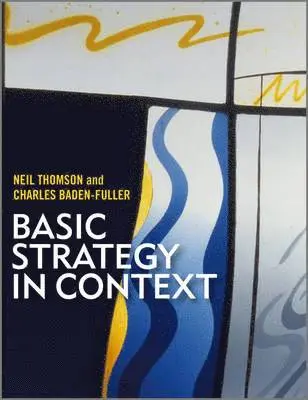
    Basic Strategy in Context

    European Text and Cases

    AvNeil Thomson,Charles Baden-Fuller

    Häftad, Engelska, 2010

    403 kr

    Tillfälligt slut

    Beskrivning

    Basic Strategy in Context centres on real-world firms and managers by giving each chapter’s cases a higher weighting in importance and explanation than is normal. Given this emphasis on real-world as opposed to theoretical treatment the book enables the solving of practical business problems like those below. This emphasis on reality is cemented by the book’s treatment of diversity as being the norm highlighted through European business cases from different countries. Giving example answers and links from case to theory rams home further the expected usefulness of the book to students about to enter industry. Often theory and cases are treated as different and separated topics; we believe that our integrated didactic treatment is quite unique. Finally we use the basic theories of strategy and then show how these mainly simple concepts can be extended to solve tricky business problems anywhere in any industry. Here is a sample of specific practical problems to which this book can show solutions:Why are resources important and how are they leveraged? Using the case of a British failure (Railtrack) we show the fatal consequences of neglecting existing resources, and then in a completely different country and industry (Carlo Gavazzi Space in Italy) how resources can be utilised from outside the firm to achieve leverage.Given our emphasis on diversity we highlight successful change in a foreign and inflexible environment (Japan and Carlos Ghosn). But can change be planned? Sometimes events or luck sabotage the best intentions as shown in the Samsung case.The book differentiates itself from the competition in four ways: Cases form the highlight of the book. Taking European and some international cases as the starting point, the objective is to link themes or topics to a description of their effect on the firm. The linkage will occur at the relevant point in the case, not in a separate section or in another book. The author team has used several longitudinal cases spread over a 15-20 year period. The longitudinal cases are supported by some new, non-longitudinal cases selected from award winning cases associated with the LRP Journal and the Gate2Growth Academic Network. We feel such an emphasis on cases is a novel feature.The theory is explained using a range of modern didactic methods not usually found in competitive offerings. Examples include colour coded and highlighted links from the theory to the case, questions inside each theory section with model answers and unanswered questions to test the student’s grasp of the concepts.The book features a mixture of cases from short specific to academically challenging ones. Too often, superficial cases are placed at the end of chapters in strategy theory books. They are picked to emphasize the topics of the preceding chapters. The result is spoon-feeding, with little need or motivation to provoke individual thought or learning. The cases in this book are comprehensive, approximately 20 pages in length, with ample quantitative and qualitative data, thus forcing a modicum of effort from the student.  Shorter cases are also included for ease of understanding and instructor flexibility.Another differentiating feature is the emphasis on diversity hence the use of European as opposed to US based cases.

    Produktinformation

    • Utgivningsdatum:2010-03-19
    • Mått:188 x 246 x 24 mm
    • Vikt:794 g
    • Format:Häftad
    • Språk:Engelska
    • Antal sidor:422
    • Upplaga:1
    • Förlag:John Wiley and Sons Ltd
    • ISBN:9781405161084

    Utforska kategorier

    • Affärsstrategi inom Ekonomi och Ledarskap

    Mer om författaren

    Although Prof. Neil Thomson has been Professor of International Business at the University of Applied Sciences, Nürnberg, Germany since 1999 and lived in Germany from the early 1980s, he is British by birth. He has a PhD from City University in London, MBA from Cornell University, USA, and a BSc from Bradford University, GB. He has extensive industrial experience in the oil industry and consulting, as well as a spell working for the US Government as a financial controller. He has several articles published in the LRP journal.Prof. Charles Baden-Fuller is Centenary Professor of Strategic Management at the Cass Business School, City University London. He is Editor-in-Chief of the LRP journal and a member of the European Academy of Management EURAM. He is author of many influential journal articles and co-author of Rejuvenating the Mature Business and Strategic Innovation.

    Innehållsförteckning

    • Chapter 1 Introduction 1.1 Introduction1.2 For the student: how to use the book1.3 For the lecturer: resources1.4 Introductory case: learning goals and objectives1.5 Preliminary concepts1.6 Trial case: Abrakebabra1.7 Keyed links between case and example answersChapter 2 What is Strategy?2.1 Introduction, learning goals and objectives2.2 Preliminary concepts including a working definition of business strategy2.3 Mini case: Mannesmann2.4 Discussion of mini case2.5 Main case: Fionia Bank – a regional savings bank from Denmark2.6 Case analysis and theory section2.7 Further student tasks and example answersChapter 3 Analysing the Internal Environment3.1 Introduction, learning goals and objectives3.2 Preliminary concepts3.3 Mini case: Railtrack Plc3.4 Discussion of mini case3.5 Main case: Carlo Gavazzi Space3.6 Case analysis and theory section3.7 Further student task and example answerChapter 4 The External Environment4.1 Introduction, learning goals and objectives4.2 Preliminary concepts4.3 Mini case: José Bové – French resistance against “malbouffe”4.4 Discussion of mini case4.5 Main case: Your Cup of Tea in Budapest4.6 Case analysis and theory section4.7 Further student tasks and example answersChapter 5 Stakeholders and Corporate Governance5.1 Introduction, learning goals and objectives5.2 Preliminary concepts5.3 Mini case: Shell Brent Spar5.4 Discussion of mini case5.5 Main case: the DaimlerChrysler takeover5.6 Case analysis and theory section5.7 Further student tasksChapter 6 Ethics6.1 Introduction, learning goals and objectives6.2 Preliminary concepts6.3 Mini case: Marta Andreasen EU whistleblower6.4 Discussion of mini case6.5 Main case: Shell shock – why do good companies do bad things?6.6 Case analysis and theory6.7 Further student tasksChapter 7 Strategic Direction7.1 Introduction, learning goals and objectives7.2 Preliminary concepts7.3 Mini case: Samsung Motors Inc.7.4 Discussion of mini case7.5 Main case: GKN7.6 Case analysis and theory section7.7 Further student tasksChapter 8 Focus – Differentiation or Low Cost8.1 Introduction, learning goals and objectives8.2 Preliminary concepts8.3 Mini case: Swatch8.4 Discussion of mini case8.5 Main case: Ryanair – the low fares airline8.6 Case analysis and theory section8.7 Further student tasksChapter 9 Change9.1 Introduction, learning goals and objectives9.2 Preliminary concepts9.3 Mini case: PUMA9.4 Discussion of mini case9.5 Main case: Chiquita Bananas (CBI)9.6 Case analysis and theory section9.7 Further student tasksChapter 10 Mergers and Acquisitions10.1 Introduction, learning goals and objectives10.2 Preliminary concepts10.3 Mini case: Singcontrol10.4 Discussion of mini case10.5 Main case: Santander is coming to town – the acquisition of Abbey National by Grupo Santander10.6 Case analysis and theory section10.7 Further student tasksChapter 11 Control11.1 Introduction, learning goals and objectives11.2 Preliminary concepts11.3 Mini case: Nick Leeson11.4 Discussion of mini case11.5 Main case: Abrakebabra from Ireland11.6 Case analysis and theory section11.7 Further student tasksChapter 12 Knowledge and the Learning Organisation12.1 Learning goals and objectives12.2 Introduction12.3 Mini case: the Beer Game12.4 Discussion of mini case12.5 Main case: Siemens ShareNet – five steps to creating a global knowledge-sharing system12.6 Case analysis and theory section12.7 Further student tasksChapter 13 Innovation and Corporate Entrepreneurship13.1 Introduction, learning goals and objectives13.2 Preliminary concepts13.3 Mini case: Unilever Liquid Gold – innovation on a European scale13.4 Discussion of mini case13.5 Main case: UniBrew – how do established companies deal with radical innovation projects?13.6 Case analysis and theory section13.7 Further student tasksChapter 14 Culture14.1 Introduction, learning goals and objectives14.2 Preliminary concepts14.3 Mini case: Starbucks in France14.4 Discussion of mini case14.5 Main case: goodbye Deutschland – a case study of Wal-Mart’s failure in Germany – everyday low crisis14.6 Case analysis and theory section14.7 Further student tasksChapter 15 Leadership15.1 Introduction, learning goals and objectives15.2 Preliminary concepts15.3 Mini case: Alain Perrin and Cartier15.4 Discussion of mini case15.5 Main case: Carlos Ghosn and Nissan15.6 Case analysis and theory section15.7 Further student tasksChapter 16 Integrative Case16.1 Learning goals and objectives16.2 Introduction16.3 Main case: Samsung16.4 Case analysis with Questions around main topics of the preceding chapters with model answers16.5 Further student tasksIndex