• Fri frakt över 249 kr
  • •
  • Snabba leveranser
  • •
  • Billiga böcker
Kundservice

Du är på sajten för privatpersoner.

Företag, bibliotek eller offentlig verksamhet?

Du handlar på classic.bokus.com, där alla dina funktioner finns intakta.
Till classic.bokus.com
Bokus logotyp. Gå till startsidan.
  • Erbjudanden
  • Nyheter
  • Student
  • Topplistor
  • Barn & ungdom
  • Bokus Play
  • E-böcker
  • Pocketböcker
  • Spel & pussel

10% rabatt på allt med kod NYSTART10 →

Sidfot

Mina sidor

    Hjälp

    • Kundservice
    • Vanliga frågor och svar
    • Frakt och leverans
    • Retur vid ångerrätt
    • Reklamera vara
    • Betalning
    • Köpvillkor
    • Allmänna villkor
    • Information om webbplatsens tillgänglighet

    Om Bokus

    • Om oss
    • Pressrum
    • För studenter
    • För företag
    • För bibliotek och offentlig verksamhet
    • För leverantörer
    • Hållbarhet

    Populärt

    • Aktuella erbjudanden
    • Presentkort
    • Studentlitteratur
    • Nya böcker
    • Topplistor
    • Signerade böcker
    • Engelska böcker

    Inspiration

    • Boktips
    • BookTok
    • Populära bokserier
    • Barnbokskaraktärer
    • Populära författare
    Logotyp för Bokus
    Följ oss på Facebook (extern länk)Följ oss på Instagram (extern länk)Följ oss på YouTube (extern länk)Följ oss på TikTok (extern länk)
    bokus @ CookiesAnpassa cookiesIntegritetspolicyKöpvillkor
    Till Citymail hemsida (extern länk)Till Budbee hemsida (extern länk)Till Postnord hemsida (extern länk)Till Schenker hemsida (extern länk)Till Early Bird hemsida (extern länk)Till Walleys hemsida (extern länk)
    1. Data och IT
    2. Informationsteknik: allmänt

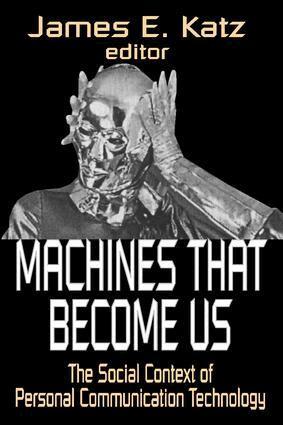
    Machines That Become Us

    The Social Context of Personal Communication Technology

    AvJames E. Katz,James E. Katz

    Häftad, Engelska, 2006

    766 kr

    Beställningsvara. Skickas inom 10-15 vardagar. Fri frakt över 249 kr.

    Fler format och utgåvor

    Inbunden

    1 762 kr

    E-bok

    906 kr

    E-bok

    908 kr

    Beskrivning

    Social critics and artificial intelligence experts have long prophesized that computers and robots would soon relegate humans to the dustbin of history. Many among the general population seem to have shared this fear of a dehumanized future. But how are people in the twenty-first century actually reacting to the ever-expanding array of gadgets and networks at their disposal? Is computer anxiety a significant problem, paralyzing and terrorizing millions, or are ever-proliferating numbers of gadgets being enthusiastically embraced? Machines that Become Us explores the increasingly intimate relationship between people and their personal communication technologies.In the first book of its kind, internationally recognized scholars from the United States and Europe explore this topic. Among the technologies analyzed include the Internet, personal digital assistants (PDAs), mobile phones, networked homes, "smart" fabrics and wearable computers, interactive location badges, and implanted monitoring devices. The authors discuss critical policy issues, such as the problems of information resource access and equity, and the recently discovered "digital dropouts" phenomena.The use of the word "become" in the book's title has three different meanings. The first suggests how people use these technologies to broaden their abilities to communicate and to represent themselves to others. Thus the technologies "become" extensions and representatives of the communicators. A second sense of "become" applies to analysis of the way these technologies become physically integrated with the user's clothing and even their bodies. Finally, contributors examine fashion aspects and uses of these technologies, that is, how they are used in ways becoming to the wearer. The conclusions of many chapters are supported by data, including ethnographic observations, attitude surveys and case studies from the United States, Britain, France, Italy, Finland, and Norway. This approach is especially valuable given the dearth of empirical studies in a field that has been traditionally dominated by extrapolation and speculation, and that has focused on possible future states rather than analysis of current situations. Other chapters are integrative, seeking to advance emerging theoretical perspectives.This exciting volume generates new insights concerning the burgeoning electronic confusion that increasingly penetrates and blurs the boundaries of various spheres of life in modern society. Machines That Become Us will be of interest to students of communications and technology, sociologists, and social psychologists.

    Produktinformation

    • Utgivningsdatum:2006-09-30
    • Mått:152 x 229 x 21 mm
    • Vikt:589 g
    • Format:Häftad
    • Språk:Engelska
    • Antal sidor:348
    • Förlag:Taylor & Francis Inc
    • ISBN:9781412806213

    Utforska kategorier

    • Informationsteknik: allmänt inom Data och IT
    • Naturvetenskap:allmänt inom Naturvetenskap och teknik

    Recensioner i media

    "A valuable addition to our growing understanding of the wide-ranging implications of new technologies.... Machines That Become Us offers a rich compendium of insights into why we think new machines both 'improve' and 'jumble' our lives." - Steve Woolgar, Chair of Marketing, Said Business School, University of Oxford "Machines That Become Us is very much focused on the empirical understanding of information technologies. This kind of work is sorely needed as such technologies become more and more present in everyday life. James Katz is to be commended for putting together a highly successful volume." - Mark Poster, professor of history, University of California, Irvine "Machines That Become Us represents a major interdisciplinary work.... The process of machines 'becoming us' no longer can be left to cognitive or computer sciences alone, but needs a deep, global view focusing on social practices, including everyday changes in human life; that is what Katz's book does with theoretical passion." - Patrizia Calefato, professor, Dipartimento di Pratiche linguistiche e analisi di testi, Universita degli studi di Bari"

    Innehållsförteckning

    • 1: Introduction; 1: Theoretical Perspectives; 2: Do Machines Become Us?; 3: Understanding Information and Communication Technology and Infrastructure in Everyday Life: Struggling with Communication-at-a-Distance; 4: Domestication and Mobile Telephony; 5: Communication Technology and Sociability: Between Local Ties and “Global Ghetto”?; 6: The Human Body: Natural and Artificial Technology; 2: National and Cross-Cultural Studies; 7: Digital Divides of the Internet and Mobile Phone: Structural Determinants of the Social Context of Communication Technologies; 8: Social Capital and the New Communication Technologies; 9: Information and Communication Technology in Russian Families: Results of Sociological Research; 10: Face and Place: The Mobile Phone and Internet In the Netherlands; 11: Computer Anxiety Among “Smart” Dutch Computer Users; 12: The Social Context of the Mobile Phone Use of Norwegian Teens; 13: Two Modes of Maintaining Interpersonal Relations Through Telephone: From the Domestic to the Mobile Phone; 14: Culture and Design for Mobile Phones for China; 3: Subcultures, Technologies, and Fashion; 15: Outwardly Mobile: Young People and Mobile Technologies; 16: Breaking Time and Place: Mobile Technologies and Reconstituted Identities; 17: Crossbreeding Wearable and Ubiquitous Computing: A Design Experience; 18: Mobile Telephony, Mobility, and the Coordination of Everyday Life; 19: Soft Machine; 20: Aesthetics in Microgravity; 21: Piercings Tattoos, and Branding: Latent and Profound Reasons for Body Manipulations; 22: “Perhaps It is a Body Part”: How the Mobile Phone Became an Organic Part of the Everyday Lives of Finnish Children and Teenagers; Coda; 23: Bodies, Machines, and Communication Contexts: What is to Become of Us?