• Fri frakt över 249 kr
  • •
  • Snabba leveranser
  • •
  • Billiga böcker
Kundservice

Du är på sajten för privatpersoner.

Företag, bibliotek eller offentlig verksamhet?

Du handlar på classic.bokus.com, där alla dina funktioner finns intakta.
Till classic.bokus.com
Bokus logotyp. Gå till startsidan.
  • Erbjudanden
  • Nyheter
  • Student
  • Topplistor
  • Barn & ungdom
  • Bokus Play
  • E-böcker
  • Pocketböcker
  • Spel & pussel

10% rabatt på allt med kod: NYSTART10 →

Sidfot

Mina sidor

    Hjälp

    • Kundservice
    • Vanliga frågor och svar
    • Frakt och leverans
    • Retur vid ångerrätt
    • Reklamera vara
    • Betalning
    • Köpvillkor
    • Allmänna villkor
    • Information om webbplatsens tillgänglighet

    Om Bokus

    • Om oss
    • Pressrum
    • För studenter
    • För företag
    • För bibliotek och offentlig verksamhet
    • För leverantörer
    • Hållbarhet

    Populärt

    • Aktuella erbjudanden
    • Presentkort
    • Studentlitteratur
    • Nya böcker
    • Topplistor
    • Signerade böcker
    • Engelska böcker

    Inspiration

    • Boktips
    • BookTok
    • Populära bokserier
    • Barnbokskaraktärer
    • Populära författare
    Logotyp för Bokus
    Följ oss på Facebook (extern länk)Följ oss på Instagram (extern länk)Följ oss på YouTube (extern länk)Följ oss på TikTok (extern länk)
    bokus @ CookiesAnpassa cookiesIntegritetspolicyKöpvillkor
    Till Citymail hemsida (extern länk)Till Budbee hemsida (extern länk)Till Postnord hemsida (extern länk)Till Schenker hemsida (extern länk)Till Early Bird hemsida (extern länk)Till Walleys hemsida (extern länk)
    1. Samhälle och politik
    2. Samhälle och kultur
    3. Kultur och medier
    4. Referensverk och tvärvetenskap

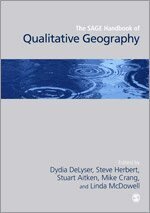
    The SAGE Handbook of Qualitative Geography

    AvDydia DeLyser,Steve Herbert

    Inbunden, Engelska, 2009

    3 266 kr

    Beställningsvara. Skickas inom 3-6 vardagar. Fri frakt över 249 kr.

    Beskrivning

    Exploring the dynamic growth, change, and complexity of qualitative research in human geography, The SAGE Handbook of Qualitative Geography brings together leading scholars in the field to examine its history, assess the current state of the art, and project future directions.

    "In its comprehensive coverage, accessible text, and range of illustrative studies, past and present, the Handbook has established an impressive new standard in presenting qualitative methods to geographers."
    -
    David Ley, University of British Columbia

    Moving beyond textbook rehearsals of standard issues, the Handbook shows how empirical details of qualitative research can be linked to the broader social, theoretical, political, and policy concerns of qualitative geographers and the communities within which they work. The book is organized into three sections:

    • Part I: Openings engages the history of qualitative geography, and details the ways that research, and the researcher's place within it, are conceptualized within broader academic, political, and social currents.
    • Part II: Encounters and Collaborations describes the different strategies of inquiry that qualitative geographers use, and the tools and techniques that address the challenges that arise in the research process.
    • Part III: Making Sense explores the issues and processes of interpretation, and the ways researchers communicate their results.

    Retrospective as well as prospective in its approach, this is geography's first peer-to-peer engagement with qualitative research detailing how to conceive, carry out and communicate qualitative research in the twenty-first century. Suitable for postgraduate students, academics, and practitioners alike, this is the methods resource for researchers in human geography.

    Produktinformation

    • Utgivningsdatum:2009-11-18
    • Mått:174 x 246 x 33 mm
    • Vikt:970 g
    • Format:Inbunden
    • Språk:Engelska
    • Antal sidor:448
    • Upplaga:1
    • Förlag:SAGE Publications
    • ISBN:9781412919913

    Utforska kategorier

    • Referensverk och tvärvetenskap inom Samhälle och politik

    Mer om författaren

    Dr. Stuart C. Aitken is Professor of Geography and June Burnett Chair at SDSU. He directs the Center for Interdisciplinary Studies of Young People and Space (ISYS). Stuart’s research interests include critical social theory, qualitative methods, children, families and communities. His recent books include The Ethnopoetics of Space and Transformation (Ashgate 2014), The Fight to Stay Put (Verlag 2013), Young People. Border Spaces and Revolutionary Imaginations (Routledge 2011), Qualitative Geographies (Sage 2010) and The Awkward Spaces of Fathering (Ashgate 2009). Stuart has published over 200 papers in academic journals and edited book collections. Mike Crang′s interests lie in the field of cultural geography. He has worked extensively on the relationship of social memory and identity. Within this he focused empirically upon on practices of public and oral history, photography and museums looking especially at examples in the UK and Sweden. This interest feeds into looking at what people make of museums and landscapes and thus the study of tourism more generally. He has an edited collection on this theme that was published in 2009(Cultures of Mass Tourism: Doing the Mediterranean in the Age of Banal Mobilities, edited with Pau Obrador and Penny Travlou, Ashgate) and a previous collection (Tourism: between place and performance, with Simon Coleman, Berghahn 2002) as well as co-editing the journal ′Tourist Studies′ for ten years from its inception. He is currrently working on the intersection of film, photography and tourism - through a case study using Captain Corelli and Cephallonia.From the angle of visual aesthetics and senses of temporality and rhythm, he has become interested in not just issues of preservation and conservation but also their converse -  destruction, dereliction and decay - as a collaborator on the ESRC project ′The Waste of the World′. On this project he has looked at the figuring of global flows through waste - especially ships in the work of differing photographic traditions. He has also explored the creation of wastescapes in (former) industrial sites, on beaches and between places. Subsequent work on the material cultures of waste is attempting to rethink approaches to the commodity through emphasising unbecoming things - that are both distasteful and unstable.He is also interested in more abstract issues regarding time-space, action and temporality and co-edited the journal Time & Society from 1997 to 2006. His interests in this area led to a collection on spatiality and social theory (′Thinking Space′, edited with Nigel Thrift). The other strand to his work is the analysis of transformations of space and time through electronic technologies, with specific work based around Singapore′s ′Wired City′ initiative and the ′digital divide′ in UK cities. He completed an ESRC project on ′Multi-Speed Cities and the Logistics of Daily Life′ with Steve Graham and is now working on the notion of a ′sentient city′ and the politics of new forms of visualisation and locative computing.In terms of service to the wider discipline he is a senior editor of the recently published International Encyclopaedia of Human Geography (2009, Elsevier) which was one of the ′CHOICE Outstanding Academic Titles 2010′ in the Social and Behavioural Sciences category and co-editor of the Sage Encyclopedia of Urban Studies (2010, with Ray Hutchison, Bob Beauregard and Manuel Aalbers), while being on the editorial board of Environment & Planning A, Geography Compass, Mondes du Tourisme, and previously Social and Cultural Geography. He was on the committee then secretary then chair of the Social and Cultural Geography Research Group of the RGS-IBG (1995-2006) and is curently on the scientific committee of the Societa Italianá di Scienze del Turismo. Within the department he has been Chair of the IT committee, convenor of research clusters, convenor of MA programmes in Space, Place and Culture and European Urban and Regional Change, and Director of the Geography and Cities degree programme and Director of Research (2003-6, 2008-10). Linda McDowell is Professor of Human Geography at the University of Oxford.

    Recensioner i media

    [The SAGE Handbook of Qualitative Geography] demystifies the complexities that surround qualitative work in the field and is an important addition on the shelves of geography books. This timely publication is indicative of the maturity of qualitative research within the community of geographers. By assembling the work of leading geographers who have chosen qualitative methods as a key means to accomplish their research, this volume also forwards dialogue between geographers and their colleagues in the humanities and other social sciences. It is a high-level, interesting and well-read book that will benefit graduates students, academics and practitioners. It is highly recommended for scholars in the various fields of human geographyOrna BlumenGeography Research Forum In its comprehensive coverage, accessible text, and range of illustrative studies, past and present, the Handbook has established an impressive new standard in presenting qualitative methods to geographers David LeyUniversity of British Columbia

    Innehållsförteckning

    • Introduction: Engaging Qualitative Geography - Dydia DeLyser et alPART ONE: OPENINGSIntroduction - Dydia DeLyserA History of Qualitative Research in Geography - Meghan Cope′Throwntogetherness′: Encounters with Difference and Diversity - Stuart C AitkenA Taut Rubber Band: Theory and Empirics in Qualitative Geographic Research - Steve HerbertPolicy, Research Design and the Socially Situated Researcher - Kari B Jensen and Amy K GlasmeierMixed Methods: Thinking, Doing and Asking in Multiple Ways - Sarah ElwoodPART TWO: ENCOUNTERS AND COLLABORATIONSIntroduction - Steve HerbertEthnography and Participant Observation - Annette Watson and Karen E TillAutoethnography as Sensibility - David ButzInterviewing: Fear and Liking in the Field - Linda McDowellLife History Interviewing - Peter Jackson and Polly RussellFocus Groups as Collaborative Research Performances - Fernando J Bosco and Thomas HermanVisual Methods and Methodologies - Mike CrangDoing Landscape Interpretation - Nancy Duncan and James DuncanCaught in the Nick of Time: Archives and Fieldwork - Hayden LorimerTextual and Discourse Analysis - Jason DittmerGIS as Qualitative Research: Knowledge, Participatory Politics and Cartographies of Affect - Stuart C Aitken and Mei-Po Kwan′A Little Bird Told Me ...′: Approaching Animals through Qualitative Methods - Mona Seymour and Jennifer WolchPerformative, Non-Representational and Affect-Based Research: Seven Injunctions - J D DewsburyPART THREE: MAKING SENSEIntroduction - Mike CrangWriting Qualitative Geography - Dydia DeLyserThe Art of Geographic Interpretation - Sara MacKianRepresenting the Other: Negotiating the Personal and the Political - Garth MyersMajor Disasters and General Panics: Methodologies of Activism, Affinity and Emotion in the Clandestine Insurgent Rebel Clown Army - Paul RoutledgeReflections on Teaching Qualitative Methods in Geography - Deborah G Martin