• Fri frakt över 249 kr
  • •
  • Snabba leveranser
  • •
  • Billiga böcker
Kundservice

Du är på sajten för privatpersoner.

Företag, bibliotek eller offentlig verksamhet?

Du handlar på classic.bokus.com, där alla dina funktioner finns intakta.
Till classic.bokus.com
Bokus logotyp. Gå till startsidan.
  • Erbjudanden
  • Nyheter
  • Student
  • Topplistor
  • Barn & ungdom
  • Bokus Play
  • E-böcker
  • Pocketböcker
  • Spel & pussel

10% rabatt på allt med kod: NYSTART10 →

Sidfot

Mina sidor

    Hjälp

    • Kundservice
    • Vanliga frågor och svar
    • Frakt och leverans
    • Retur vid ångerrätt
    • Reklamera vara
    • Betalning
    • Köpvillkor
    • Allmänna villkor
    • Information om webbplatsens tillgänglighet

    Om Bokus

    • Om oss
    • Pressrum
    • För studenter
    • För företag
    • För bibliotek och offentlig verksamhet
    • För leverantörer
    • Hållbarhet

    Populärt

    • Aktuella erbjudanden
    • Presentkort
    • Studentlitteratur
    • Nya böcker
    • Topplistor
    • Signerade böcker
    • Engelska böcker

    Inspiration

    • Boktips
    • BookTok
    • Populära bokserier
    • Barnbokskaraktärer
    • Populära författare
    Logotyp för Bokus
    Följ oss på Facebook (extern länk)Följ oss på Instagram (extern länk)Följ oss på YouTube (extern länk)Följ oss på TikTok (extern länk)
    bokus @ CookiesAnpassa cookiesIntegritetspolicyKöpvillkor
    Till Citymail hemsida (extern länk)Till Budbee hemsida (extern länk)Till Postnord hemsida (extern länk)Till Schenker hemsida (extern länk)Till Early Bird hemsida (extern länk)Till Walleys hemsida (extern länk)
    1. Skönlitteratur
    2. Litteraturvetenskap
    3. Litteraturvetenskap

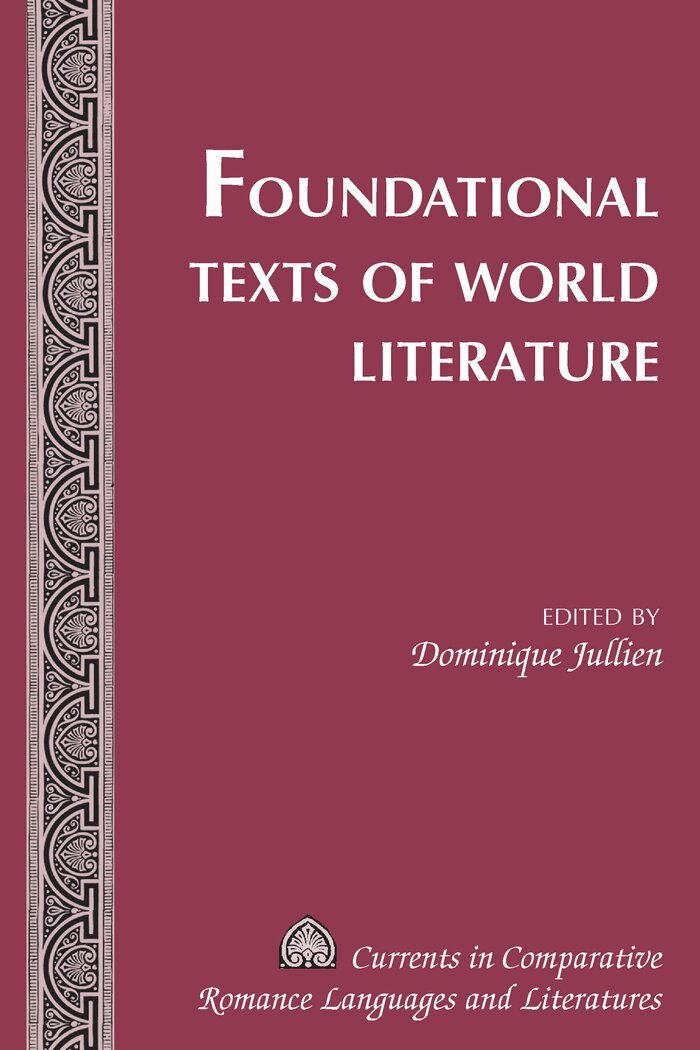
    Foundational Texts of World Literature

    AvDominique Jullien

    Inbunden, Engelska, 2011

    Del 184 i serien Currents in Comparative Romance Languages & Literatures

    1 106 kr

    Beställningsvara. Skickas inom 5-8 vardagar. Fri frakt över 249 kr.

    Beskrivning

    What makes a world author? How did Homer become a «cosmopolitan» author? How does a Mayan creation narrative challenge our Western logocentric ideas of foundational texts? What might world literature look like to a fourth-century Roman reader? How do past and more recent translations of Dante’s Commedia help us to rethink the changing definitions of world literature? How did the Alexander romance adapt to an Islamic context? How did Tasso’s epic adapt to a later cultural context dominated by the «Turkish Fear»? What shaped the West’s first impression of The Tale of Genji? How does the Ovidian myth of Arachne migrate from Japan to the Caribbean? What are the foundational metaphors at the root of Goethe’s weltliteratur paradigm? What happens when cultures import canonical texts for lack of their own? By what process does an eccentric writer reconstruct a new foundational text from heterogeneous fragments of other cultures? How did literary criticism contribute to the canonization of the Thousand and One Nights in Western literature? What is left of the primacy of the national language when writers are published simultaneously in various translations? How do modern misreadings shape our understanding of national epics and ensure their survival?World literature, first intuited in Goethe’s foundational idea of weltliteratur as literature that seeks to transcend national boundaries, is viewed here in its essential mobility and migratory capacity, which relies on the centrality of the reading act. This volume focuses on foundational texts as they are read across cultures, languages and historical contexts. Its goal is to reflect on canonical texts – from Homer’s Odyssey to Murakami’s Genji, from Cervantes to Mayan hieroglyphs, from Dante to Coetzee, from Goethe to Lezama Lima, from the Thousand and One Nights to Jorge Luis Borges – in a global perspective: how they are translated, appropriated, transformed, how they travel across different cultures and languages, their foundational status evolving accordingly in a post-European world.Foundational Texts of World Literature includes contributions by Gerardo Aldana, Sandra Bermann, Piero Boitani, Michael Emmerich, Azadeh Yamini Hamedani, Stefan Helgesson, Paulo Lemos Horta, Juan Pablo Lupi, Peter Madsen, Ulrich Marzolph, Suzanne Saïd, Evanghelia Stead, Mads Rosendahl Thomsen, and Richard Van Leeuwen.

    Produktinformation

    • Utgivningsdatum:2011-07-31
    • Mått:160 x 230 x 19 mm
    • Vikt:460 g
    • Format:Inbunden
    • Språk:Engelska
    • Serie:Currents in Comparative Romance Languages & Literatures
    • Antal sidor:231
    • Förlag:Peter Lang Publishing Inc
    • ISBN:9781433112690

    Utforska kategorier

    • Litteraturvetenskap inom Skönlitteratur

    Mer om författaren

    Dominique Jullien is Professor of French and Comparative Literature at the University of California, Santa Barbara. She is the author of Proust et ses modèles : les Mille et Une Nuits et les Mémoires de Saint-Simon (1989), Récits du Nouveau Monde : les voyageurs français en Amérique de Chateaubriand à nos jours (1992), Les Amoureux de Schéhérazade: variations modernes sur les Mille et Une Nuits (2009), as well as numerous articles on French and comparative literature of the nineteenth and twentieth centuries.

    Innehållsförteckning

    • Contents: Dominique Jullien: Introduction – Piero Boitani: World Literature Two Thousand Years Ago: Reflections of a Senator in 306 A.D. – Suzanne Saïd: Homer, or How to Create a World Writer – Gerardo Aldana: On Deciphering Ancient Mesoamerican Foundational Texts: The Challenges of a Non-Logos-Based Creation Narrative – Ulrich Marzolph: The Creative Reception of the Alexander Romance in Iran – Sandra Bermann: In the Light of Translation: on Dante and World Literature – Richard Van Leeuwen: The Canonization of the Thousand and One Nights in World Literature: The Role of Literary Criticism – Peter Madsen: Epic Encounters - from Torquato Tasso’s Gerusalemme Liberata to Miklós Zrinyi’s Obsidio Szigetiana – Paulo Lemos Horta: The Lusiads as World Literature: The Romantic Hypothesis of Eastern Influence on Camões – Azadeh Yamini Hamedani: Foundational Metaphors: Goethe’s World Literature; Posnett’s Comparative Literature – Evanghelia Stead: Worldwide Tales and the Latin Tradition: The Myth of Arachne in Jan Havlasa’s Four Japanese Tales (1919) and Grace Hallworth’s A Web of Stories (1990) – Michael Emmerich: A New Planet: The Tale of Genji as World Literature – Stefan Helgesson: «… A casement opening on the spectacle of the world …»: Post-European Texts in Translation – Mads Rosendahl Thomsen: Subversive Foundations: Renaissance Classics and the Imported Canon – Juan Pablo Lupi: (Mis)Reading as Engagement: Some Thoughts on World Literature and José Lezama Lima.