• Fri frakt över 249 kr
  • •
  • Snabba leveranser
  • •
  • Billiga böcker
Kundservice

Du är på sajten för privatpersoner.

Företag, bibliotek eller offentlig verksamhet?

Du handlar på classic.bokus.com, där alla dina funktioner finns intakta.
Till classic.bokus.com
Bokus logotyp. Gå till startsidan.
  • Erbjudanden
  • Nyheter
  • Student
  • Topplistor
  • Barn & ungdom
  • Bokus Play
  • E-böcker
  • Pocketböcker
  • Spel & pussel

10% rabatt på allt med kod: NYSTART10 →

Sidfot

Mina sidor

    Hjälp

    • Kundservice
    • Vanliga frågor och svar
    • Frakt och leverans
    • Retur vid ångerrätt
    • Reklamera vara
    • Betalning
    • Köpvillkor
    • Allmänna villkor
    • Information om webbplatsens tillgänglighet

    Om Bokus

    • Om oss
    • Pressrum
    • För studenter
    • För företag
    • För bibliotek och offentlig verksamhet
    • För leverantörer
    • Hållbarhet

    Populärt

    • Aktuella erbjudanden
    • Presentkort
    • Studentlitteratur
    • Nya böcker
    • Topplistor
    • Signerade böcker
    • Engelska böcker

    Inspiration

    • Boktips
    • BookTok
    • Populära bokserier
    • Barnbokskaraktärer
    • Populära författare
    Logotyp för Bokus
    Följ oss på Facebook (extern länk)Följ oss på Instagram (extern länk)Följ oss på YouTube (extern länk)Följ oss på TikTok (extern länk)
    bokus @ CookiesAnpassa cookiesIntegritetspolicyKöpvillkor
    Till Citymail hemsida (extern länk)Till Budbee hemsida (extern länk)Till Postnord hemsida (extern länk)Till Schenker hemsida (extern länk)Till Early Bird hemsida (extern länk)Till Walleys hemsida (extern länk)
    1. Filosofi och religion
    2. Filosofi
    3. Filosofiska discipliner

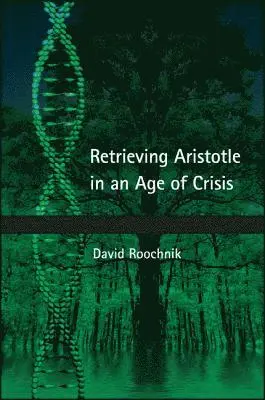
    Retrieving Aristotle in an Age of Crisis

    AvDavid Roochnik

    Inbunden, Engelska, 2013

    Del i serien SUNY series in Ancient Greek Philosophy

    1 076 kr

    Tillfälligt slut

    Fler format och utgåvor

    Häftad

    Tillf. slut

    Beskrivning

    An urgent, contemporary defense of AristotleIn 1935 Edmund Husserl delivered his now famous lecture "Philosophy and the Crisis of European Humanity," in which he argued that the "misguided rationalism" of modern Western science, dominated by the model of mathematical physics, can tell us nothing about the "meaning" of our lives. Today Husserl's conviction that the West faces a crisis is no longer an abstraction. With the ever-present threat of nuclear explosion, the degradation of the oceans, and the possibility that climate change will wreak havoc on civilization itself, people from all walks of life are wondering what has gone so terribly wrong and what remedies might be available.In Retrieving Aristotle in an Age of Crisis, David Roochnik makes a lucid and powerful case that Aristotle offers a philosophical resource that even today can be of significant therapeutic value. Unlike the scientific revolutionaries of the seventeenth century, he insisted that both ordinary language and sense-perception play essential roles in the acquisition of knowledge. Centuries before Husserl, Aristotle was a phenomenologist who demanded that a successful theory remain faithful to human experience. His philosophy can thus provide precisely what modern European rationalism now so painfully lacks: an understanding and appreciation of the world in which human beings actually make their homes.

    Produktinformation

    • Utgivningsdatum:2013-01-01
    • Mått:152 x 229 x undefined mm
    • Vikt:476 g
    • Format:Inbunden
    • Språk:Engelska
    • Serie:SUNY series in Ancient Greek Philosophy
    • Antal sidor:258
    • Upplaga:13115
    • Förlag:State University of New York Press
    • ISBN:9781438445199

    Utforska kategorier

    • Filosofiska discipliner inom Filosofi och religion

    Mer om författaren

    David Roochnik is Professor of Philosophy at Boston University. His books include Retrieving the Ancients: An Introduction to Greek Philosophy and Beautiful City: The Dialectical Character of Plato's Republic.

    Recensioner i media

    "…[Roochnik's] investigation is a welcome addition to this pivotal topic." — International Journal of the Classical Tradition"Roochnik has an easy grasp of Aristotelian scholarship and presents his exegesis of the texts clearly in defense of his claim that Aristotle provides an 'as-we-experience-it' understanding of the world that is both accurate and valuable. Against a host of critics and conversation partners, from Francis Bacon to Richard Dawkins and from Daniel Gilbert to John Rawls, Roochnik offers a coherent and intriguing polemic, both scholarly and surprising." — CHOICE"Roochnik's thorough development of the protophenomenological character of Aristotle's work is by far the most detailed I know of, and this enables him to mount a defense of Aristotle's relevance today that is as strong as I have read. Moreover, the polemical, passionate, and personal style is a welcome change from the dryness of too much Aristotle scholarship." — Drew A. Hyland, author of Plato and the Question of Beauty

    Innehållsförteckning

    • AcknowledgmentsA Note to the ReaderPrologueIntroduction: Why Aristotle Matters1. The Stars Are Eternal.I.1: There are Only Three Dimensions.I.2: Threeness Determines Wholeness.I.3: There Are Four Elements.I.4: Elements Naturally Move to Their Natural Place.I.5: The Circle Is Perfect.I.6: The Body Moving in Circular Orbit Is External.I.7: History Is More or Less Bunk.I.8: Religion Bears Witness to the Truth.2. Nature is Purpose.II.1: Teleology Is Good Science.II.2: Intelligent Design Isn’t All Stupid.II.3: Some Beings Are Natural; Others Are Not.II.4: Form Is Nature More than Matter.II.5: Form Is More Divine than Matter.II.6: Nature is Hierarchical.II.7: To Understand Nature, Study Its Best Examples.II.8: The Finite Is Better than the Infinite.II.9: Good Science Appreciates Things as They Are.3. Being Is Good.III.1: Metaphysics Is Onto-Theology.III.2: There Are Substances Out There.III.3: We Know a Substance When We See One.III.4: God Is Alive and Good.III.5: To Stand Firmly.4. Truth Is Easy.IV.1: If the Eye Were an Animal, Vision Would Be Its Soul.IV.2: The World Is Nourishing.IV.3: Perceiving Is Like Eating.IV.4: We Are Wrong More Often than Not.IV.5: Thinking IS Like Perceiving (Which Is Like Eating).IV.6: We Can Say What We Think.IV.7: We "Truth" the World.5. The Theoretical Life Is Divine.V.1: Life Is Meaningful.V.2: Happiness Is Objective.V.3: Good Life Comes from Good Habits.V.4: Freedom Isn’t All It’s Cracked Up To Be.V.5: Moral Evaluation Requires Stories.V.6: Smart Moral People Are Better than Dumb Moral People.V.7: Lack-of-Leisure Is for the Sake of Leisure.V.8: Theâria Is Not "Contemplation."6. Enough Is Enough.VI.1: The Best City Needs the Best Life.VI.2: The Practical Life Is Not the Best.VI.3: Natural Slavery Is Justified.VI.4: A Woman’s Place Is in the Home.VI.5: Small, but Not Too Small, Is Beautiful.VI.6: War Is for the Sake of Peace.VI.7: Philosophy Cures.EpilogueNotesBibliographyIndex