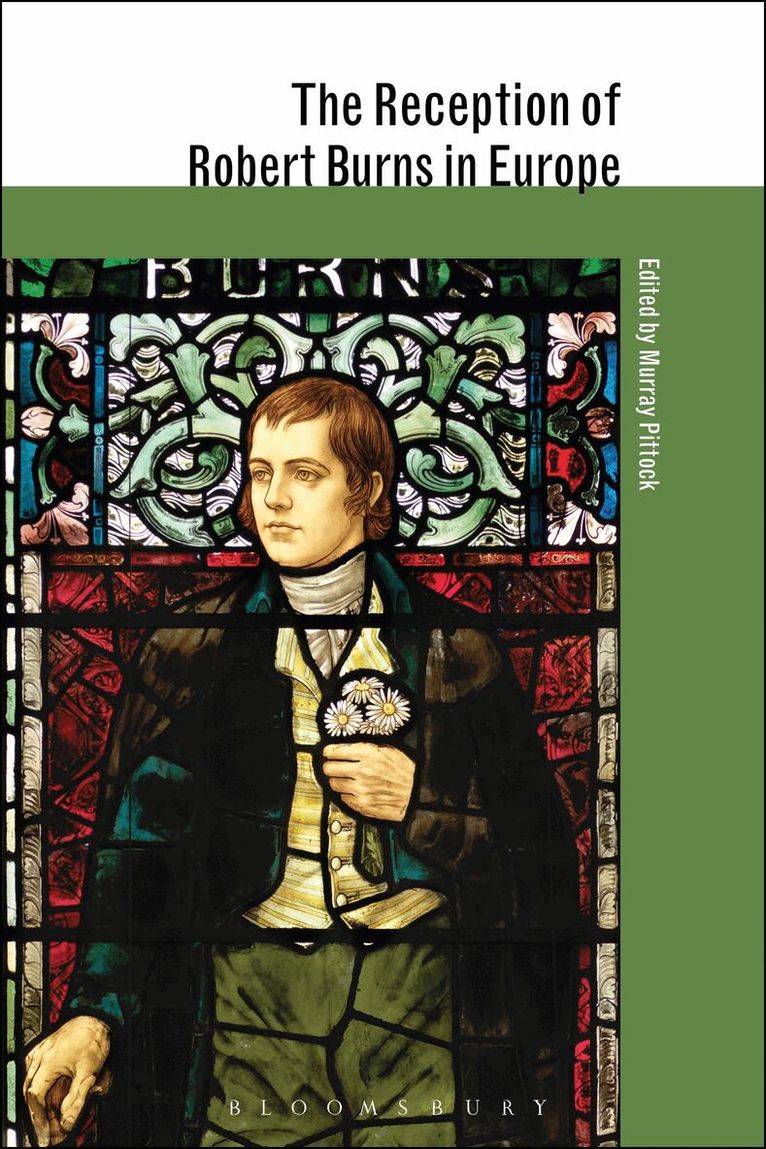
Inbunden, Engelska, 2014
The Reception of Robert Burns in Europe
Del i serien The Reception of British and Irish Authors in Europe
6135 kr
Beställningsvara. Skickas inom 10-15 vardagar. Fri frakt över 249 kr.
Beskrivning
Produktinformation
- Utgivningsdatum: 2014-06-19
- Mått: 156 x 234 x 28 mm
- Vikt: 755 g
- Format: Inbunden
- Språk: Engelska
- Serie: The Reception of British and Irish Authors in Europe
- Antal sidor: 416
- Förlag: Bloomsbury Publishing Plc
- ISBN: 9781441170316
Utforska kategorier
Mer om författaren
Murray Pittock is Bradley Professor of English Literature at the University of Glasgow, a Fellow of the Royal Society of Edinburgh, and a prizewinner of that society and of the British Academy, as well as winning or being nominated or shortlisted for over ten other literary prizes. He is the author or editor of a number of prominent works on Jacobitism and Romanticism, including Scottish and Irish Romanticism (2008, 2011), Robert Burns in Global Culture (2011) and Material Culture and Sedition: Treacherous, Objects, Secret Places (2013). He is currently editing the Scots Musical Museum in the AHRC Collected Burns edition.
Recensioner i media
In her preface to this book, Elinor Shaffer (editor of the series in which the book appears) argues that translation histories show the complex interweaving of ideas, periods, and peoples and illuminate an author by refracting unexpected attributes in texts one takes for granted. The 14 critics assembled by Pittock (Univ. of Glasgow, Scotland)—among them Silvia Mergenthal, Francesca Saggini, Marjorie Rycroft, Natalia Kaloh Vid, and Frauke Reitemeier—bring to this volume a broad expanse of knowledge, location, and focus and in so doing weave a fascinating critical tapestry. Anchored by a timeline of translations (1798–2012), the volume tracks reception all over Europe and into music, revealing the unexpected at every turn. Burns’s work contributed to the development of nationalism, picking up on the influence of Ossian. But at times it failed to connect or found a space (e.g., Spain) already occupied by Sir Walter Scott. In France, Burns’s reputation soared and dived. Elsewhere (Germany and Switzerland), it engaged sporadically, according to the surge in ideas or familiarity with dialects. Russia claimed itself as the only country that understood him; in Austria, Burns's work was once restricted to “reliable citizens.” Burns, it seems, lives dangerously—and always interestingly—abroad. An excellent resource. Summing Up: Highly recommended. Graduate students, researchers, faculty.
Betyg & recensioner
0 recensioner
Inga recensioner tillgängliga.