• Fri frakt över 249 kr
  • •
  • Snabba leveranser
  • •
  • Billiga böcker
Kundservice

Du är på sajten för privatpersoner.

Företag, bibliotek eller offentlig verksamhet?

Du handlar på classic.bokus.com, där alla dina funktioner finns intakta.
Till classic.bokus.com
Bokus logotyp. Gå till startsidan.
  • Erbjudanden
  • Nyheter
  • Student
  • Topplistor
  • Barn & ungdom
  • Bokus Play
  • E-böcker
  • Pocketböcker
  • Spel & pussel

10% rabatt på allt med kod: NYSTART10 →

Sidfot

Mina sidor

    Hjälp

    • Kundservice
    • Vanliga frågor och svar
    • Frakt och leverans
    • Retur vid ångerrätt
    • Reklamera vara
    • Betalning
    • Köpvillkor
    • Allmänna villkor
    • Information om webbplatsens tillgänglighet

    Om Bokus

    • Om oss
    • Pressrum
    • För studenter
    • För företag
    • För bibliotek och offentlig verksamhet
    • För leverantörer
    • Hållbarhet

    Populärt

    • Aktuella erbjudanden
    • Presentkort
    • Studentlitteratur
    • Nya böcker
    • Topplistor
    • Signerade böcker
    • Engelska böcker

    Inspiration

    • Boktips
    • BookTok
    • Populära bokserier
    • Barnbokskaraktärer
    • Populära författare
    Logotyp för Bokus
    Följ oss på Facebook (extern länk)Följ oss på Instagram (extern länk)Följ oss på YouTube (extern länk)Följ oss på TikTok (extern länk)
    bokus @ CookiesAnpassa cookiesIntegritetspolicyKöpvillkor
    Till Citymail hemsida (extern länk)Till Budbee hemsida (extern länk)Till Postnord hemsida (extern länk)Till Schenker hemsida (extern länk)Till Early Bird hemsida (extern länk)Till Walleys hemsida (extern länk)
    1. Naturvetenskap och teknik
    2. Matematik och naturvetenskap
    3. Fysik

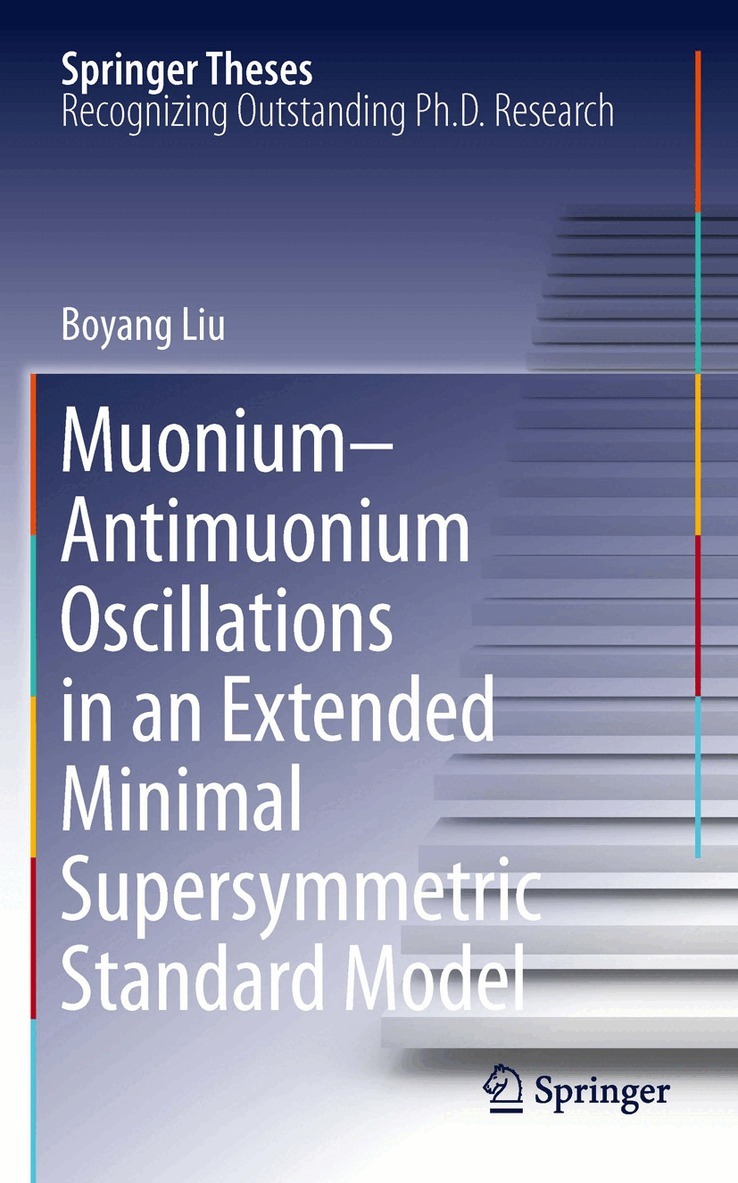
    Muonium-antimuonium Oscillations in an Extended Minimal Supersymmetric Standard Model

    AvBoyang Liu

    Inbunden, Engelska, 2011

    Del i serien Springer Theses

    547 kr

    Beställningsvara. Skickas inom 10-15 vardagar. Fri frakt över 249 kr.

    Fler format och utgåvor

    E-bok

    710 kr

    Häftad

    547 kr

    Beskrivning

    This innovative work investigated two models where the muonium-antimuonium oscillation process was mediated by massive Majorana neutrinos and sneutrinos. First, we modified the Standard Model only by the inclusion of singlet right-handed neutrinos and allowing for general renormalizable interactions producing neutrino masses and mixing. The see-saw mechanism was employed to explain the smallness of the observed neutrino masses. A lower bound on the righthanded neutrino mass was constructed using the experimental limits set by the nonobservation of the muonium-antimuonium oscillation process. Second, we modified the Minimal Supersymmetric Standard Model by the inclusion of three right-handed neutrino superfields. The experimental result of the muonium-antimuonium oscillation process generated a lower bound on the ratio of the two Higgs field VEVs. This work helps to set up relationships between the experimental result of the muonium-antimuonium oscillation process and the model parameters in two specific models. Further improvement of the experiment in the future can generate more stringent bounds on the model parameters using the procedure developed by this work.

    Produktinformation

    • Utgivningsdatum:2011-02-09
    • Mått:155 x 235 x 15 mm
    • Vikt:289 g
    • Format:Inbunden
    • Språk:Engelska
    • Serie:Springer Theses
    • Antal sidor:67
    • Upplaga:2011
    • Förlag:Springer-Verlag New York Inc.
    • ISBN:9781441983299

    Utforska kategorier

    • Fysik inom Naturvetenskap och teknik
    • Kvantfysik inom Naturvetenskap och teknik

    Mer om författaren

    Boyang Liu, Chinese Academy of Sciences, boyangleo@gmail.com

    Innehållsförteckning

    • Introduction to muonium-antimuonium oscillation.- Muonium-antimuonium oscillation in a modified Standard Model.- Supersymmetry and the Minimal Supersymmetric Standard Model.- The muonium-antimuonium oscillation in the extended Minimal Supersymmetric Standard Model.- The constraints from the muon and electron anomalous magnetic moment experiments.- Conclusions.