• Fri frakt över 249 kr
  • •
  • Snabba leveranser
  • •
  • Billiga böcker
Kundservice

Du är på sajten för privatpersoner.

Företag, bibliotek eller offentlig verksamhet?

Du handlar på classic.bokus.com, där alla dina funktioner finns intakta.
Till classic.bokus.com
Bokus logotyp. Gå till startsidan.
  • Erbjudanden
  • Nyheter
  • Student
  • Topplistor
  • Barn & ungdom
  • Bokus Play
  • E-böcker
  • Pocketböcker
  • Spel & pussel

10% rabatt på allt med kod: NYSTART10 →

Sidfot

Mina sidor

    Hjälp

    • Kundservice
    • Vanliga frågor och svar
    • Frakt och leverans
    • Retur vid ångerrätt
    • Reklamera vara
    • Betalning
    • Köpvillkor
    • Allmänna villkor
    • Information om webbplatsens tillgänglighet

    Om Bokus

    • Om oss
    • Pressrum
    • För studenter
    • För företag
    • För bibliotek och offentlig verksamhet
    • För leverantörer
    • Hållbarhet

    Populärt

    • Aktuella erbjudanden
    • Presentkort
    • Studentlitteratur
    • Nya böcker
    • Topplistor
    • Signerade böcker
    • Engelska böcker

    Inspiration

    • Boktips
    • BookTok
    • Populära bokserier
    • Barnbokskaraktärer
    • Populära författare
    Logotyp för Bokus
    Följ oss på Facebook (extern länk)Följ oss på Instagram (extern länk)Följ oss på YouTube (extern länk)Följ oss på TikTok (extern länk)
    bokus @ CookiesAnpassa cookiesIntegritetspolicyKöpvillkor
    Till Citymail hemsida (extern länk)Till Budbee hemsida (extern länk)Till Postnord hemsida (extern länk)Till Schenker hemsida (extern länk)Till Early Bird hemsida (extern länk)Till Walleys hemsida (extern länk)
    1. Skönlitteratur
    2. Dramatik

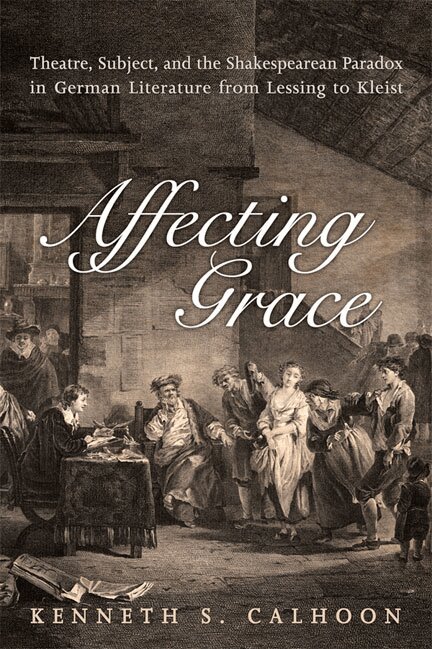
    Affecting Grace

    Literature from Lessing to Kleist

    AvKenneth S. Calhoon

    E-bok
    Engelska, 2013

    Del i serien German and European Studies

    472 kr

    Läs direkt i Bokus Reader – eller ladda ned till din enhet

    Fler format och utgåvor

    Inbunden

    826 kr

    E-bok

    472 kr

    Beskrivning

    Affecting Grace examines the importance of Shakespeare’s poetry and plays within German literature and thought after 1750 – including its relationship to German classicism, which favoured unreflected ease over theatricality. Kenneth S. Calhoon examines this tension against an extensive backdrop that includes a number of canonical German authors – Goethe, Schiller, Herder, Lessing, von Kleist, and Nietzsche – as well as the advent of Meissen porcelain, the painting of Bernardo Bellotto and Francesco Guardi, and aspects of German styles of architecture.Extending from Shakespeare’s The Merchant of Venice (c. 1597) to Kleist’s The Broken Jug (1806), this study turns on the paradox that the German literary world had begun to embrace Shakespeare just as it was firming up the broad but pronounced anti-Baroque sensibility found pivotally in Lessing’s critical and dramatic works. Through these investigations, Calhoon illuminates the deep cultural changes that fundamentally affected Germany’s literary and artistic traditions.

    Produktinformation

    • Utgivningsdatum:2013-04-09
    • Språk:Engelska
    • Antal sidor:296
    • Filformat:EPUB
    • Kopieringsskydd:LCP
    • ISBN:9781442664166
    • Förlag:University of Toronto Press
    • Serie:German and European Studies
    • Vikt:1 g

    Utforska kategorier

    • Dramatik inom Skönlitteratur
    • Litteraturvetenskap inom Skönlitteratur
    • Litteraturvetenskap inom Skönlitteratur

    Mer om författaren

    Kenneth S. Calhoon is a professor of German and Comparative Literature at the University of Oregon.

    Recensioner i media

    ‘Calhoon’s book offers an important contribution to Shakespeare scholarship within German studies that nicely complements previous publications in this area…A rich study of eighteenth-century theatre and its influence on litterature and aesthetics.’ - Olivia Landry (German Studies Review, vol 37:02:2014)

    Innehållsförteckning

    • AcknowledgmentsList of IllustrationsIntroductionChapter One: Mercy and the Spirit of Commerce: Shylock’s Shadow in the Age of DisinterestChapter Two: Judging Adam: Theater and the Fall into HistoryChapter Three: The Virtue of Things: Meissen Porcelain and the Classical ObjectChapter Four: Of Praise and Poison in Hamlet and Miss Sara SampsonChapter Five: Scenic Fantasies: Bellotto in Dresden-Goethe in StrasbourgChapter Six: Sovereign Innocence: Schiller’s “Walk” and the NaÏve SpectatorChapter Seven: Caught in the Act: The Comedic Miscarriage of Kleist’s Broken JugEpilogueBibliographyIndex