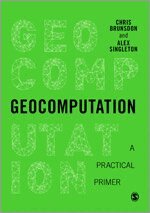
Inbunden, Engelska, 2015
Geocomputation
A Practical Primer
Av Chris Brunsdon, Alex David Singleton
Del i serien Spatial Analytics and GIS
3900 kr
Beställningsvara. Skickas inom 3-6 vardagar. Fri frakt över 249 kr.
Beskrivning
Produktinformation
- Utgivningsdatum: 2015-01-29
- Mått: 170 x 242 x 20 mm
- Vikt: 550 g
- Format: Inbunden
- Språk: Engelska
- Serie: Spatial Analytics and GIS
- Antal sidor: 392
- Upplaga: 1
- Förlag: SAGE Publications Ltd
- ISBN: 9781446272923
Utforska kategorier
Mer om författaren
Chris Brunsdon is Professor of Geocomputation and Director of the National Centre for Geocomputation at the National University of Ireland, Maynooth, having worked previously in the Universities of Newcastle, Glamorgan, Leicester and Liverpool, variously in departments focusing on both geography and computing. He has interests that span both of these disciplines, including spatial statistics, geographical information science, and exploratory spatial data analysis, and in particular the application of these ideas to crime pattern analysis, the modelling of house prices, medical and health geography and the analysis of land use data. He was one of the originators of the technique of geographically weighted regression (GWR). He has extensive experience of programming in R, going back to the late 1990s, and has developed a number of R packages which are currently available on CRAN, the Comprehensive R Archive Network. He is an advocate of free and open source software, and in particular the use of reproducible research methods, and has contributed to a large number of workshops on the use of R and of GWR in a number of countries, including the UK, Ireland, Japan, Canada, the USA, the Czech Republic and Australia. When not involved in academic work he enjoys running, collecting clocks and watches, and cooking – the last of these probably cancelling out the benefits of the first.Alex Singleton is Professor of Geographic Information Science at the University of Liverpool, where he entered as a lecturer in 2010. He holds a BSc (Hons) Geography from the University of Manchester and a PhD from University College London. To date, his research income totals around £15m, with two career highlights including the ESRC funded Consumer Data Research Centre; and the recently awarded ESRC Centre for Doctoral Training in New Forms of Data. Alex’s research is embedded within the Geographic Data Science Lab (geographicdatascience.com) and concerns various aspects of urban analytics. In particular, his work has extended a tradition of area classification within Geography where he has developed an empirically informed critique of the ways in which geodemographic methods can be refined for effective yet ethical use in public resource allocation applications.
Recensioner i media
This is a vital primer to what is ‘Big’ about geocomputation: new data (and lots of them), innovative methods of analysis, new geographic information technologies and, above all, an over-arching rethink of how we represent geography. It provides an important and strategic contribution to contemporary scientific geography and data analytics.
Betyg & recensioner
0 recensioner
Inga recensioner tillgängliga.