• Fri frakt över 249 kr
  • •
  • Snabba leveranser
  • •
  • Billiga böcker
Kundservice

Du är på sajten för privatpersoner.

Företag, bibliotek eller offentlig verksamhet?

Du handlar på classic.bokus.com, där alla dina funktioner finns intakta.
Till classic.bokus.com
Bokus logotyp. Gå till startsidan.
  • Erbjudanden
  • Student
  • Topplistor
  • Barn & ungdom
  • Bokus Play
  • E-böcker
  • Ljudböcker
  • Pocketböcker
  • Spel & pussel

10% rabatt på allt med kod NYSTART10 →

Sidfot

Mina sidor

    Hjälp

    • Kundservice
    • Vanliga frågor och svar
    • Frakt och leverans
    • Retur vid ångerrätt
    • Reklamera vara
    • Betalning
    • Köpvillkor
    • Allmänna villkor
    • Information om webbplatsens tillgänglighet

    Om Bokus

    • Om oss
    • Pressrum
    • För studenter
    • För företag
    • För bibliotek och offentlig verksamhet
    • För leverantörer
    • Hållbarhet

    Populärt

    • Aktuella erbjudanden
    • Presentkort
    • Studentlitteratur
    • Nya böcker
    • Topplistor
    • Signerade böcker
    • Engelska böcker

    Inspiration

    • Boktips
    • BookTok
    • Populära bokserier
    • Barnbokskaraktärer
    • Populära författare
    Logotyp för Bokus
    Följ oss på Facebook (extern länk)Följ oss på Instagram (extern länk)Följ oss på YouTube (extern länk)Följ oss på TikTok (extern länk)
    bokus @ CookiesAnpassa cookiesIntegritetspolicyKöpvillkor
    Till Citymail hemsida (extern länk)Till Budbee hemsida (extern länk)Till Postnord hemsida (extern länk)Till Schenker hemsida (extern länk)Till Early Bird hemsida (extern länk)Till Walleys hemsida (extern länk)
    1. Data och IT
    2. Systemvetenskap och AI

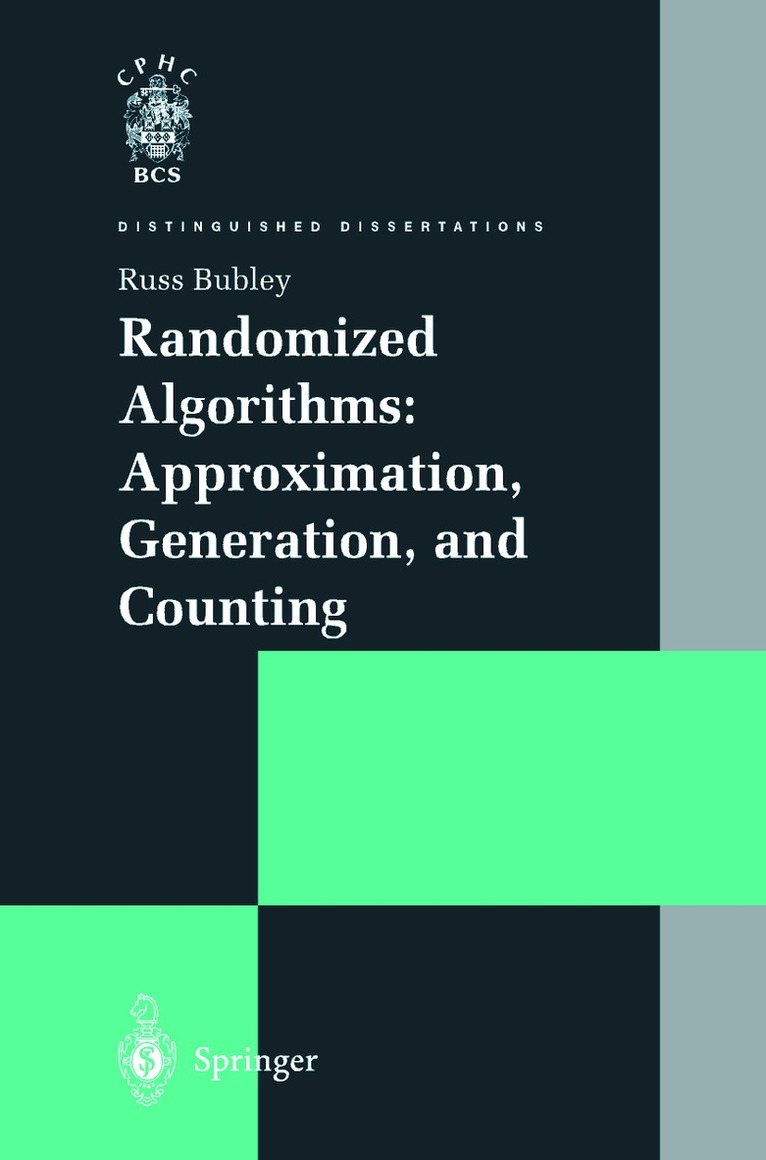
    Randomized Algorithms: Approximation, Generation, and Counting

    AvRuss Bubley

    Häftad, Engelska, 2011

    Del i serien Distinguished Dissertations

    1 116 kr

    Beställningsvara. Skickas inom 10-15 vardagar. Fri frakt över 249 kr.

    Fler format och utgåvor

    E-bok

    1 413 kr

    Beskrivning

    Randomized Algorithms discusses two problems of fine pedigree: counting and generation, both of which are of fundamental importance to discrete mathematics and probability. When asking questions like "How many are there?" and "What does it look like on average?" of families of combinatorial structures, answers are often difficult to find -- we can be blocked by seemingly intractable algorithms. Randomized Algorithms shows how to get around the problem of intractability with the Markov chain Monte Carlo method, as well as highlighting the method's natural limits. It uses the technique of coupling before introducing "path coupling" a new technique which radically simplifies and improves upon previous methods in the area.

    Produktinformation

    • Utgivningsdatum:2011-09-16
    • Mått:155 x 235 x 10 mm
    • Vikt:277 g
    • Format:Häftad
    • Språk:Engelska
    • Serie:Distinguished Dissertations
    • Antal sidor:152
    • Förlag:Springer London Ltd
    • ISBN:9781447111801

    Utforska kategorier

    • Systemvetenskap och AI inom Data och IT
    • Programmeringsböcker inom Data och IT

    Innehållsförteckning

    • 1 Mathematical Background.- 1.1 Computational Complexity.- 1.2 Probability.- 1.3 Markov Chains.- 1.4 Graph Theory.- 2 Techniques for Sampling and Approximate Sampling.- 2.1 Introduction.- 2.2 Direct Sampling.- 2.3 Markov Chain Method.- 3 Approximate Counting.- 3.1 Parsimonious Reductions.- 3.2 Counting Directly.- 3.3 Counting and Sampling.- 3.4 The Markov Chain Monte Carlo Method.- 4 Applications: Coupling.- 4.1 Hypergraph Colourings.- 4.2 Sink-Free Graph Orientations and Twice-Sat.- 4.3 Log-Concave Sampling, and the Volume of a Convex Body.- Intermezzo: Path Coupling.- 5 Applications: Path Coupling.- 5.1 Introduction.- 5.2 Twice-Sat Revisited.- 5.3 Sink- and Source-Free Graph Orientations.- 5.4 Totally Edge Cyclic Orientations.- 5.5 Independent Sets: The Conserved Hard-Core Model.- 5.6 Independent Sets: The Non-Conserved Hard-Core Model.- 5.7 Linear Extensions of a Partial Order.- 5.8 Graph Colouring.- 5.9 The Extended Potts Framework.- 5.10 Graph Colouring Revisited.- 6 Directions for Future Work.- 6.1 Breaking Thresholds.- 6.2 Beyond Self-Reducibility.- 6.3 Mixed Methods for Approximate Counting.- 6.4 Faster Reductions from Approximate Counting to Approximate Sampling.- 6.5 Anti-ferromagnetic Models.- 6.6 Log-Concave Sampling via Path Coupling.- Appendices.- A An Application of Dobrushin’s Uniqueness Criterion.- B A Hierarchy of #SAT Restrictions.- B.1 Introduction.- B.2 A Summary of Known Results.- B.2.1 Easy Exact Counting.- B.2.2 Hard Exact Counting.- B.2.3 Easy Approximate Counting.- B.2.4 Hard Approximate Counting.- B.3 Summary and Conclusions.- C Equivalence of Transposition Distance to Spearman’s Footrule.