• Fri frakt över 249 kr
  • •
  • Snabba leveranser
  • •
  • Billiga böcker
Kundservice

Du är på sajten för privatpersoner.

Företag, bibliotek eller offentlig verksamhet?

Du handlar på classic.bokus.com, där alla dina funktioner finns intakta.
Till classic.bokus.com
Bokus logotyp. Gå till startsidan.
  • Erbjudanden
  • Nyheter
  • Student
  • Topplistor
  • Barn & ungdom
  • Bokus Play
  • E-böcker
  • Pocketböcker
  • Spel & pussel

10% rabatt på allt med kod: NYSTART10 →

Sidfot

Mina sidor

    Hjälp

    • Kundservice
    • Vanliga frågor och svar
    • Frakt och leverans
    • Retur vid ångerrätt
    • Reklamera vara
    • Betalning
    • Köpvillkor
    • Allmänna villkor
    • Information om webbplatsens tillgänglighet

    Om Bokus

    • Om oss
    • Pressrum
    • För studenter
    • För företag
    • För bibliotek och offentlig verksamhet
    • För leverantörer
    • Hållbarhet

    Populärt

    • Aktuella erbjudanden
    • Presentkort
    • Studentlitteratur
    • Nya böcker
    • Topplistor
    • Signerade böcker
    • Engelska böcker

    Inspiration

    • Boktips
    • BookTok
    • Populära bokserier
    • Barnbokskaraktärer
    • Populära författare
    Logotyp för Bokus
    Följ oss på Facebook (extern länk)Följ oss på Instagram (extern länk)Följ oss på YouTube (extern länk)Följ oss på TikTok (extern länk)
    bokus @ CookiesAnpassa cookiesIntegritetspolicyKöpvillkor
    Till Citymail hemsida (extern länk)Till Budbee hemsida (extern länk)Till Postnord hemsida (extern länk)Till Schenker hemsida (extern länk)Till Early Bird hemsida (extern länk)Till Walleys hemsida (extern länk)
    1. Ekonomi och Ledarskap
    2. Nationalekonomi

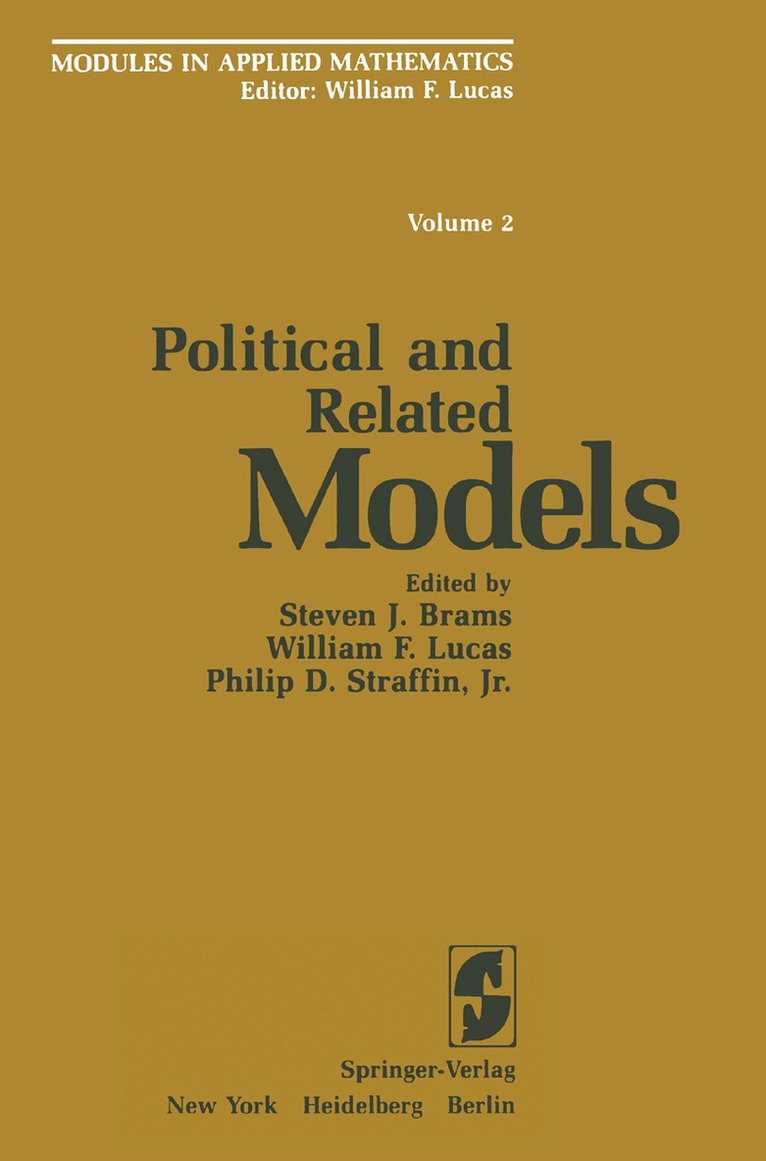
    Political and Related Models

    AvS.J. Brams,W.F. Lucas

    Häftad, Engelska, 2012

    Del i serien Modules in Applied Mathematics

    563 kr

    Beställningsvara. Skickas inom 10-15 vardagar. Fri frakt över 249 kr.

    Beskrivning

    The purpose of this four volume series is to make available for college teachers and students samples of important and realistic applications of mathematics which can be covered in undergraduate programs. The goal is to provide illustrations of how modern mathematics is actually employed to solve relevant contemporary problems. Although these independent chapters were prepared primarily for teachers in the general mathematical sciences, they should prove valuable to students, teachers, and research scientists in many of the fields of application as well. Prerequisites for each chapter and suggestions for the teacher are provided. Several of these chapters have been tested in a variety of classroom settings, and all have undergone extensive peer review and revision. Illustrations and exercises are included in most chapters. Some units can be covered in one class, whereas others provide sufficient material for a few weeks of class time. Volume 1 contains 23 chapters and deals with differential equations and, in the last four chapters, problems leading to partial differential equations. Applications are taken from medicine, biology, traffic systems and several other fields. The 14 chapters in Volume 2 are devoted mostly to problems arising in political science, but they also address questions appearing in sociology and ecology. Topics covered include voting systems, weighted voting, proportional representation, coalitional values, and committees. The 14 chapters in Volume 3 emphasize discrete mathematical methods such as those which arise in graph theory, combinatorics, and networks.

    Produktinformation

    • Utgivningsdatum:2012-11-26
    • Mått:155 x 235 x 23 mm
    • Vikt:633 g
    • Format:Häftad
    • Språk:Engelska
    • Serie:Modules in Applied Mathematics
    • Antal sidor:396
    • Förlag:Springer-Verlag New York Inc.
    • Medarbetare:W.F. Lucas
    • ISBN:9781461254324

    Utforska kategorier

    • Nationalekonomi inom Ekonomi och Ledarskap

    Innehållsförteckning

    • 1. The Process of Applied Mathematics.- 1. Introduction.- 2. Applied Mathematics as a Process.- 3. The Construction and Use of Mathematical Models.- 4. Planetary Motion: The Evolution of a Model.- 5. An Example from Psychology.- 6. Concluding Remarks.- References.- 2. Proportional Representation.- 1. Introduction.- 2. Cumulative Voting.- 3. Single Transferable Vote.- 4. Cumulative Voting with Transfer of Surplus.- 5. Cumulative Voting with Transfer of Surplus and Elimination of Low-Ranking Candidates.- 6. An Illustration of the Use of Cumulative Voting.- 7. STV versus CTV.- References.- Notes for the Instructor.- 3. Comparison Voting.- 1. Preview: Do the Rules of the Game Make a Difference?.- 2. Introduction.- 3. Negative Voting in Two-Candidate Contests.- 4. Negative Voting in Three-Candidate Contests without a Runoff.- 5. Negative Voting in Three-Candidate Contests with a Runoff.- 6. Advantages of Approval Voting.- 7. General Results for Approval Voting.- 8. The Possible Confounding Effects of a Poll.- 9. Approval Voting and Presidential Elections.- 10. Summary and Conclusions.- Solutions to Selected Exercises.- References.- Notes for the Instructor.- 4. Modeling Coalitional Values.- 1. Introduction.- 2. Basic Concepts.- 3. Some Experiments.- 4. Some Pollution Models.- 5. Equitable User’s Fees.- 6. Economic Markets.- 7. Business Games.- References.- Notes for the Instructor.- 5. Urban Wastewater Management Planning.- 1. Introduction.- 2. Description of the Study Area and the Scenario.- 3. Environmental Engineering Design.- 4. Economic Analysis.- 5. Financial Analysis.- 6. Environmental Impact Statement—Ecology.- 7. Public Participation.- 8. Political Science.- 9. Epilogue.- Notes for the Instructor.- 6. An Everyday Approach to Matrix Operations.- 1. Introductionto Vectors and Matrices.- 2. Vector Addition, Subtraction, and Multiplication by Scalars.- 3. Vector Inner Product.- 4. Multiplication of a Matrix and a Vector.- 5. Matrix Addition, Subtraction, and Multiplication.- 6. Properties of Matrix Operations and Special Matrices.- 7. Matrices and Profits.- Exercises.- Reference.- Notes for the Instructor.- 7. Sources of Applications of Mathematics in Ecological and Environmental Subject Areas, Suitable for Classroom Use.- 1. Introduction.- 2. Probability Theory.- 3. Matrix and Linear Algebra.- 4. Calculus.- 5. Differential Equations.- 6. Game Theory.- 7. Graph Theory.- 8. Optimal Control Theory.- 9. Miscellaneous.- References.- 8. How To Ask Sensitive Questions without Getting Punched in the Nose.- 1. Introduction.- 2. Definitions.- 3. The Randomized Response Method.- 4. Unrelated Question Model.- 5. Using the Randomized Response Method and the Unrelated Question Model.- 6. Classroom Suggestions.- 7. Complements and Problems.- Appendix: Randomized Response Survey.- References.- Notes for the Instructor.- 9. Measuring Power in Weighted Voting Systems.- 1. Introduction.- 2. Simple Examples.- 3. Measures in Voting Power.- 4. Additional Examples.- 5. Mini-Projects.- 6. Computational Aids.- 7. The Electoral College.- 8. Additional Voting Problems.- 9. Limits of the Mathematical Models.- References.- Notes for the Instructor.- 10. To the (Minimal Winning) Victors Go the (Equally Divided) Spoils: A New Power Index for Simple n-Person Games.- 1. Introduction.- 2. Power Index Definition and Examples.- 3. Characterization Axioms.- 4. Applications and Limitations.- 5. Concluding Remarks.- Exercises.- References.- Notes for the Instructor.- 11. Power Indices in Politics.- 1. Voting Games and Power Indices.- 2. Using the Power Indices.- 3.Characterizing the Power Indices.- Solutions to Selected Exercises.- References.- Notes for the Instructor.- 12. Committee Decision Making.- 1. Introduction.- 2. Committee Decision-Making Experiment.- 3. Geometric Representation of the Situation.- 4. Utility.- 5. Remarks on Models in Political Science.- 6. The Barycenter Model.- 7. The Pareto Model.- 8. The Core Model.- 9. General Discussion.- 10. The Arrow Theorem.- Appendix I: An Example of an Experiment.- Appendix II: Mathematical Notes.- Notes for the Instructor.- 13. Stochastic Difference Equations with Sociological Applications.- 1. Difference Equation Models.- 2. Review of Probability and Statistics.- 3. Stochastic Difference Equations.- Notes for the Instructor.- 14. The Apportionment Problem.- 1. The Basic Problem.- 2. Some Traditional Methods.- 3. Local Measures of Inequity.- 4. The Axiomatic Approach.- 5. The General Apportionment Problem.- 6. Conclusions.- References.