• Fri frakt över 249 kr
  • •
  • Snabba leveranser
  • •
  • Billiga böcker
Kundservice

Du är på sajten för privatpersoner.

Företag, bibliotek eller offentlig verksamhet?

Du handlar på classic.bokus.com, där alla dina funktioner finns intakta.
Till classic.bokus.com
Bokus logotyp. Gå till startsidan.
  • Erbjudanden
  • Nyheter
  • Student
  • Topplistor
  • Barn & ungdom
  • Bokus Play
  • E-böcker
  • Pocketböcker
  • Spel & pussel

10% rabatt på allt med kod: NYSTART10 →

Sidfot

Mina sidor

    Hjälp

    • Kundservice
    • Vanliga frågor och svar
    • Frakt och leverans
    • Retur vid ångerrätt
    • Reklamera vara
    • Betalning
    • Köpvillkor
    • Allmänna villkor
    • Information om webbplatsens tillgänglighet

    Om Bokus

    • Om oss
    • Pressrum
    • För studenter
    • För företag
    • För bibliotek och offentlig verksamhet
    • För leverantörer
    • Hållbarhet

    Populärt

    • Aktuella erbjudanden
    • Presentkort
    • Studentlitteratur
    • Nya böcker
    • Topplistor
    • Signerade böcker
    • Engelska böcker

    Inspiration

    • Boktips
    • BookTok
    • Populära bokserier
    • Barnbokskaraktärer
    • Populära författare
    Logotyp för Bokus
    Följ oss på Facebook (extern länk)Följ oss på Instagram (extern länk)Följ oss på YouTube (extern länk)Följ oss på TikTok (extern länk)
    bokus @ CookiesAnpassa cookiesIntegritetspolicyKöpvillkor
    Till Citymail hemsida (extern länk)Till Budbee hemsida (extern länk)Till Postnord hemsida (extern länk)Till Schenker hemsida (extern länk)Till Early Bird hemsida (extern länk)Till Walleys hemsida (extern länk)
    1. Naturvetenskap och teknik
    2. Matematik och naturvetenskap
    3. Fysik
    4. Materietillstånd

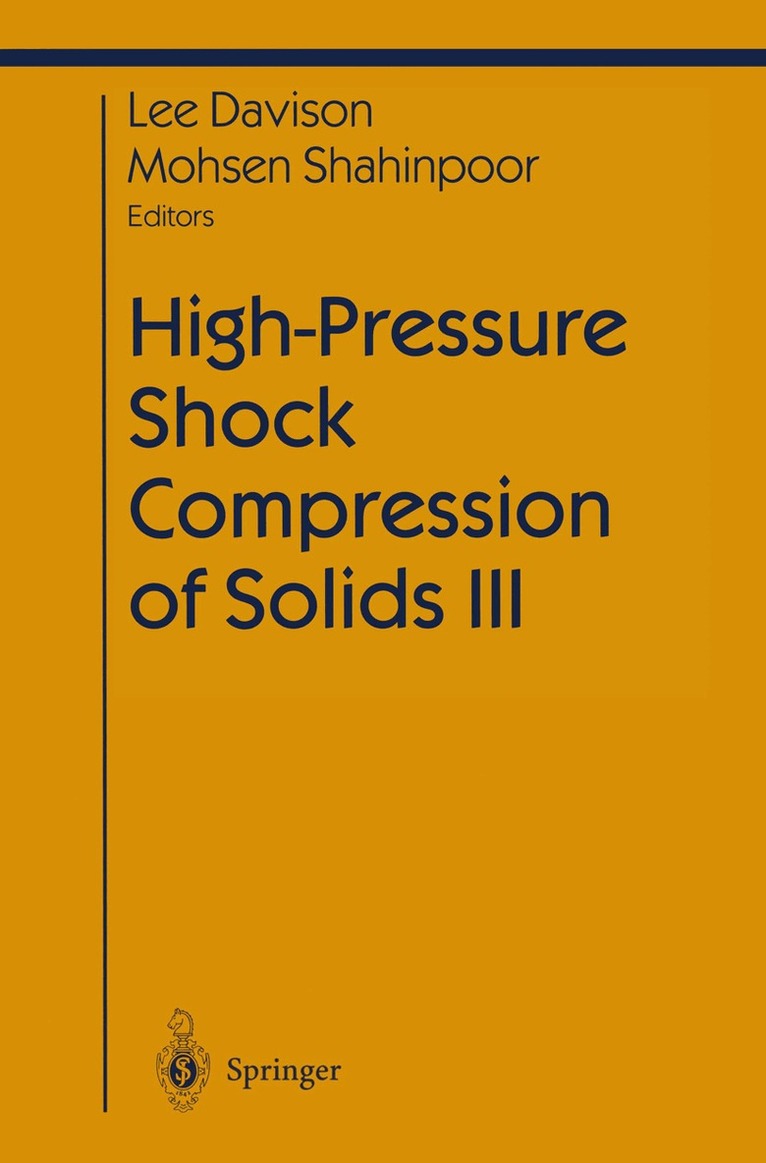
    High-Pressure Shock Compression of Solids III

    AvLee Davison,Mohsen Shahinpoor

    Häftad, Engelska, 2011

    Del i serien Shock Wave and High Pressure Phenomena

    547 kr

    Beställningsvara. Skickas inom 10-15 vardagar. Fri frakt över 249 kr.

    Beskrivning

    Developments in experimental methods are providing an increasingly detailed understanding of shock compression phenomena on the bulk, intermediate, and molecular scales. This third volume in a series of reviews of the curent state of knowledge covers several diverse areas. The first group of chapters addresses fundamental physical and chemical aspects of the response of condensed matter to shock comression: equations of state, molecular-dynamic analysis, deformation of materials, spectroscopic methods. Two further chapters focus on a particular group of materials: ceramics. Another chapter discusses shock-induced reaction of condensed-phase explosives. And a final pair of chapters considers shock phenomena at low stresses from the point of view of continuum mechanics.

    Produktinformation

    • Utgivningsdatum:2011-09-17
    • Mått:155 x 235 x 20 mm
    • Vikt:546 g
    • Format:Häftad
    • Språk:Engelska
    • Serie:Shock Wave and High Pressure Phenomena
    • Antal sidor:341
    • Förlag:Springer-Verlag New York Inc.
    • ISBN:9781461274544

    Utforska kategorier

    • Materietillstånd inom Naturvetenskap och teknik

    Innehållsförteckning

    • 1 Equation of State at High Pressure.- 1.1. Introduction.- 1.2. General Considerations.- 1.3. Some Results.- 1.4. Summary.- References.- 2 Molecular Dynamics Analysis of Shock Phenomena.- 2.1. Introduction.- 2.2. Model and Methods.- 2.3. Nonenergetic A2 Piston-Driven Simulations.- 2.4. Energetic Chemically-Sustained Shock Waves.- 2.5. Conclusions.- Acknowledgments.- References.- 3 Mechanisms of Elastoplastic Response of Metals to Impact.- 3.1. Introduction.- 3.2. Dislocation Motion.- 3.3. Plastic Strain Rate.- 3.4. Comparison with Experiments.- 3.5. High-Amplitude Shock Loading.- 3.6. Elastic and Plastic Waves in Shocks.- 3.7. Electroplastic Effects.- 3.8. Impediments to Dislocation Motion and Crystal Failure.- 3.9. Energy Dissipation by Moving Dislocations.- 3.10. Conclusions.- Acknowledgments.- References.- 4 Molecular Processes in a Shocked Explosive: Time-Resolved Spectroscopy of Liquid Nitromethane.- 4.1. Introduction.- 4.2. Optical Spectroscopy Probes.- 4.3. Shock Response of Nitromethane and Sensitized Nitromethane.- 4.4. Summary and Conclusions.- Acknowledgments.- References.- 5 Effects of Shock Compression on Ceramic Materials.- 5.1. Introduction.- 5.2. Shock Compression Studies on Some Selected Ceramic Materials.- 5.3. Yielding Mechanism and Correlation with Material Characterization.- 5.4. Effects of Shock Compression on Shock-Induced Phase Transition.- 5.5. Concluding Remarks.- References.- 6 Response of High-Strength Ceramics to Plane and Spherical Shock Waves.- 6.1. Introduction.- 6.2. Elements of Experimental Strategy.- 6.3. Uniaxial Deformation by a Plane Shock Wave.- 6.4. Triaxial Deformation by a Divergent Spherical Wave.- 6.5. Conclusions, Prospects, and Recommendations.- References.- 7 Initiation and Propagation of Detonation in Condensed-Phase HighExplosives.- 7.1. Introduction.- 7.2. Brief History of Condensed-Phase Explosive Technology.- 7.3. Planar Steady Detonation Theory.- 7.4. Equations Governing Reactive Flow.- 7.5. Initiation of Detonation.- 7.6. 2D Steady Detonation in Homogeneous and Heterogeneous Materials.- 7.7. Properties of High Explosives.- 7.8. Initiation and Detonation Measurement Techniques.- 7.9. Summary.- 7.10. Glossary.- Acknowledgments.- References.- 8 Analysis of Shock-Induced Damage in Fiber-Reinforced Composites.- 8.1. Introduction.- 8.2. Background.- 8.3. Micromechanical Model.- 8.4. Constitutive Models.- 8.5. Numerical Implementation.- 8.6. Computational Simulations.- 8.7. Summary.- Acknowledgments.- References.- 9 Attenuation of Longitudinal Elastoplastic Pulses.- 9.1. Introduction.- 9.2. Stress and Deformation Fields.- 9.3. Longitudinal Shocks.- 9.4. Material Response Model: Ideal Elastoplasticity at Small Strain.- 9.5. Shock Propagation in a Slab.- 9.6. Elastoplastic Pulse Attenuation.- 9.7. Summary and Conclusions.- 9.A. Appendix: Field Values for Pulse Attenuation in Range C.- 9.B. Appendix: Field Values for Pulse Attenuation in Range D.- 9.C. Appendix: Field Values for Pulse Attenuation in Range E.- References.- Author Index.