• Fri frakt över 249 kr
  • •
  • Snabba leveranser
  • •
  • Billiga böcker
Kundservice

Du är på sajten för privatpersoner.

Företag, bibliotek eller offentlig verksamhet?

Du handlar på classic.bokus.com, där alla dina funktioner finns intakta.
Till classic.bokus.com
Bokus logotyp. Gå till startsidan.
  • Erbjudanden
  • Nyheter
  • Student
  • Topplistor
  • Barn & ungdom
  • Bokus Play
  • E-böcker
  • Pocketböcker
  • Spel & pussel

10% rabatt på allt med kod: NYSTART10 →

Sidfot

Mina sidor

    Hjälp

    • Kundservice
    • Vanliga frågor och svar
    • Frakt och leverans
    • Retur vid ångerrätt
    • Reklamera vara
    • Betalning
    • Köpvillkor
    • Allmänna villkor
    • Information om webbplatsens tillgänglighet

    Om Bokus

    • Om oss
    • Pressrum
    • För studenter
    • För företag
    • För bibliotek och offentlig verksamhet
    • För leverantörer
    • Hållbarhet

    Populärt

    • Aktuella erbjudanden
    • Presentkort
    • Studentlitteratur
    • Nya böcker
    • Topplistor
    • Signerade böcker
    • Engelska böcker

    Inspiration

    • Boktips
    • BookTok
    • Populära bokserier
    • Barnbokskaraktärer
    • Populära författare
    Logotyp för Bokus
    Följ oss på Facebook (extern länk)Följ oss på Instagram (extern länk)Följ oss på YouTube (extern länk)Följ oss på TikTok (extern länk)
    bokus @ CookiesAnpassa cookiesIntegritetspolicyKöpvillkor
    Till Citymail hemsida (extern länk)Till Budbee hemsida (extern länk)Till Postnord hemsida (extern länk)Till Schenker hemsida (extern länk)Till Early Bird hemsida (extern länk)Till Walleys hemsida (extern länk)
    1. Naturvetenskap och teknik
    2. Teknik och industri
    3. Elektronik och kommunikationer

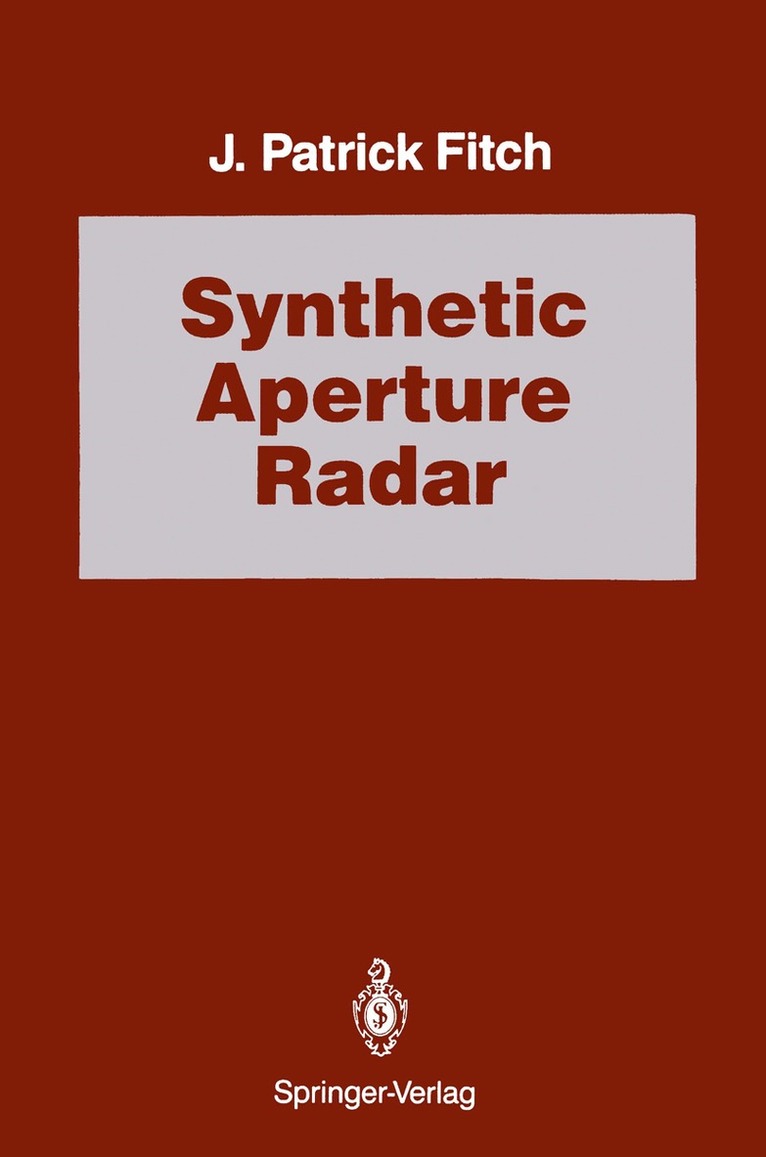
    Synthetic Aperture Radar

    AvJ. Patrick Fitch

    Häftad, Engelska, 2011

    Del i serien Signal Processing and Digital Filtering

    547 kr

    Beställningsvara. Skickas inom 10-15 vardagar. Fri frakt över 249 kr.

    Fler format och utgåvor

    E-bok

    710 kr

    Beskrivning

    Radar, like most well developed areas, has its own vocabulary. Words like Doppler frequency, pulse compression, mismatched filter, carrier frequency, in-phase, and quadrature have specific meaning to the radar engineer. In fact, the word radar is actually an acronym for RAdio Detection And Rang­ ing. Even though these words are well defined, they can act as road blocks which keep people without a radar background from utilizing the large amount of data, literature, and expertise within the radar community. This is unfortunate because the use of digital radar processing techniques has made possible the analysis of radar signals on many general purpose digi­ tal computers. Of special interest are the surface mapping radars, such as the Seasat and the shuttle imaging radars, which utilize a technique known as synthetic aperture radar (SAR) to create high resolution images (pic­ tures). This data appeals to cartographers, agronomists, oceanographers, and others who want to perform image enhancement, parameter estima­ tion, pattern recognition, and other information extraction techniques on the radar imagery. The first chapter presents the basics of radar processing: techniques for calculating range (distance) by measuring round trip propagation times for radar pulses. This is the same technique that sightseers use when calculat­ ing the width of a canyon by timing the round trip delay using echoes. In fact, the corresponding approach in radar is usually called the pulse echo technique.

    Produktinformation

    • Utgivningsdatum:2011-10-08
    • Mått:155 x 235 x 11 mm
    • Vikt:289 g
    • Format:Häftad
    • Språk:Engelska
    • Serie:Signal Processing and Digital Filtering
    • Antal sidor:170
    • Förlag:Springer-Verlag New York Inc.
    • ISBN:9781461283669

    Utforska kategorier

    • Elektronik och kommunikationer inom Naturvetenskap och teknik

    Innehållsförteckning

    • 1 Radar Processing.- 1.1 Radar: A Well Defined Problem.- 1.2 Transmitting and Receiving.- 1.3 Digital Processing of Radar Returns.- 1.4 Seasat Radar Processing.- 1.5 Summary of Radar Processing.- 1.6 References.- 1.7 Problems.- 2 Radar Imaging.- 2.1 Restrictions on Antenna Size.- 2.2 Antenna Arrays.- 2.3 Synthetic. Antenna Arrays.- 2.4 Airborne Synthetic Arrays.- 2.5 Matched Filter Interpretation.- 2.6 Model of the Antenna — Target Motion.- 2.7 Doppler Frequency Shift.- 2.8 Digital Implementation Considerations.- 2.9 Seasat Image Reconstruction.- 2.10 Summary of Radar Imaging.- 2.11 References.- 2.12 Problems.- 3 Optical Processing Of SAR Data.- 3.1 Optical Signal Processing.- 3.2 SAR Processor.- 3.3 Response to a Point Target.- 3.4 Holographic Interpretation.- 3.5 Advances in Optical Processing.- 3.6 Summary of Optical Processing Techniques.- 3.7 References.- 3.8 Problems.- 4 Related Algorithms: An Overview.- 4.1 Ultrasonic Inspection—SAFT-UT.- 4.2 Tomography.- 4.3 Spotlight Mode SAR.- 4.4 Inverse SAR.- 4.5 Summary of Related Algorithms.- 4.6 References.- 4.7 Problems.- A Signal Processing Tools.- A.1 Sampling Continuous Time Signals.- A.2 Specifying A Model: Linear Systems.- A.3 The Convolution Representation.- A.4 Fast Convolution with FFTs.- A.5 Summary of Signal Processing Tools.- A.6 References.- A.7 Problems.- B Matched Filter Derivation.- B.1 Problem Definition.- B.2 Optimization: Maximizing the SNR.- B.3 Example Assuming White Noise.- B.4 Summary of Matched Filter Statistics.- B.5 References.- B.6 Problems.- C Matched Filter Implementation.- C.1 Eliminating The Bit Reversal Operation.- C.2 FFT of a Real Valued Sequence.- C.3 Summary of Implementation Considerations.- C.4 References.- C.5 Problems.- D Solutions to Exercises.