• Fri frakt över 249 kr
  • •
  • Snabba leveranser
  • •
  • Billiga böcker
Kundservice

Du är på sajten för privatpersoner.

Företag, bibliotek eller offentlig verksamhet?

Du handlar på classic.bokus.com, där alla dina funktioner finns intakta.
Till classic.bokus.com
Bokus logotyp. Gå till startsidan.
  • Erbjudanden
  • Nyheter
  • Student
  • Topplistor
  • Barn & ungdom
  • Bokus Play
  • E-böcker
  • Pocketböcker
  • Spel & pussel

10% rabatt på allt med kod NYSTART10 →

Sidfot

Mina sidor

    Hjälp

    • Kundservice
    • Vanliga frågor och svar
    • Frakt och leverans
    • Retur vid ångerrätt
    • Reklamera vara
    • Betalning
    • Köpvillkor
    • Allmänna villkor
    • Information om webbplatsens tillgänglighet

    Om Bokus

    • Om oss
    • Pressrum
    • För studenter
    • För företag
    • För bibliotek och offentlig verksamhet
    • För leverantörer
    • Hållbarhet

    Populärt

    • Aktuella erbjudanden
    • Presentkort
    • Studentlitteratur
    • Nya böcker
    • Topplistor
    • Signerade böcker
    • Engelska böcker

    Inspiration

    • Boktips
    • BookTok
    • Populära bokserier
    • Barnbokskaraktärer
    • Populära författare
    Logotyp för Bokus
    Följ oss på Facebook (extern länk)Följ oss på Instagram (extern länk)Följ oss på YouTube (extern länk)Följ oss på TikTok (extern länk)
    bokus @ CookiesAnpassa cookiesIntegritetspolicyKöpvillkor
    Till Citymail hemsida (extern länk)Till Budbee hemsida (extern länk)Till Postnord hemsida (extern länk)Till Schenker hemsida (extern länk)Till Early Bird hemsida (extern länk)Till Walleys hemsida (extern länk)
    1. Filosofi och religion
    2. Filosofi
    3. Filosofiska discipliner

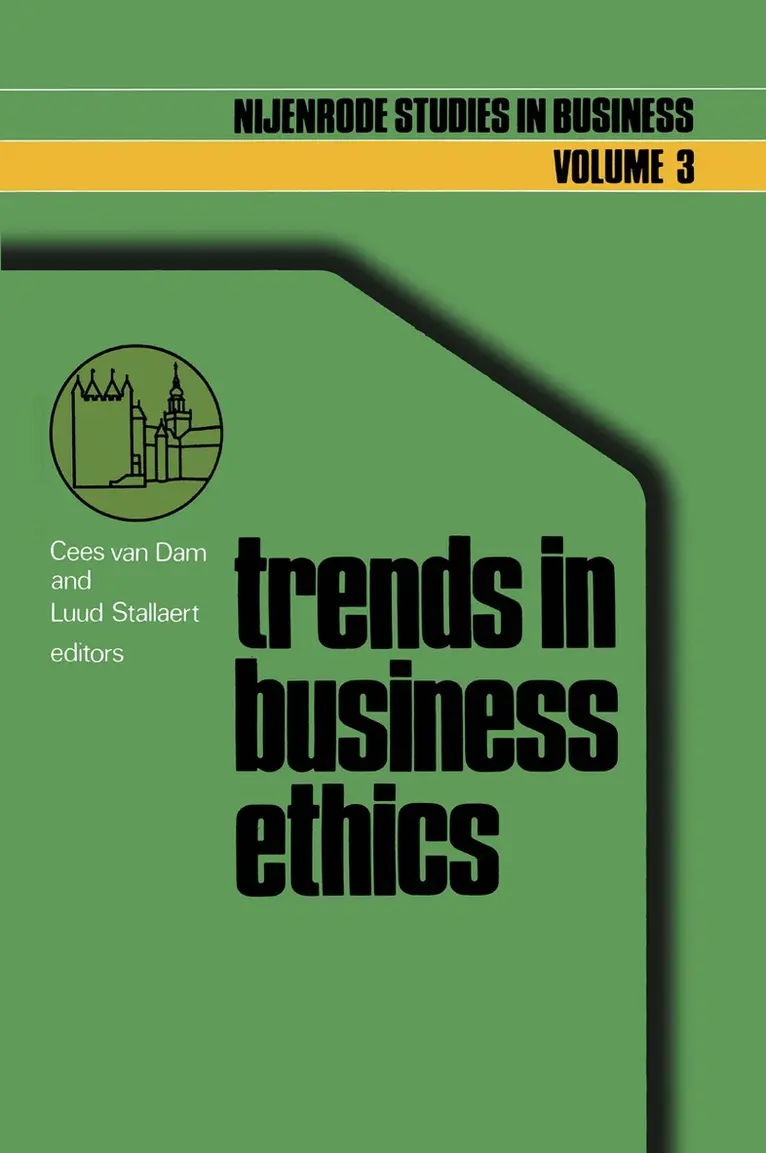
    Trends in business ethics

    Implications for decision-making

    AvCees van Dam,L. Stallaert

    Häftad, Engelska, 2011

    Del 3 i serien Nijenrode Studies in Business

    546 kr

    Beställningsvara. Skickas inom 10-15 vardagar. Fri frakt över 249 kr.

    Beskrivning

    In August 1976 the research seminar 'Decision-making in business' was organized at Nijenrode, The Netherlands School of Business. More than fifty scientists and practitioners from nine countries presented research papers in one of the six discussion groups. Some ofthem also presented some of their ideas in front of a large mixed audience at a one-day symposium. Many of the papers presented at Nijenrode were of such a high quality that the decision to publish a selection of them was an easy one. At the same time the new series Nijenrode studies in business was initiated. All who were involved, the policy committee 'Of the Nijenrode studies, the advisory and editorial board of the series, the publisher, and the organizing committee of the seminar and symposium, acclaimed the idea of publishing three volumes in the new series. A collection of eleven papers could be grouped under the title Trends in managerial andfinancial accounting, and has been published as volume 1 of this series. A collection of fourteen papers has been published as the second volume under the title Trends in financial decision­ making, while this volume, consisting of twelve papers (and an introduction) explores the theme Trends in business ethics. The introduction by Stanley L. Jakiwas written for the symposium. It suggests why the papers of Pjotr Hesseling, Antoine Kreykamp, and Richard H. Viola, which were not presented at Nijenrode, are introduced here.

    Produktinformation

    • Utgivningsdatum:2011-11-08
    • Mått:152 x 229 x 11 mm
    • Vikt:293 g
    • Format:Häftad
    • Språk:Engelska
    • Serie:Nijenrode Studies in Business
    • Antal sidor:190
    • Förlag:Springer-Verlag New York Inc.
    • ISBN:9781461340614

    Utforska kategorier

    • Filosofiska discipliner inom Filosofi och religion

    Innehållsförteckning

    • I. Decision-making in business: amoral?.- II. Standards and values in the business enterprise.- 1. Introduction.- 2. The growing pluriformity of our value judgements.- 3. Ethical problems are nearly always problems of choice.- 4. The gap between moralists and entrepreneurs.- 5. The company’s changing raison d’etre: towards unity of values and objectives.- 6. Choice is common to ethical action and economic action.- 7. Who is the bearer of the standards for an organisation?.- 8. Standards as actualised values.- III. Theses on man and private enterprise.- 1. On Man.- 2. On Man’s Organisations.- 3. On Private Enterprise: Its Purposes and Responsibilities.- 4. On International Private Enterprise.- IV. A moral interregnum for multinationals in the Third World?.- 1. The nature of formal organizations.- 2. Personal responsibility.- 3. The need for an intermediate level of business ethos.- 4. The development gap.- 5. Some proposals.- 6. Conclusions.- V. Trade unionism and ethics.- 1. Introduction.- 2. Individualism or collectivism?.- 3. The Christian-social idea.- 4. Some consequences for social ethics.- 5. The structure of the modern enterprise.- 6. A social bill of rights.- VI. Moral policy and public policy.- 1. The ethical component in public policy?.- 2. What makes public policy different?.- 3. Fetal research.- 4. Doctors, experts, politicians or laymen?.- 5. The backdrop.- VII. Power and legitimation.- 1. Introduction.- 2. Personal and structural violence.- 3. Can power be legitimated?.- 4. Is the problem of legitimation correlated with seeking the truth?.- VIII. The social responsibility of business.- 1. Introduction.- 2. Economic theory and ethics.- 3. The social responsibility of business.- IX. A reconnaissance into technology and ethics.- 1. A challenging offer.-2. Narrowing consciousness.- 3. Research and development.- 4. Emancipation.- 5. Current questions concerning research and development.- 6. Agoraphobia.- 7. I am more than.- 8. Blinding specialization.- 9. Apparent illumination.- 10. Visible impotence.- 11. Still, the show must go on.- 12. Shocking information.- 13. Beyond science.- 14. Ethical problems are are-problems.- 15. World models only provide material.- 16. An ethical chat by the fire-side.- 17. Unschooled on wasteland.- X. The business corporation and human values.- 1. Introduction.- 2. The problem of organizational life.- 3. The need for a new organizational analysis.- 4. Effects of decision makers’ myopia.- 5. The meaning of values.- 6. A new perspective.- 7. A new understanding of morality.- 8. The age of technology and its impact on human values.- 9. Conclusions.- XI. Ethics and profit.- 1. The illusion of objectivity.- 2. The meaning of ethics.- 3. Goals of business.- 4. Profit and ethics.- XII. Ethics and the science of decision-making in business: A specification of perspectives.- 1. Perspectives on science.- 2. Perspectives on decision-making.- 3. Perspectives on ethics.- XIII. Incorporating ethics in business decision-making.- 1. Introduction.- 2. Decision-making in business situations.- 3. Ethics and social responsibility.- 4. Incorporation of social responsibility in laws and guidelines.- 5. Goals of firms and participants in the decision-making process.- 6. Decision-makers and ethics.- 7. Conclusion.