• Fri frakt över 249 kr
  • •
  • Snabba leveranser
  • •
  • Billiga böcker
Kundservice

Du är på sajten för privatpersoner.

Företag, bibliotek eller offentlig verksamhet?

Du handlar på classic.bokus.com, där alla dina funktioner finns intakta.
Till classic.bokus.com
Bokus logotyp. Gå till startsidan.
  • Erbjudanden
  • Student
  • Topplistor
  • Barn & ungdom
  • Bokus Play
  • E-böcker
  • Ljudböcker
  • Pocketböcker
  • Spel och pussel

5% studentrabatt – använd koden KURSBOK27 →

Sidfot

Mina sidor

    Hjälp

    • Kundservice
    • Vanliga frågor och svar
    • Frakt och leverans
    • Retur vid ångerrätt
    • Reklamera vara
    • Betalning
    • Köpvillkor
    • Allmänna villkor
    • Information om webbplatsens tillgänglighet

    Om Bokus

    • Om oss
    • Pressrum
    • För studenter
    • För företag
    • För bibliotek och offentlig verksamhet
    • För leverantörer
    • Hållbarhet

    Populärt

    • Aktuella erbjudanden
    • Presentkort
    • Studentlitteratur
    • Nya böcker
    • Topplistor
    • Signerade böcker
    • Engelska böcker

    Inspiration

    • Boktips
    • BookTok
    • Barnbokskaraktärer
    • Populära författare
    Logotyp för Bokus
    Följ oss på Facebook (extern länk)Följ oss på Instagram (extern länk)Följ oss på YouTube (extern länk)Följ oss på TikTok (extern länk)
    bokus @ CookiesAnpassa cookiesIntegritetspolicyKöpvillkor
    Till Citymail hemsida (extern länk)Till Budbee hemsida (extern länk)Till Postnord hemsida (extern länk)Till Schenker hemsida (extern länk)Till Early Bird hemsida (extern länk)Till Walleys hemsida (extern länk)
    1. Naturvetenskap och teknik
    2. Teknik och industri
    3. Elektronik och kommunikationer

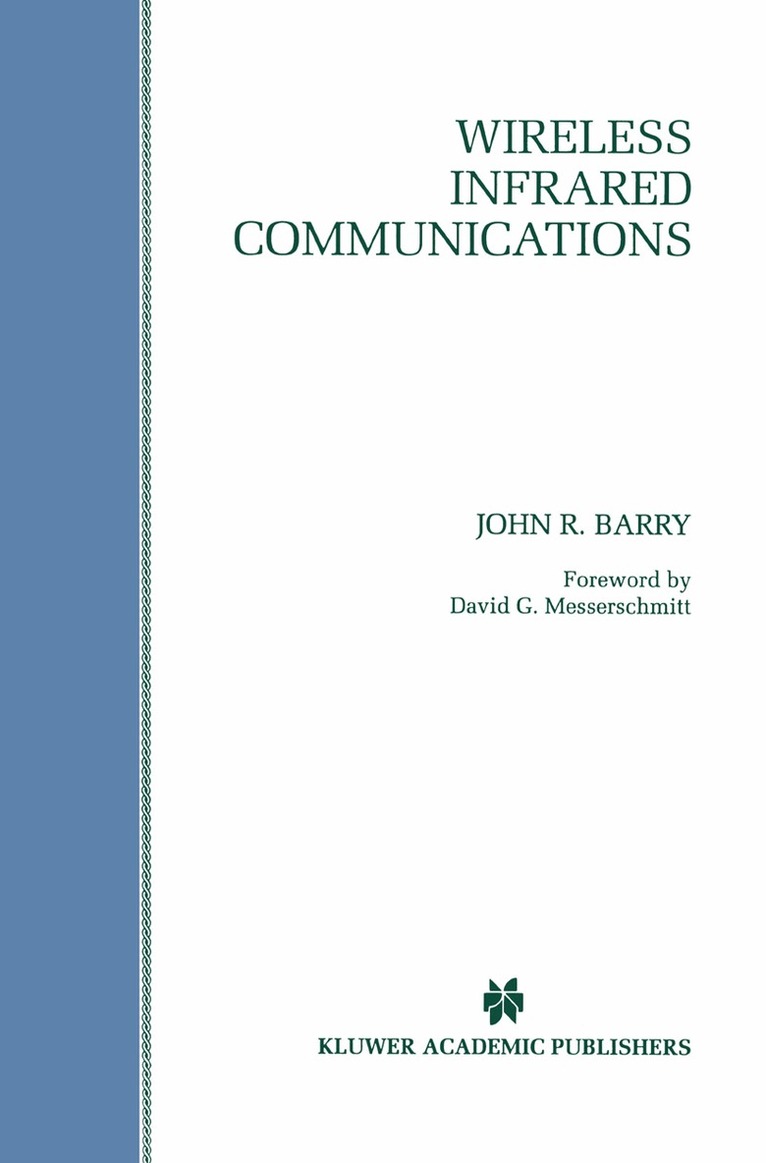
    Wireless Infrared Communications

    AvJohn R. Barry

    Häftad, Engelska, 2012

    Del 280 i serien Springer International Series in Engineering and Computer Science

    1 078 kr

    Beställningsvara. Skickas inom 10-15 vardagar. Fri frakt över 249 kr.

    Fler format och utgåvor

    Inbunden

    1 078 kr

    E-bok

    1 413 kr

    Beskrivning

    The demand for wireless access to network services is growing in virtually all communications and computing applications. Once accustomed to unteathered opera­ tion, users resent being tied to a desk or a fixed location, but will endure it when there is some substantial benefit, such as higher resolution or bandwidth. Recent technolog­ ical advances, however, such as the scaling of VLSI, the development of low-power circuit design techniques and architectures, increasing battery energy capacity, and advanced displays, are rapidly improving the capabilities of wireless devices. Many of the technological advances contributing to this revolution pertain to the wireless medium itself. There are two viable media: radio and optical. In radio, spread-spectrum techniques allow different users and services to coexist in the same bandwidth, and new microwave frequencies with plentiful bandwidth become viable as the speed of the supporting low-cost electronics increases. Radio has the advantage of being available ubiquitously indoors and outdoors, with the possibility of a seam­ less system infrastructure that allows users to move between the two. There are unan­ swered (but likely to be benign) biological effects of microwave radiation at higher power densities. Optical communications is enhanced by advances in photonic devices, such as semiconductor lasers and detectors. Optical is primarily an indoor technology - where it need not compete with sunlight - and offers advantages such as the immediate availability of a broad bandwidth without the need for regulatory approval.

    Produktinformation

    • Utgivningsdatum:2012-10-08
    • Mått:155 x 235 x 11 mm
    • Vikt:300 g
    • Format:Häftad
    • Språk:Engelska
    • Serie:Springer International Series in Engineering and Computer Science
    • Antal sidor:181
    • Förlag:Springer-Verlag New York Inc.
    • ISBN:9781461361626

    Utforska kategorier

    • Elektronik och kommunikationer inom Naturvetenskap och teknik
    • Energiteknik inom Naturvetenskap och teknik
    • Systemvetenskap och AI inom Data och IT

    Innehållsförteckning

    • 1. Introduction.- 1.1 Comparison of Infrared and Radio Communications.- 1.2 The Wireless Infrared Channel.- 1.3 History of Wireless Infrared Communications.- 1.4 A High-Speed Wireless LAN.- 1.5 Optoelectronic Components.- 1.6 Outline.- 2. Link Analysis and Optics Design.- 2.1 Introduction.- 2.2 Thin-Film Optical Filters.- 2.3 Truncated Spherical Concentrators.- 2.4 Joint Optimization of Transmitter and Filter.- 2.5 Summary and Conclusions.- 3. Receiver Design.- 3.1 Introduction.- 3.2 Limitations on Photodetector Bandwidth.- 3.3 Analysis of Current-Feedback Pair.- 3.4 Optimal Filtering for Quadratic Noise Spectrum.- 3.5 Choosing the Right Transistor.- 3.6 Design Procedures.- 3.7 Optional Design Embellishments.- 3.8 Summary and Conclusions.- 4. Modeling Multipath Dispersion.- 4.1 Introduction.- 4.2 Models for Diffuse Reflectors and Transmitters.- 4.3 Multiple-Bounce Impulse Response.- 4.4 Simulation and Experimental Results.- 4.5 Multipath-Induced Power Penalty.- 4.6 Summary.- 5. Modulation and Equalization.- 5.1 Intensity Modulation and Direct Detection.- 5.2 Binary Modulation.- 5.3 Multi-Level Modulation.- 5.4 Discussion.- 5.5 ML Sequence Detection and Equalization for PPM.- 5.6 Coherent Optical Communication.- 5.7 Summary.- 6. System-Level Issues.- 6.1 Introduction.- 6.2 Single-Cell Architectures.- 6.3 Overlapping Cells.- 6.4 Summary.- 7. Conclusions and Future Work.- 7.1 Conclusions.- 7.2 Future Work.- References.- A. Power Efficiency on the Linear Gaussian-Noise Channel.