• Fri frakt över 249 kr
  • •
  • Snabba leveranser
  • •
  • Billiga böcker
Kundservice

Du är på sajten för privatpersoner.

Företag, bibliotek eller offentlig verksamhet?

Du handlar på classic.bokus.com, där alla dina funktioner finns intakta.
Till classic.bokus.com
Bokus logotyp. Gå till startsidan.
  • Erbjudanden
  • Nyheter
  • Student
  • Topplistor
  • Barn & ungdom
  • Bokus Play
  • E-böcker
  • Pocketböcker
  • Spel & pussel

10% studentrabatt med kod TERM26

Sidfot

Mina sidor

    Hjälp

    • Kundservice
    • Vanliga frågor och svar
    • Frakt och leverans
    • Retur vid ångerrätt
    • Reklamera vara
    • Betalning
    • Köpvillkor
    • Allmänna villkor
    • Information om webbplatsens tillgänglighet

    Om Bokus

    • Om oss
    • Pressrum
    • För studenter
    • För företag
    • För bibliotek och offentlig verksamhet
    • För leverantörer
    • Hållbarhet

    Populärt

    • Aktuella erbjudanden
    • Presentkort
    • Studentlitteratur
    • Nya böcker
    • Topplistor
    • Signerade böcker
    • Engelska böcker

    Inspiration

    • Boktips
    • BookTok
    • Populära bokserier
    • Barnbokskaraktärer
    • Populära författare
    Logotyp för Bokus
    Följ oss på Facebook (extern länk)Följ oss på Instagram (extern länk)Följ oss på YouTube (extern länk)Följ oss på TikTok (extern länk)
    bokus @ CookiesAnpassa cookiesIntegritetspolicyKöpvillkor
    Till Citymail hemsida (extern länk)Till Budbee hemsida (extern länk)Till Postnord hemsida (extern länk)Till Schenker hemsida (extern länk)Till Early Bird hemsida (extern länk)Till Walleys hemsida (extern länk)
    1. Naturvetenskap och teknik
    2. Teknik och industri
    3. Energiteknik

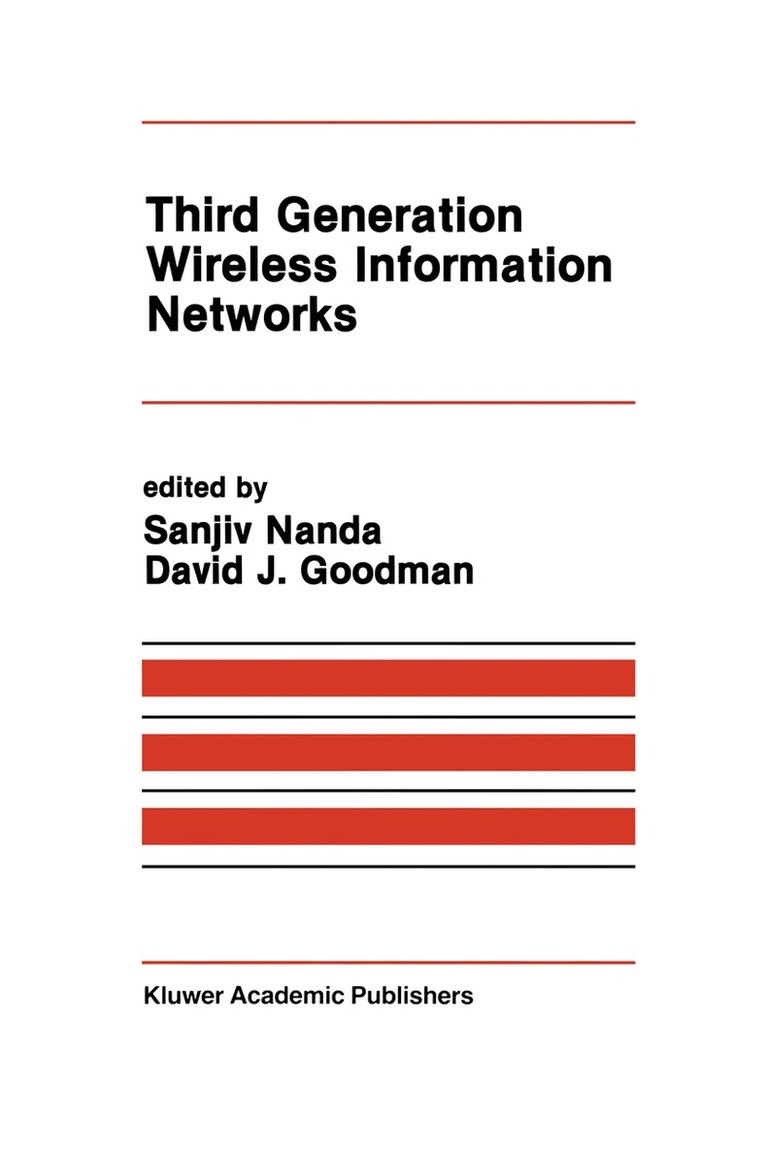
    Third Generation Wireless Information Networks

    AvDavid J. Goodman,Sanjiv Nanda

    Häftad, Engelska, 2012

    Del 156 i serien Springer International Series in Engineering and Computer Science

    1 634 kr

    Beställningsvara. Skickas inom 10-15 vardagar. Fri frakt över 249 kr.

    Beskrivning

    Rutgers University launched WINLAB in 1989, just as the communications industry, the Federal government, and the financial community in the United States, were waking up to the growing public appetite for wireless communications and to the shortage of technology to feed it. The secret was already out in Europe, where no fewer than three new cordless and cellular systems were progressing from drawing board to laboratory to factory to consumers. In July 1989, the FCC held a well-attended tutorial that turned into a debate over whether second generation British or Swedish technology held the key to mass-market personal communications. Many in the audience wondered whether United States technology was out of the picture. Technology uncertainties are more acute in wireless communications than in any other information service. For example multi-gigabit optical fiber communications have followed an orderly progression from basic science leading to technology, which in turn stimulated standards, and then commercial products. Eventually applications will be found and industry and society at large will reap the benefits. By contrast, the applications of wireless communications are apparent to an eager public. A large market exists but is held in check by a shortage of capacity. The demand has led the cellular industry to formulate standards for advanced systems before the technology is in place to implement them. Everyone holds their breath waiting to observe performance of the first products. Gaps in basic science add to the uncertainty and forestall the resolution of technological debates.

    Produktinformation

    • Utgivningsdatum:2012-10-12
    • Mått:160 x 240 x 19 mm
    • Vikt:538 g
    • Format:Häftad
    • Språk:Engelska
    • Serie:Springer International Series in Engineering and Computer Science
    • Antal sidor:317
    • Upplaga:1992
    • Förlag:Springer-Verlag New York Inc.
    • ISBN:9781461367949

    Utforska kategorier

    • Energiteknik inom Naturvetenskap och teknik
    • Hårdvara inom Data och IT

    Innehållsförteckning

    • 1. Developments in Wireless Communications - Navigating the Regulatory Morass.- 2. Why do We Need Standards for Mobile/Wireless Communications.- 3. Standards for Global Personal Communications Services.- 4. WIN with OSI.- 5. Trellis Coding for Full-Response CPM.- 6. Design Considerations for a Future Portable Multimedia Terminal.- 7. Dynamic Resource Acquisition: Distributed Carrier Allocation for Tdma Cellular Systems.- 8. On Dynamic Channel Allocation in Cellular/Wireless Networks.- 9. A Radio-Local Area Network with Efficient Resource Allocation.- 10. Radio Channel Control for a Multi-Carrier TDMA Microcell System.- 11. Models for Call Hand-Off Schemes in Cellular Communication Networks.- 12. Handoff in Microcellular Based Personal Telephone Systems.- 13. Sip Simulation for Urban Microcells.- 14. Evaluation of VTS CSMA for Media Access Control in Land Mobile Data Communication.- 15. Analytical Performance Evaluation of the R-BTMA Mac Protocol.- 16. A Multiple Access Technique for Radio-Local Area Networks.- 17. Spread Spectrum Wireless Information Networks for the Small Office.- 18. An Overview of Code Division Multiple Access (CDMA) Applied to the Design of Personal Communications Networks.- 19. CDMA Power Control for Wireless Networks.