• Fri frakt över 249 kr
  • •
  • Snabba leveranser
  • •
  • Billiga böcker
Kundservice

Du är på sajten för privatpersoner.

Företag, bibliotek eller offentlig verksamhet?

Du handlar på classic.bokus.com, där alla dina funktioner finns intakta.
Till classic.bokus.com
Bokus logotyp. Gå till startsidan.
  • Erbjudanden
  • Nyheter
  • Student
  • Topplistor
  • Barn & ungdom
  • Bokus Play
  • E-böcker
  • Pocketböcker
  • Spel & pussel

10% rabatt på allt med kod: NYSTART10 →

Sidfot

Mina sidor

    Hjälp

    • Kundservice
    • Vanliga frågor och svar
    • Frakt och leverans
    • Retur vid ångerrätt
    • Reklamera vara
    • Betalning
    • Köpvillkor
    • Allmänna villkor
    • Information om webbplatsens tillgänglighet

    Om Bokus

    • Om oss
    • Pressrum
    • För studenter
    • För företag
    • För bibliotek och offentlig verksamhet
    • För leverantörer
    • Hållbarhet

    Populärt

    • Aktuella erbjudanden
    • Presentkort
    • Studentlitteratur
    • Nya böcker
    • Topplistor
    • Signerade böcker
    • Engelska böcker

    Inspiration

    • Boktips
    • BookTok
    • Populära bokserier
    • Barnbokskaraktärer
    • Populära författare
    Logotyp för Bokus
    Följ oss på Facebook (extern länk)Följ oss på Instagram (extern länk)Följ oss på YouTube (extern länk)Följ oss på TikTok (extern länk)
    bokus @ CookiesAnpassa cookiesIntegritetspolicyKöpvillkor
    Till Citymail hemsida (extern länk)Till Budbee hemsida (extern länk)Till Postnord hemsida (extern länk)Till Schenker hemsida (extern länk)Till Early Bird hemsida (extern länk)Till Walleys hemsida (extern länk)
    1. Naturvetenskap och teknik
    2. Teknik och industri
    3. Elektronik och kommunikationer

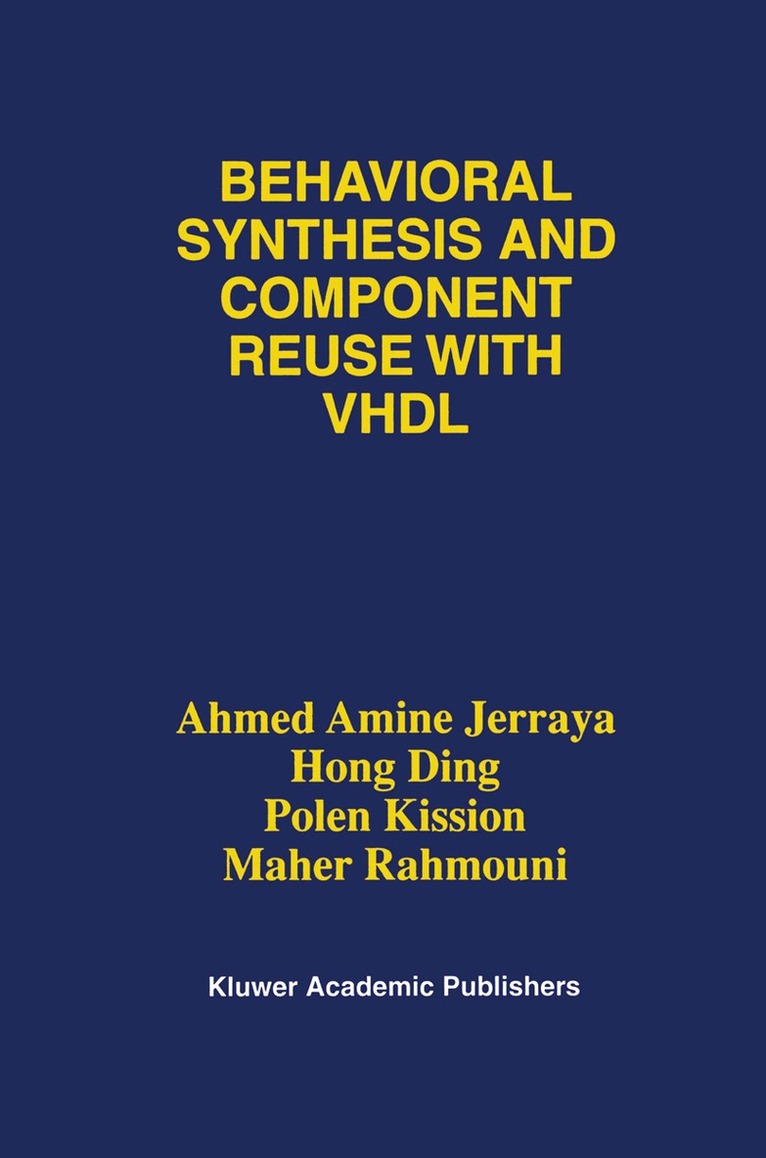
    Behavioral Synthesis and Component Reuse with VHDL

    AvAhmed Amine Jerraya,Hong Ding

    Häftad, Engelska, 2012

    1 625 kr

    Beställningsvara. Skickas inom 10-15 vardagar. Fri frakt över 249 kr.

    Fler format och utgåvor

    Inbunden

    1 673 kr

    Beskrivning

    Improvement in the quality of integrated circuit designs and a designer's productivity can be achieved by a combination of two factors: Using more structured design methodologies for extensive reuse of existing components and subsystems. It seems that 70% of new designs correspond to existing components that cannot be reused because of a lack of methodologies and tools. Providing higher level design tools allowing to start from a higher level of abstraction. After the success and the widespread acceptance of logic and RTL synthesis, the next step is behavioral synthesis, commonly called architectural or high-level synthesis. Behavioral Synthesis and Component Reuse with VHDL provides methods and techniques for VHDL based behavioral synthesis and component reuse. The goal is to develop VHDL modeling strategies for emerging behavioral synthesis tools. Special attention is given to structured and modular design methods allowing hierarchical behavioral specification and design reuse. The goal of this book is not to discuss behavioral synthesis in general or to discuss a specific tool but to describe the specific issues related to behavioral synthesis of VHDL description. This book targets designers who have to use behavioral synthesis tools or who wish to discover the real possibilities of this emerging technology. The book will also be of interest to teachers and students interested to learn or to teach VHDL based behavioral synthesis.

    Produktinformation

    • Utgivningsdatum:2012-10-10
    • Mått:155 x 235 x 16 mm
    • Vikt:441 g
    • Format:Häftad
    • Språk:Engelska
    • Antal sidor:263
    • Förlag:Springer-Verlag New York Inc.
    • ISBN:9781461378990

    Utforska kategorier

    • Elektronik och kommunikationer inom Naturvetenskap och teknik
    • CAD-program inom Data och IT
    • Energiteknik inom Naturvetenskap och teknik

    Innehållsförteckning

    • 1 Introduction.- 1.1 System Design: the Productivity Bottleneck.- 1.2 From Physical Design to System Design: Abstraction Levels.- 1.3 Behavioral Synthesis.- 1.4 Design Reuse.- 1.5 Component Reuse in VLSI.- 1.6 Modular Design Methodology for Component Reuse at the Behavioral Level.- 1.7 Summary.- 2 Models for Behavioral Synthesis.- 2.1 Design representation for behavioral synthesis.- 2.2 The datapath controller model.- 2.3 Datapath models.- 2.4 Controller models.- 2.5 Summary.- 3 VHDL Modeling for Behavioral Synthesis.- 3.1 Interpretation of VHDL descriptions.- 3.2 Behavioral VHDL execution modes.- 3.3 Scheduling VHDL descriptions.- 3.4 Summary.- 4 Behavioral VHDL Description Styles for Design Reuse.- 4.1 Design reuse.- 4.2 Design reuse at the behavioral level.- 4.3 Modular design.- 4.4 VHDL modeling for reuse.- 4.5 Towards object oriented design in VHDL.- 4.6 Summary.- 5 Anatomy of a Behavioral Synthesis System Based on VHDL.- 5.1 Main principles.- 5.2 Design steps and execution models.- 5.3 Interactive synthesis.- 5.4 Behavioral synthesis in the design loop.- 5.5 Summary.- 6 Case Study: Hierarchical Design Using Behavioral Synthesis.- 6.1 The PID.- 6.2 Specifications.- 6.3 System-level analysis and partitioning.- 6.4 Hierarchical Design.- 6.5 Design for reuse of the fixed-point unit as a behavioral component.- 6.6 Abstraction for reuse.- 6.7 Design reuse.- 6.8 The behavioral synthesis process.- 6.9 Summary.- 7 Case Study: Modular Design Using Behavioral Synthesis.- 7.1 Introduction.- 7.2 System specification.- 7.3 System partitioning.- 7.4 Behavioral specifications of subsystems.- 7.5 System design.- 7.6 Behavioral and RTL simulations.- 7.7 Summary.- References.