• Fri frakt över 249 kr
  • •
  • Snabba leveranser
  • •
  • Billiga böcker
Kundservice

Du är på sajten för privatpersoner.

Företag, bibliotek eller offentlig verksamhet?

Du handlar på classic.bokus.com, där alla dina funktioner finns intakta.
Till classic.bokus.com
Bokus logotyp. Gå till startsidan.
  • Erbjudanden
  • Nyheter
  • Student
  • Topplistor
  • Barn & ungdom
  • Bokus Play
  • E-böcker
  • Pocketböcker
  • Spel & pussel

10% rabatt på allt med kod NYSTART10 →

Sidfot

Mina sidor

    Hjälp

    • Kundservice
    • Vanliga frågor och svar
    • Frakt och leverans
    • Retur vid ångerrätt
    • Reklamera vara
    • Betalning
    • Köpvillkor
    • Allmänna villkor
    • Information om webbplatsens tillgänglighet

    Om Bokus

    • Om oss
    • Pressrum
    • För studenter
    • För företag
    • För bibliotek och offentlig verksamhet
    • För leverantörer
    • Hållbarhet

    Populärt

    • Aktuella erbjudanden
    • Presentkort
    • Studentlitteratur
    • Nya böcker
    • Topplistor
    • Signerade böcker
    • Engelska böcker

    Inspiration

    • Boktips
    • BookTok
    • Populära bokserier
    • Barnbokskaraktärer
    • Populära författare
    Logotyp för Bokus
    Följ oss på Facebook (extern länk)Följ oss på Instagram (extern länk)Följ oss på YouTube (extern länk)Följ oss på TikTok (extern länk)
    bokus @ CookiesAnpassa cookiesIntegritetspolicyKöpvillkor
    Till Citymail hemsida (extern länk)Till Budbee hemsida (extern länk)Till Postnord hemsida (extern länk)Till Schenker hemsida (extern länk)Till Early Bird hemsida (extern länk)Till Walleys hemsida (extern länk)
    1. Data och IT
    2. Systemvetenskap och AI

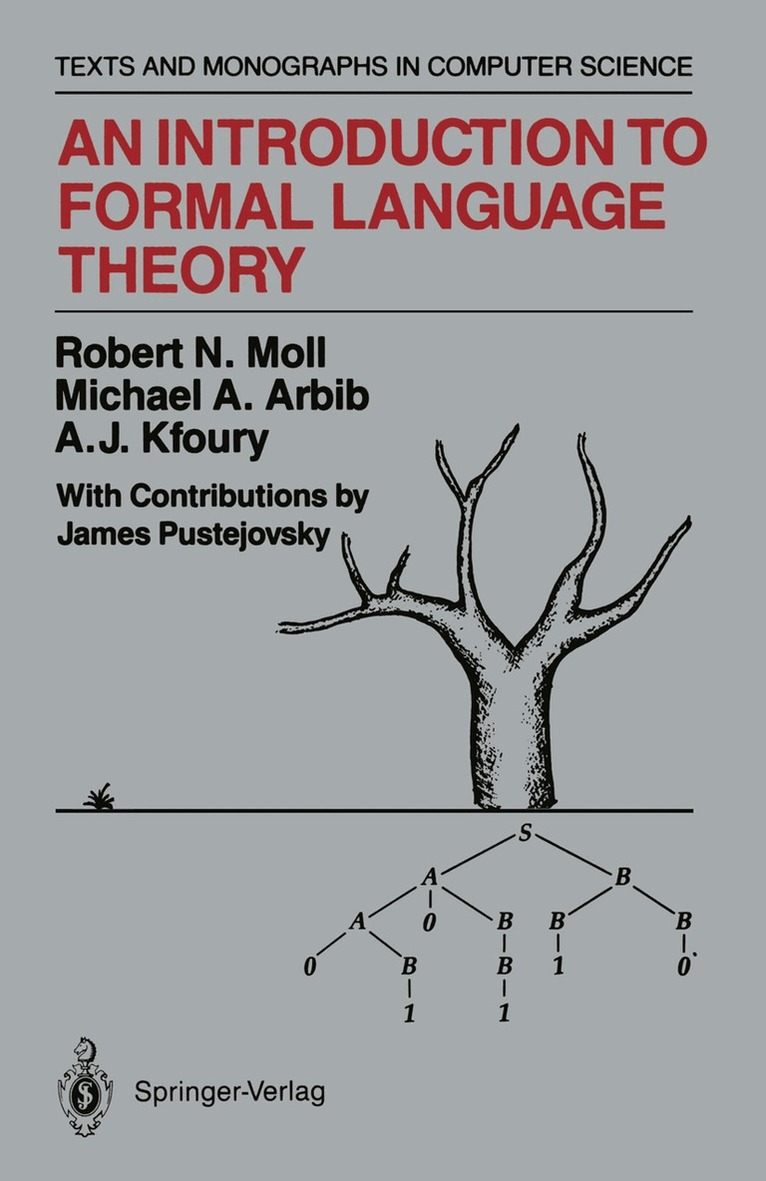
    Introduction to Formal Language Theory

    AvRobert N. Moll,Michael A. Arbib

    Häftad, Engelska, 2012

    Del i serien Monographs in Computer Science

    563 kr

    Beställningsvara. Skickas inom 10-15 vardagar. Fri frakt över 249 kr.

    Beskrivning

    The study of formal languages and of related families of automata has long been at the core of theoretical computer science. Until recently, the main reasons for this centrality were connected with the specification and analy­ sis of programming languages, which led naturally to the following ques­ tions. How might a grammar be written for such a language? How could we check whether a text were or were not a well-formed program generated by that grammar? How could we parse a program to provide the structural analysis needed by a compiler? How could we check for ambiguity to en­ sure that a program has a unique analysis to be passed to the computer? This focus on programming languages has now been broadened by the in­ creasing concern of computer scientists with designing interfaces which allow humans to communicate with computers in a natural language, at least concerning problems in some well-delimited domain of discourse. The necessary work in computational linguistics draws on studies both within linguistics (the analysis of human languages) and within artificial intelligence. The present volume is the first textbook to combine the topics of formal language theory traditionally taught in the context of program­ ming languages with an introduction to issues in computational linguistics. It is one of a series, The AKM Series in Theoretical Computer Science, designed to make key mathematical developments in computer science readily accessible to undergraduate and beginning graduate students.

    Produktinformation

    • Utgivningsdatum:2012-03-02
    • Mått:155 x 235 x 12 mm
    • Vikt:335 g
    • Format:Häftad
    • Språk:Engelska
    • Serie:Monographs in Computer Science
    • Antal sidor:203
    • Förlag:Springer-Verlag New York Inc.
    • ISBN:9781461395973

    Utforska kategorier

    • Systemvetenskap och AI inom Data och IT

    Innehållsförteckning

    • 1 Introduction.- 1.1 The First Language.- 1.2 Grammers and Languages.- 1.3 Context-Free and Context-Sensitive Languages.- 1.4 Programs, Languages, and Parsing.- 1.5 Context-Free Grammars and Natural Language.- 2 Grammars and Machines.- 2.1 The Chomsky Hierarchy.- 2.2 Closure Properties.- 2.3 Regular and Finite-State Languages.- 3 Push-Down Automata and Context-Free Grammars.- 3.1 Push-Down Automata.- 3.2 Normal Forms for Context-Free Grammars.- 3.3 The Equivalence Theorem.- 4 Parsing, Part 1.- 4.1 The Cocke-Kasami-Younger Algorithm.- 4.2 Earley’s Algorithm.- 5 Turing Machines and Language Theory.- 5.1 Turing Machines.- 5.2 The Universal Turing Machine.- 5.3 Nondeterministic Turing Machines and Linear Bounded Automata.- 5.4 The Halting Problem and Undecidability.- 6 Fixed Point Principles in Language Theory.- 6.1 Partial Orders and Fixed Points.- 6.2 Fixed Point Theory and Context-Free Languages.- 7 Parsing, Part II.- 7.1 Top-Down Parsing and LL Grammars.- 7.2 Bottom-Up Parsing and LR Grammars.- 8 The Formal Description of Natural Languages.- 8.1 The Aims of Linguistic Theory.- 8.2 The Generative Power of Natural Languages.- 8.3 Augmented Transition Networks.- 9 Recent Approaches to Linguistic Theory.- 9.1 Beyond Unrestricted Phrase Structure Formalisms.- 9.2 Generalized Phrase Structure Grammars.- 9.3 Government and Binding Theory.- References for Chapters 8 and 9.- Symbol Index.- Author Index.