• Fri frakt över 249 kr
  • •
  • Snabba leveranser
  • •
  • Billiga böcker
Kundservice

Du är på sajten för privatpersoner.

Företag, bibliotek eller offentlig verksamhet?

Du handlar på classic.bokus.com, där alla dina funktioner finns intakta.
Till classic.bokus.com
Bokus logotyp. Gå till startsidan.
  • Erbjudanden
  • Nyheter
  • Student
  • Topplistor
  • Barn & ungdom
  • Bokus Play
  • E-böcker
  • Pocketböcker
  • Spel & pussel

10% studentrabatt med kod TERM26

Sidfot

Mina sidor

    Hjälp

    • Kundservice
    • Vanliga frågor och svar
    • Frakt och leverans
    • Retur vid ångerrätt
    • Reklamera vara
    • Betalning
    • Köpvillkor
    • Allmänna villkor
    • Information om webbplatsens tillgänglighet

    Om Bokus

    • Om oss
    • Pressrum
    • För studenter
    • För företag
    • För bibliotek och offentlig verksamhet
    • För leverantörer
    • Hållbarhet

    Populärt

    • Aktuella erbjudanden
    • Presentkort
    • Studentlitteratur
    • Nya böcker
    • Topplistor
    • Signerade böcker
    • Engelska böcker

    Inspiration

    • Boktips
    • BookTok
    • Populära bokserier
    • Barnbokskaraktärer
    • Populära författare
    Logotyp för Bokus
    Följ oss på Facebook (extern länk)Följ oss på Instagram (extern länk)Följ oss på YouTube (extern länk)Följ oss på TikTok (extern länk)
    bokus @ CookiesAnpassa cookiesIntegritetspolicyKöpvillkor
    Till Citymail hemsida (extern länk)Till Budbee hemsida (extern länk)Till Postnord hemsida (extern länk)Till Schenker hemsida (extern länk)Till Early Bird hemsida (extern länk)Till Walleys hemsida (extern länk)
    1. Naturvetenskap och teknik
    2. Matematik och naturvetenskap
    3. Fysik

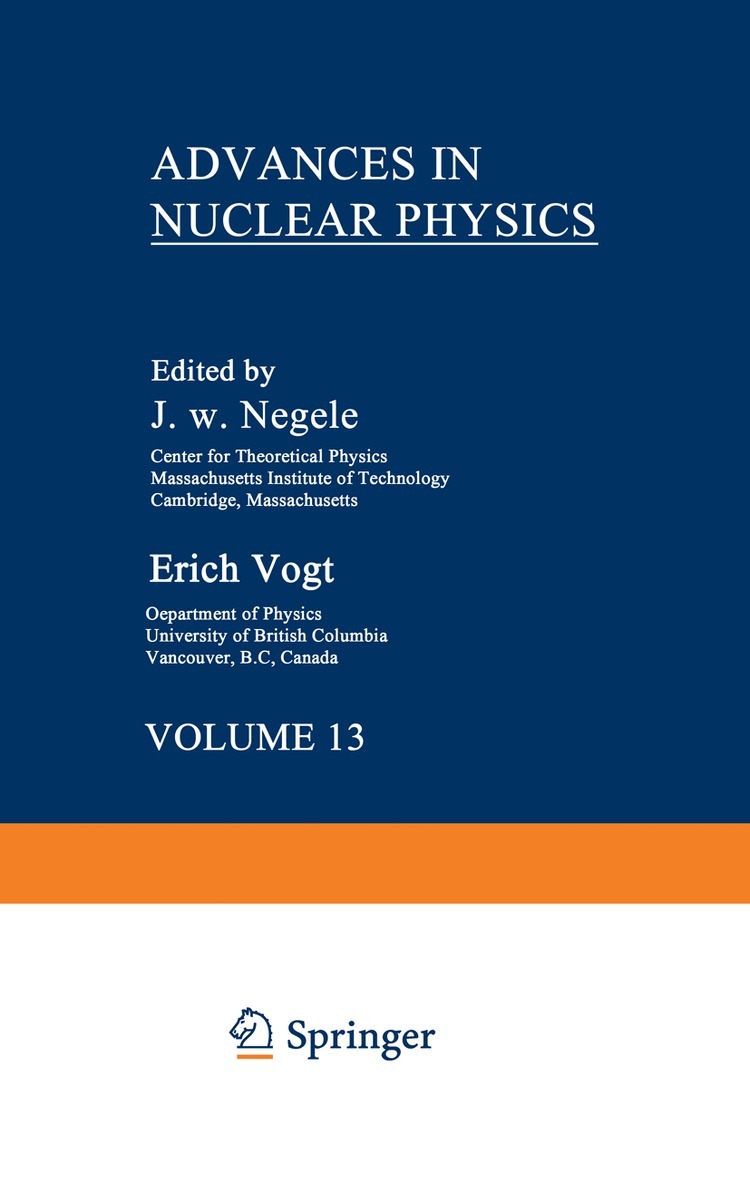
    Advances in Nuclear Physics

    Volume 13

    AvJohn Negele

    Häftad, Engelska, 2012

    Del i serien Advances in Nuclear Physics

    549 kr

    Beställningsvara. Skickas inom 10-15 vardagar. Fri frakt över 249 kr.

    Beskrivning

    The reviews in this volume address advances in three important but diverse areas of nuc1ear physics. Within nuc1ear physics it would be hard to provide a wider range of subject matter, style, or treatment. The first artic1e, on quark bags, is a pedagogic artic1e intended to make accessible to the nuc1ear physics community important new ideas from partic1e physics. The second, on interacting boson models, reviews a very interesting and controversial new approach to some of the central problems of nuc1ear spectroscopy. The third, on relativistic heavy-ion physics, is a guide to the extensive literature on a new subject which has been fuH of great expectations, puz- zling data, and speculative ideas. In the past decade, partic1e theorists' understanding of the structure of hadrons has undergone a revolution strikingly similar to that brought about in nuc1ear physics by the introduction of the Iluc1ear sheH model. Like the sheH model, the bag model of hadrons phenomenologically specifies an interior region in which constituents are confined and described by single-partic1e wave functions that are only weakly perturbed by residual interactions.

    Produktinformation

    • Utgivningsdatum:2012-10-12
    • Mått:152 x 229 x 19 mm
    • Vikt:488 g
    • Format:Häftad
    • Språk:Engelska
    • Serie:Advances in Nuclear Physics
    • Antal sidor:322
    • Förlag:Springer-Verlag New York Inc.
    • ISBN:9781461398943

    Utforska kategorier

    • Fysik inom Naturvetenskap och teknik

    Innehållsförteckning

    • 1 Chiral Symmetry and the BAG Model: A New Starting Point for Nuclear Physics.- 1. Introduction.- 2. The Basic Bag Model.- 3. Hadronic Properties in the MIT Bag Model.- 4. Chiral Symmetry.- 5. Bag Models with Chiral Symmetry.- 6. Applications of the Cloudy Bag Model.- 7. Towards a New View of Nuclear Physics.- 8. Conclusion.- Acknowledgements.- Appendix I.- References.- 2 The Interacting Boson Model.- 1. Introduction.- 2. The Interacting Boson Model-1.- 3. Geometric Properties of the Interacting Boson Model-1.- 4. The Interacting Boson Model-2.- 5. Microscopic Description of Interacting Bosons.- 6. Conclusions.- Acknowledgements.- References.- 3 High-Energy Nuclear Collisions.- 1. Introduction.- 2. Theoretical Tools.- 3. Elements of the Reaction Mechanism.- 4. Toward the Physics of Dense Nuclear Matter.- 5. Summary and Outlook.- Acknowledgments.- Appendix: Definition of Common Variables.- References.