• Fri frakt över 249 kr
  • •
  • Snabba leveranser
  • •
  • Billiga böcker
Kundservice

Du är på sajten för privatpersoner.

Företag, bibliotek eller offentlig verksamhet?

Du handlar på classic.bokus.com, där alla dina funktioner finns intakta.
Till classic.bokus.com
Bokus logotyp. Gå till startsidan.
  • Erbjudanden
  • Student
  • Topplistor
  • Barn & ungdom
  • Bokus Play
  • Bokus Play
  • E-böcker
  • Ljudböcker
  • Pocketböcker
  • Spel & pussel

10% rabatt på allt med kod NYSTART10 →

Sidfot

Mina sidor

    Hjälp

    • Kundservice
    • Vanliga frågor och svar
    • Frakt och leverans
    • Retur vid ångerrätt
    • Reklamera vara
    • Betalning
    • Köpvillkor
    • Allmänna villkor
    • Information om webbplatsens tillgänglighet

    Om Bokus

    • Om oss
    • Pressrum
    • För studenter
    • För företag
    • För bibliotek och offentlig verksamhet
    • För leverantörer
    • Hållbarhet

    Populärt

    • Aktuella erbjudanden
    • Presentkort
    • Studentlitteratur
    • Nya böcker
    • Topplistor
    • Signerade böcker
    • Engelska böcker

    Inspiration

    • Boktips
    • BookTok
    • Populära bokserier
    • Barnbokskaraktärer
    • Populära författare
    Logotyp för Bokus
    Följ oss på Facebook (extern länk)Följ oss på Instagram (extern länk)Följ oss på YouTube (extern länk)Följ oss på TikTok (extern länk)
    bokus @ CookiesAnpassa cookiesIntegritetspolicyKöpvillkor
    Till Citymail hemsida (extern länk)Till Budbee hemsida (extern länk)Till Postnord hemsida (extern länk)Till Schenker hemsida (extern länk)Till Early Bird hemsida (extern länk)Till Walleys hemsida (extern länk)
    1. Naturvetenskap och teknik
    2. Matematik och naturvetenskap
    3. Fysik
    4. Klassisk mekanik

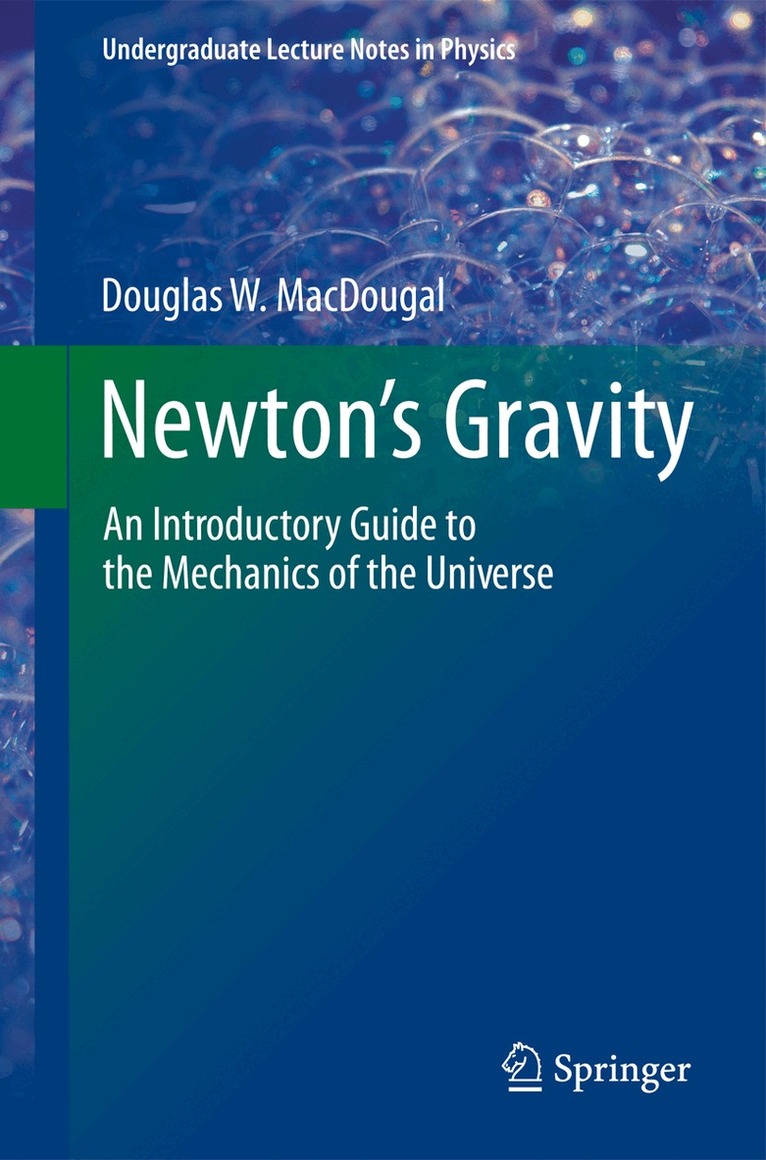
    Newton's Gravity

    An Introductory Guide to the Mechanics of the Universe

    AvDouglas W. MacDougal

    Häftad, Engelska, 2012

    Del i serien Undergraduate Lecture Notes in Physics

    815 kr

    Beställningsvara. Skickas inom 10-15 vardagar. Fri frakt över 249 kr.

    Fler format och utgåvor

    E-bok

    1 029 kr

    Beskrivning

    “Newton’s Gravity” conveys the power of simple mathematics to tell the fundamental truth about nature. Many people, for example, know the tides are caused by the pull of the Moon and to a lesser extent the Sun. But very few can explain exactly how and why that happens. Fewer still can calculate the  actual pulls of the Moon and Sun on the oceans. This book shows in clear detail how to do this with simple tools. It uniquely crosses disciplines – history, astronomy, physics and mathematics – and takes pains to explain things frequently passed over or taken for granted in other books. Using a problem-based approach, “Newton’s Gravity” explores the surprisingly basic mathematics behind gravity, the most fundamental force that governs the movements of satellites, planets, and the stars. Author Douglas W. MacDougal uses actual problems from the history of astronomy, as well as original examples, to deepen understanding of how discoveries were made and what they mean. “Newton’s Gravity” concentrates strongly on the development of the science of orbital motion, beginning with Galileo, Kepler, and Newton, each of whom is prominently represented. Quotes and problems from Galileo’s Dialogs Concerning Two New Sciences and particularly Newton’s Principia help the reader get inside the mind of those thinkers and see the problems as they saw them, and experience their concise and typically eloquent writing. This book enables students and curious minds to explore the mysteries of celestial motion without having to know advanced mathematics. It will whet the reader’s curiosity to explore further and provide him or her the tools (mathematical or physical) to do so.

    Produktinformation

    • Utgivningsdatum:2012-12-16
    • Mått:155 x 235 x 25 mm
    • Vikt:678 g
    • Format:Häftad
    • Språk:Engelska
    • Serie:Undergraduate Lecture Notes in Physics
    • Antal sidor:433
    • Förlag:Springer-Verlag New York Inc.
    • ISBN:9781461454434

    Utforska kategorier

    • Klassisk mekanik inom Naturvetenskap och teknik

    Mer om författaren

    Douglas W. MacDougal has a degree in mathematics, with a minor in physics, from the University of Vermont, and is an adjunct professor at Portland State University teaching celestial mechanics and (previously) astronomy. For many years he also taught courses in astronomy and mathematics in Portland’s Saturday Academy, whose classes typically include gifted middle school and high school students. MacDougal is a lifelong amateur astronomer, and he teaches every summer at the Oregon Museum of Science and Industry (OMSI) Astronomy Camp in the Oregon desert, showing students the stars through his 18-inch telescope.

    Recensioner i media

    From the reviews: "It would suit a class in astronomy for non-scientists who know the basic rules of algebra and arithmetic and who are prepared for some quantitative work without the use of advanced mathematics; or an adult evening-education class; or amateur astronomers ... who have always wanted to know how to do astronomical calculations. ... I give it high marks, and anyone working through it thoroughly will acquire a pretty good knowledge of the subject, so go for it." (Jeremy B. Tatum, The Observatory, Vol. 133 (1236), October, 2013)

    Innehållsförteckning

    • Preface.- Chapter 1: Introduction - The Twin Mysteries of Mass.- Chapter 2: Galileo's Great Discovery - How Things Fall.- Chapter 3: Christiaan Huygens' Remarkable Pendulum.- Chapter 4: The Geometry of the Solar System - Kepler's Laws of Planetary Motion.- Chapter 5: How the Moon Falls Toward the Earth (but keeps missing it).- Chapter 6: Newton's Moon Test.- Chapter 7: Newton Demonstrate How an Inverse Square Law Could Explain Planetary Motions.- Chapter 8: Newton's Master Stroke - The Universal Law of Gravitation.- Chapter 9: Determining the Value of g on Earth.- Chapter 10: A Binary System Close to Home - How the Moon and Earth Orbit Each Other.- Chapter 11: Using Kepler's Third Law to Find the Masses of Stars and Planets.- Chapter 12: Motion in Elliptical Orbits.- Chapter 13: The Energy and Geometry of Orbits.- Chapter 14: Introduction to Spaceflight.- Chapter 15: Getting Oriented - The Sun, the Earth, and the Ecliptic Planet.- Chapter 16: An Introduction to Kepler's Problem - Finding the True Anomaly of an Orbiting Body.- Chapter 17: What Causes the Tides?.- Chapter 18: Moon, Rings, and the Ripping Forces of Tides.- Chapter 19: Hovering in Space - Those Mysterious Langrangian Points.- Appendix: Solutions.- Index.