• Fri frakt över 249 kr
  • •
  • Snabba leveranser
  • •
  • Billiga böcker
Kundservice

Du är på sajten för privatpersoner.

Företag, bibliotek eller offentlig verksamhet?

Du handlar på classic.bokus.com, där alla dina funktioner finns intakta.
Till classic.bokus.com
Bokus logotyp. Gå till startsidan.
  • Erbjudanden
  • Nyheter
  • Student
  • Topplistor
  • Barn & ungdom
  • Bokus Play
  • E-böcker
  • Pocketböcker
  • Spel & pussel

10% rabatt på allt med kod NYSTART10 →

Sidfot

Mina sidor

    Hjälp

    • Kundservice
    • Vanliga frågor och svar
    • Frakt och leverans
    • Retur vid ångerrätt
    • Reklamera vara
    • Betalning
    • Köpvillkor
    • Allmänna villkor
    • Information om webbplatsens tillgänglighet

    Om Bokus

    • Om oss
    • Pressrum
    • För studenter
    • För företag
    • För bibliotek och offentlig verksamhet
    • För leverantörer
    • Hållbarhet

    Populärt

    • Aktuella erbjudanden
    • Presentkort
    • Studentlitteratur
    • Nya böcker
    • Topplistor
    • Signerade böcker
    • Engelska böcker

    Inspiration

    • Boktips
    • BookTok
    • Populära bokserier
    • Barnbokskaraktärer
    • Populära författare
    Logotyp för Bokus
    Följ oss på Facebook (extern länk)Följ oss på Instagram (extern länk)Följ oss på YouTube (extern länk)Följ oss på TikTok (extern länk)
    bokus @ CookiesAnpassa cookiesIntegritetspolicyKöpvillkor
    Till Citymail hemsida (extern länk)Till Budbee hemsida (extern länk)Till Postnord hemsida (extern länk)Till Schenker hemsida (extern länk)Till Early Bird hemsida (extern länk)Till Walleys hemsida (extern länk)
    1. Naturvetenskap och teknik
    2. Matematik och naturvetenskap
    3. Kemi
    4. Organisk kemi

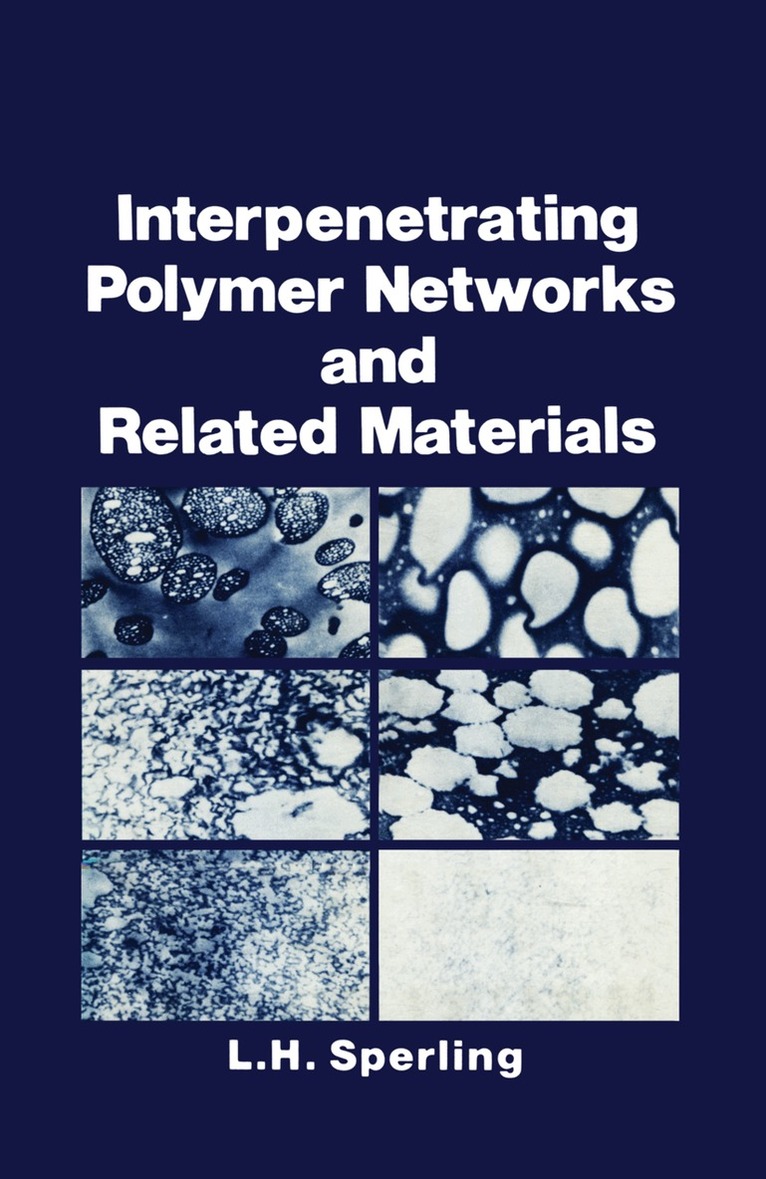
    Interpenetrating Polymer Networks and Related Materials

    AvL.H. Sperling

    Häftad, Engelska, 2012

    546 kr

    Beställningsvara. Skickas inom 10-15 vardagar. Fri frakt över 249 kr.

    Fler format och utgåvor

    E-bok

    710 kr

    Beskrivning

    To the surprise of practically no one, research and engineering on multi­ polymer materials has steadily increased through the 1960s and 1970s. More and more people are remarking that we are running out of new monomers to polymerize, and that the improved polymers of the future will depend heavily on synergistic combinations of existing materials. In the era of the mid-1960s, three distinct multipolymer combinations were recognized: polymer blends, grafts, and blocks. Although inter­ penetrating polymer networks, lPNs, were prepared very early in polymer history, and already named by Millar in 1960, they played a relatively low-key role in polymer research developments until the late 1960s and 1970s. I would prefer to consider the IPNs as a subdivision of the graft copolymers. Yet the unique topology of the IPNs imparts properties not easily obtainable without the presence of crosslinking. One of the objectives of this book is to point out the wealth of work done on IPNs or closely related materials. Since many papers and patents actually concerned with IPNs are not so designated, this literature is significantly larger than first imagined. It may also be that many authors will meet each other for the first time on these pages and realize that they are working on a common topology. The number of applications suggested in the patent literature is large­ and growing. Included are impact-resistant plastics, ion exchange resins, noise-damping materials, a type of thermoplastic elastomer, and many more.

    Produktinformation

    • Utgivningsdatum:2012-03-22
    • Mått:152 x 229 x 16 mm
    • Vikt:410 g
    • Format:Häftad
    • Språk:Engelska
    • Antal sidor:265
    • Förlag:Springer-Verlag New York Inc.
    • ISBN:9781468438321

    Utforska kategorier

    • Organisk kemi inom Naturvetenskap och teknik
    • Maskinteknik och material inom Naturvetenskap och teknik
    • Oorganisk kemi inom Naturvetenskap och teknik

    Innehållsförteckning

    • 1. An Introduction to Polymer Networks and IPNs.- 1.1. On the Nature of a Crosslink.- 1.2. Definition of an Interpenetrating Polymer Network.- 1.3. Historical Development of IPNs.- 1.4. A Researcher’s Approach to IPNs.- Suggested Reading. Bibliography of Selected Polymer Books.- 2. Phase Separation and Mechanical Behavior of Multicomponent Polymer Systems.- 2.1. Introduction.- 2.2. Polymer I/Polymer II Incompatibility.- 2.3. Polymer/Polymer Phase Diagrams.- 2.4. Morphology of Two-Phased Systems.- 2.5. More Complex Materials.- 2.6. On Determining Phase Continuity.- 2.7. Mechanical Behavior of Two-Phased Systems.- 2.8. Applications of Polymer Blends, Grafts, and Blocks.- Suggested Reading. Recent Multicomponent Polymer Books.- 3. A Nomenclature for Multipolymer Systems.- 3.1. Existing Nomenclature.- 3.2. Introduction to the New System.- 3.3. Nomenclature in this Work.- 3.4. Abbreviations and Jargon.- Appendix 3.1. Examples of the Proposed Nomenclature.- Appendix 3.2. Relating the New System to the Old.- 4. Homo-IPNs as Model Networks.- 4.1. Polystyrene/Polystyrene IPNs.- 4.2. Development of Theory.- 4.3. Relative Network Continuity and Physical Crosslinks.- 5. Synthesis of IPNs and Related Materials.- 5.1. Introduction.- 5.2. Sequential IPNs.- 5.3. Latex Interpenetrating Elastomeric Networks (IENs).- 5.4. Latex IPNs.- 5.5. Simultaneous Interpenetrating Networks (SINs).- 5.6. AB-Crosslinked Polymers (ABCPs).- 5.7. Thermoplastic IPNs.- 6. Morphology and Glass Transition Behavior.- 6.1. Introduction.- 6.2. Molecular Control of Morphology.- 6.3. Morphology via Optical Microscopy.- 6.4. Morphology via Transmission Electron Microscopy.- 6.5. Quantitative Expressions for Phase Domain Size.- 6.5.1. Block Copolymers and ABCPs.- 6.5.2. Sequential IPNs and Semi-IPNs.- 6.6. InducedMorphological Changes.- 6.7. Physical and Glass Transition Behavior.- 6.8. Transition Layer Thickness.- 6.9. Phase Continuity Evaluation via Modulus.- 6.10. The Interpenetration Problem.- 7. Engineering, Mechanical, and General Behavior.- 7.1. Introduction.- 7.2. Filled Interpenetrating Polymer Networks.- 7.3. Ultimate Behavior.- 7.4. Electrical and Barrier Properties.- 7.5. Ionically Charged IPNs.- 7.6. Gradient IPNs.- 7.7. Vulcanized Rubber/Rubber Blends.- 8. Actual or Proposed Applications.- 8.1. Reinforced Elastomers.- 8.2. Sheet Molding Compounds.- 8.3. Dynamically Partly Cured Thermoplastic Elastomer Blends.- 8.4. Use of Graded Rubber Latexes with Surface Functionality in Thermosets.- 8.5. Dental Fillings.- 8.6. Graft Copolymerization onto Leather.- 8.7. Thermoplastic IPNs.- 8.8. Noise- and Vibration-Damping Materials.- 8.9. Coatings and Adhesives.- 8.10. Miscellaneous IPN Patents and Studies.- 8.11. Summary of Applications.- Annotated Bibliography.