• Fri frakt över 249 kr
  • •
  • Snabba leveranser
  • •
  • Billiga böcker
Kundservice

Du är på sajten för privatpersoner.

Företag, bibliotek eller offentlig verksamhet?

Du handlar på classic.bokus.com, där alla dina funktioner finns intakta.
Till classic.bokus.com
Bokus logotyp. Gå till startsidan.
  • Erbjudanden
  • Nyheter
  • Student
  • Topplistor
  • Barn & ungdom
  • Bokus Play
  • E-böcker
  • Pocketböcker
  • Spel & pussel

10% rabatt på allt med kod: NYSTART10 →

Sidfot

Mina sidor

    Hjälp

    • Kundservice
    • Vanliga frågor och svar
    • Frakt och leverans
    • Retur vid ångerrätt
    • Reklamera vara
    • Betalning
    • Köpvillkor
    • Allmänna villkor
    • Information om webbplatsens tillgänglighet

    Om Bokus

    • Om oss
    • Pressrum
    • För studenter
    • För företag
    • För bibliotek och offentlig verksamhet
    • För leverantörer
    • Hållbarhet

    Populärt

    • Aktuella erbjudanden
    • Presentkort
    • Studentlitteratur
    • Nya böcker
    • Topplistor
    • Signerade böcker
    • Engelska böcker

    Inspiration

    • Boktips
    • BookTok
    • Populära bokserier
    • Barnbokskaraktärer
    • Populära författare
    Logotyp för Bokus
    Följ oss på Facebook (extern länk)Följ oss på Instagram (extern länk)Följ oss på YouTube (extern länk)Följ oss på TikTok (extern länk)
    bokus @ CookiesAnpassa cookiesIntegritetspolicyKöpvillkor
    Till Citymail hemsida (extern länk)Till Budbee hemsida (extern länk)Till Postnord hemsida (extern länk)Till Schenker hemsida (extern länk)Till Early Bird hemsida (extern länk)Till Walleys hemsida (extern länk)
    1. Naturvetenskap och teknik
    2. Matematik och naturvetenskap
    3. Kemi
    4. Organisk kemi

    Carbenes nitrenes and arynes

    AvT. L. Gilchrist

    Häftad, Engelska, 2012

    Del i serien Studies in Modern Chemistry

    1 194 kr

    Beställningsvara. Skickas inom 10-15 vardagar. Fri frakt över 249 kr.

    Beskrivning

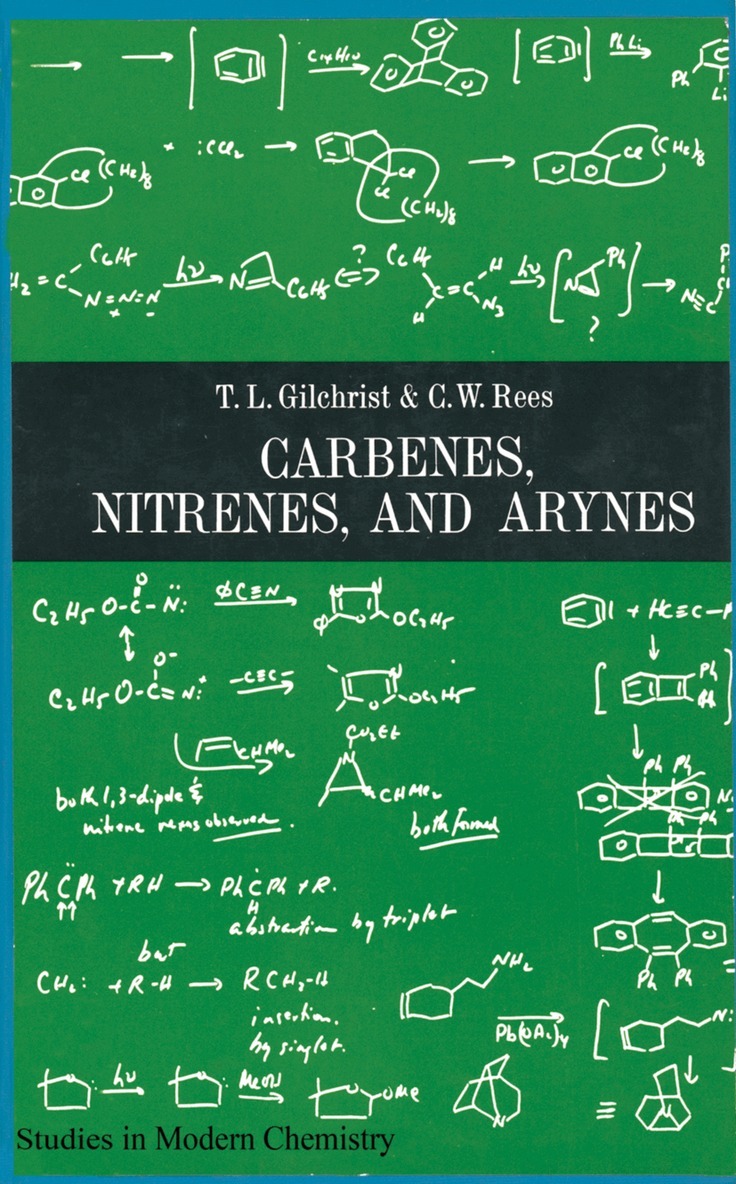
    Carbenes, nitrenes, and arynes are of great interest to chemists because of the central role they play, as the key intermediates, in a wide range of chemical reactions. Their study has illuminated many aspects of synthetic and mechanistic chemistry. Their organic chemistry has developed enormously over the last ten to fifteen years so that now a fairly clear pattern of reactions and reactivity, strikingly similar for all three, has emerged. Partly because of this, but also because of the many unsolved problems and gaps in our present knowledge, it now seems appropriate to present a comparative account of their chemistry. Our approach is a simple, descriptive one that nevertheless attempts to bring the reader as nearly up-to-date as possible; there is considerable emphasis on recent work in the text and the problems. We have been selective rather than comprehensive, have concentrated on underlying principles, and have tried to emphasize what can, and what cannot, reasonably be claimed on the basis of the available experimental evidence. (The development of this area of organic chemistry could weil serve as a cauti'onary tale in this respect. ) We have written the book primarily at the advanced student level but it should also be useful to postgraduates students and to more experienced chemists. Some of the problems are at a rather more advanced level, the aim being to extend the reader's knowledge and understanding and to direct him to some recent originalliterature.

    Produktinformation

    • Utgivningsdatum:2012-06-17
    • Mått:152 x 229 x 8 mm
    • Vikt:215 g
    • Format:Häftad
    • Språk:Engelska
    • Serie:Studies in Modern Chemistry
    • Antal sidor:131
    • Förlag:Springer-Verlag New York Inc.
    • ISBN:9781468472929

    Utforska kategorier

    • Organisk kemi inom Naturvetenskap och teknik

    Innehållsförteckning

    • 1 Structure and relationship of the intermediates.- 1–1 Definitions and nomenclature.- 1–2 Substituents and structure.- 1–3 General methods of formation.- 1–4 Evidence for the intermediates in reactions.- 2 Generation of carbenes.- 2–1 Introduction.- 2–2 Carbenes from diazoalkanes, ketens, and ylids.- 2–3 Carbenes by other fragmentations.- 2–4 Carbenes from carbanions.- 2–5 Carbenoids.- 2–6 Other carbene-forming reactions.- Problems.- 3 Generation of nitrenes.- 3–1 Introduction.- 3–2 From azides.- 3–3 Other thermolytic and photolytic routes.- 3–4 From nitrogen anions.- 3–5 Oxidative routes.- 3–6 Reductive routes.- 3–7 Other routes.- Problems.- 4 Generation of arynes.- 4–1 Introduction.- 4–2 From aryl anions.- 4–3 From aryl cations.- 4–4 From zwitterions.- 4–5 From aryl radicals.- 4–6 By fragmentation of cyclic systems.- Problems.- 5 Cycloaddition reactions of carbenes.- 5–1 Introduction.- 5–2 Mechanism of the cycloaddition.- 5–3 Cycloadditions to olefins.- 5–4 Cycloadditions to allenes and acetylenes.- 5–5 Cycloadditions to aromatic systems.- 5–6 Cycloadditions to other unsaturated systems.- 5–7 Carbenoid cycloadditions.- Problems.- 6 Reactions of carbenes: insertions and other reactions.- 6–1 Insertion reactions.- 6–2 Skeletal rearrangements.- 6–3 Reactions with nucleophiles.- 6–4 Dimerization.- 6–5 Carbenes in transition-metal complexes.- Problems.- 7 Reactions of nitrenes.- 7–1 Introduction.- 7–2 Cycloaddition reactions.- 7–3 Insertion reactions.- 7–4 1,2-Shifts.- 7–5 Dimerization.- 7–6 Other reactions of aminonitrenes.- 7–7 Reactions of nitrenes with nucleophiles.- 7–8 Transition-metal complexes.- Problems.- 8 Reactions of arynes.- 8–1 Introduction.- 8–2 Cycloadditions.- 8–3Reactions with nucleophiles 70S.- 8–4 Reactions with electrophiles and radicals.- 8–5 Dimerization and trimerization.- 8–6 Transition-metal complexes.- Problems.- 9 Synthetic applications.- 9–1 Introduction.- 9–2 Dihalogenocarbenes.- 9–3 Diels-Alder reactions of benzyne.- 9–4 Intramolecular cyclizations via aryne intermediates.- 9–5 cine-Substitution via arynes.- General References.