• Fri frakt över 249 kr
  • •
  • Snabba leveranser
  • •
  • Billiga böcker
Kundservice

Du är på sajten för privatpersoner.

Företag, bibliotek eller offentlig verksamhet?

Du handlar på classic.bokus.com, där alla dina funktioner finns intakta.
Till classic.bokus.com
Bokus logotyp. Gå till startsidan.
  • Erbjudanden
  • Nyheter
  • Student
  • Topplistor
  • Barn & ungdom
  • Bokus Play
  • E-böcker
  • Pocketböcker
  • Spel & pussel

10% rabatt på allt med kod NYSTART10 →

Sidfot

Mina sidor

    Hjälp

    • Kundservice
    • Vanliga frågor och svar
    • Frakt och leverans
    • Retur vid ångerrätt
    • Reklamera vara
    • Betalning
    • Köpvillkor
    • Allmänna villkor
    • Information om webbplatsens tillgänglighet

    Om Bokus

    • Om oss
    • Pressrum
    • För studenter
    • För företag
    • För bibliotek och offentlig verksamhet
    • För leverantörer
    • Hållbarhet

    Populärt

    • Aktuella erbjudanden
    • Presentkort
    • Studentlitteratur
    • Nya böcker
    • Topplistor
    • Signerade böcker
    • Engelska böcker

    Inspiration

    • Boktips
    • BookTok
    • Populära bokserier
    • Barnbokskaraktärer
    • Populära författare
    Logotyp för Bokus
    Följ oss på Facebook (extern länk)Följ oss på Instagram (extern länk)Följ oss på YouTube (extern länk)Följ oss på TikTok (extern länk)
    bokus @ CookiesAnpassa cookiesIntegritetspolicyKöpvillkor
    Till Citymail hemsida (extern länk)Till Budbee hemsida (extern länk)Till Postnord hemsida (extern länk)Till Schenker hemsida (extern länk)Till Early Bird hemsida (extern länk)Till Walleys hemsida (extern länk)
    1. Ekonomi och Ledarskap
    2. Ledarskapsböcker

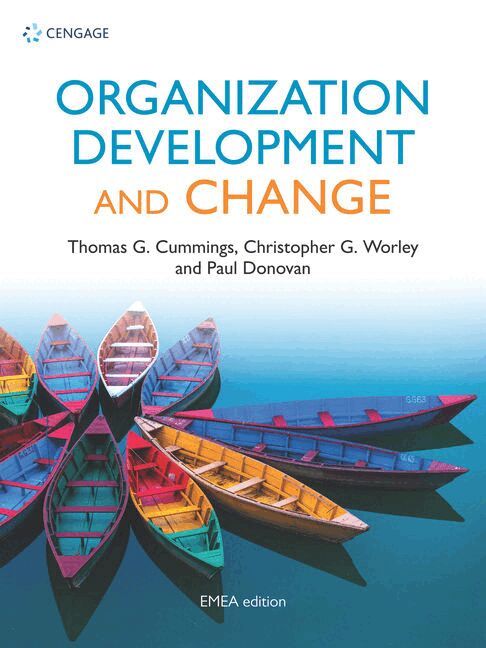
    Organization Development and Change

    AvThomas Cummings,Christopher Worley

    Häftad, Engelska, 2019

    1 017 kr

    Tillfälligt slut

    Beskrivning

    Market-leading text Organization Development and Change provides students with an excellent grounding in the theoretical underpinnings of the subject as well as describing, in practical terms, how behavioural science can be used to develop organizational strategies, structures and processes. It will enrich students’ understanding and study of organization development, change management and human resources management.This is the first time the textbook has been adapted for Europe, South Africa and the Middle East. Therefore, all the core elements which have contributed to this popular textbook’s success are complemented by the inclusion of recent and relevant developments in the field pertinent to these regions, enabling students to fully relate to the topics discussed.This title is available with MindTap, a flexible online learning solution which features an interactive eReader, a wide range of assignments and quizzes as well as scenario-based questions and cases to further entrench key concepts, boost confidence, develop critical thinking skills and prepare students for the workplace, alongside analytics to help you track their progress.

    Produktinformation

    • Utgivningsdatum:2019-12-11
    • Mått:196 x 25 x 261 mm
    • Vikt:1 250 g
    • Format:Häftad
    • Språk:Engelska
    • Antal sidor:656
    • Förlag:Cengage Learning
    • ISBN:9781473768352

    Utforska kategorier

    • Ledarskapsböcker inom Ekonomi och Ledarskap

    Mer om författaren

    Thomas G. Cummings is Professor of Management and Organization, Marshall School of Business, University of Southern California. He received his B.S. and MBA from Cornell University, and his Ph.D. from the University of California at Los Angeles. He has authored over 70 articles and 22 books and was formerly President of the Western Academy of Management, Chair of the Organization Development and Change Division of the Academy of Management, and Founding Editor of the Journal of Management Inquiry. Dr. Cummings was the 61st President of the Academy of Management, the largest professional association of management scholars in the world with a total membership of over 20,000. He is listed in American Men and Women of Science and Who’s Who in America. His major research and consulting interests include designing high-performing organizations and strategic change management. He has conducted several large-scale organization design and change projects, and has consulted to a variety of private and public-sector organizations in the United States, Mexico and Europe. Christopher G. Worley is Professor of Strategy and Entrepreneurship at the NEOMA Business School. He is also the founding strategy director for the school’s Center for Leadership and Effective Organizations. Chris serves as a senior research scientist at the Center for Effective Organizations (USC’s Marshall School of Business) and teaches in Pepperdine’s Master of Science in Organization Development (MSOD) program. He received his B.S. from Westminster College, master’s degrees from Colorado State University and Pepperdine University, and his doctorate from the University of Southern California. He served as Chair of the Organization Development and Change Division of the Academy of Management, received the Luckman Teaching Fellowship at Pepperdine University, and the Douglas McGregor Award for best paper in the Journal of Applied Behavioral Science. His most recent books are The Agility Factor, Becoming Agile, Management Reset and Built to Change. His articles on agility and strategic organization design have appeared in the Journal of Applied Behavioral Science, Journal of Organization Behavior, Sloan Management Review, Strategy+Business, and Organizational Dynamics. Paul Donovan is Senior Lecturer at the School of Business, Maynooth University. Prior to this, he was Head of Management Development at the Irish Management Institute (IMI) in Dublin where he worked in senior management positions, including Registrar, for 17 years. Before joining IMI, he worked as a General Operations Manager for Bord na Mona, the Irish Peat Development Authority during its major transformation. While there, he participated in major change initiatives, including the introduction of self-managing teams in the production and transport functions. He also wrote a thesis on the subject of major change in completion of a Masters Degree in Organizational Behaviour at Trinity College Dublin and graduated with a doctorate in human resources from Leicester University. He has considerable practitioner engagement experience and has delivered management development programmes in 15 countries over a period of 20 years. His current teaching includes the Change Management and Organizational Development module at Maynooth. His research interests include the transfer of learning from training interventions back into the workplace, and effective teaching and learning in higher education. He has contributed articles to the Journal of Management Education, Management Teaching Review and the Journal of European Industrial Training as well as several book chapters. He currently serves as Associate Editor with Management Teaching Review. While at IMI, he edited a series of six management textbooks aimed at supporting students of supervisory management.

    Innehållsförteckning

    • Chapter 1: General introduction to organization developmentPART 1 Overview of organization developmentChapter 2: The nature of planned changeChapter 3: The organization development practitionerPART 2 The process of organization developmentChapter 4: Entering and contractingChapter 5: DiagnosingChapter 6: Collecting, analyzing and feeding back diagnostic informationChapter 7: Designing interventionsChapter 8: Managing changeChapter 9: Evaluating and institutionalizing organization development interventionsPART 3 Human process interventionsChapter 10: Interpersonal and group process approachesChapter 11: Organization process approachesPART 4 Technostructural interventionsChapter 12: Restructuring organizationsChapter 13: Employee involvementChapter 14: Work designPART 5 Human resource interventionsChapter 15: Performance managementChapter 16: Talent managementChapter 17: Workforce diversity and wellnessPART 6 Strategic change interventionsChapter 18: Transformational changeChapter 19: Continuous changeChapter 20: Transorganizational changePART 7 Special applications of organization developmentChapter 21: Organization development for economic, ecological, social and health outcomesChapter 22: Future directions in organization developmentGlossaryName indexSubject index