• Fri frakt över 249 kr
  • •
  • Snabba leveranser
  • •
  • Billiga böcker
Kundservice

Du är på sajten för privatpersoner.

Företag, bibliotek eller offentlig verksamhet?

Du handlar på classic.bokus.com, där alla dina funktioner finns intakta.
Till classic.bokus.com
Bokus logotyp. Gå till startsidan.
  • Erbjudanden
  • Student
  • Topplistor
  • Barn & ungdom
  • Bokus Play
  • E-böcker
  • Ljudböcker
  • Pocketböcker
  • Spel och pussel

Upp till 25% på utvalda nyheter →

Sidfot

Mina sidor

    Hjälp

    • Kundservice
    • Vanliga frågor och svar
    • Frakt och leverans
    • Retur vid ångerrätt
    • Reklamera vara
    • Betalning
    • Köpvillkor
    • Allmänna villkor
    • Information om webbplatsens tillgänglighet

    Om Bokus

    • Om oss
    • Pressrum
    • För studenter
    • För företag
    • För bibliotek och offentlig verksamhet
    • För leverantörer
    • Hållbarhet

    Populärt

    • Aktuella erbjudanden
    • Presentkort
    • Studentlitteratur
    • Nya böcker
    • Topplistor
    • Signerade böcker
    • Engelska böcker

    Inspiration

    • Boktips
    • BookTok
    • Barnbokskaraktärer
    • Populära författare
    Logotyp för Bokus
    Följ oss på Facebook (extern länk)Följ oss på Instagram (extern länk)Följ oss på YouTube (extern länk)Följ oss på TikTok (extern länk)
    bokus @ CookiesAnpassa cookiesIntegritetspolicyKöpvillkor
    Till Citymail hemsida (extern länk)Till Budbee hemsida (extern länk)Till Postnord hemsida (extern länk)Till Schenker hemsida (extern länk)Till Early Bird hemsida (extern länk)Till Walleys hemsida (extern länk)
    1. Data och IT
    2. Systemvetenskap och AI

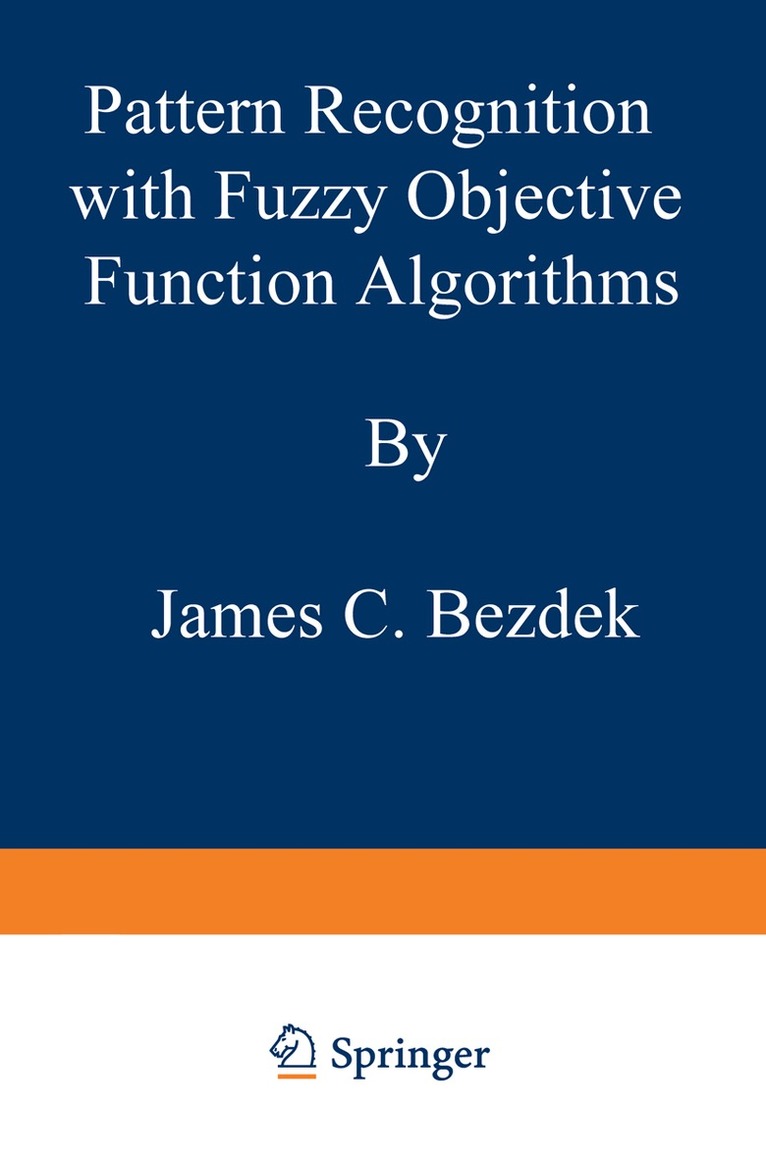
    Pattern Recognition with Fuzzy Objective Function Algorithms

    AvJames C. Bezdek

    Häftad, Engelska, 2012

    Del i serien Advanced Applications in Pattern Recognition

    1 189 kr

    Beställningsvara. Skickas inom 10-15 vardagar. Fri frakt över 249 kr.

    Fler format och utgåvor

    E-bok

    1 575 kr

    Beskrivning

    The fuzzy set was conceived as a result of an attempt to come to grips with the problem of pattern recognition in the context of imprecisely defined categories. In such cases, the belonging of an object to a class is a matter of degree, as is the question of whether or not a group of objects form a cluster. A pioneering application of the theory of fuzzy sets to cluster analysis was made in 1969 by Ruspini. It was not until 1973, however, when the appearance of the work by Dunn and Bezdek on the Fuzzy ISODATA (or fuzzy c-means) algorithms became a landmark in the theory of cluster analysis, that the relevance of the theory of fuzzy sets to cluster analysis and pattern recognition became clearly established. Since then, the theory of fuzzy clustering has developed rapidly and fruitfully, with the author of the present monograph contributing a major share of what we know today. In their seminal work, Bezdek and Dunn have introduced the basic idea of determining the fuzzy clusters by minimizing an appropriately defined functional, and have derived iterative algorithms for computing the membership functions for the clusters in question. The important issue of convergence of such algorithms has become much better understood as a result of recent work which is described in the monograph.

    Produktinformation

    • Utgivningsdatum:2012-05-20
    • Mått:152 x 229 x 16 mm
    • Vikt:404 g
    • Format:Häftad
    • Språk:Engelska
    • Serie:Advanced Applications in Pattern Recognition
    • Antal sidor:272
    • Förlag:Springer-Verlag New York Inc.
    • ISBN:9781475704525

    Utforska kategorier

    • Systemvetenskap och AI inom Data och IT
    • Matematik inom Naturvetenskap och teknik

    Innehållsförteckning

    • 1. Models for Pattern Recognition.- S1 Pattern Recognition.- S2 Some Notes on Mathematical Models.- S3 Uncertainty.- 2. Partitions and Relations.- S4 The Algebra of Fuzzy Sets.- S5 Fuzzy Partition Spaces.- S6 Properties of Fuzzy Partition Spaces.- S7 Fuzzy Relations.- 3. Objective Function Clustering.- S8 Cluster Analysis: An Overview.- S9 Density Functionals.- S10 Likelihood Functionals: Congenital Heart Disease.- S11 Least-Squares Functionals: Fuzzy c-Means.- S12 Descent and Convergence of Fuzzy c-Means.- S13 Feature Selection for Binary Data: Important Medical Symptoms.- 4. Cluster Validity.- S14 Cluster Validity: An Overview.- S15 The Partition Coefficient: Numerical Taxonomy.- S16 Classification Entropy.- S17 The Proportion Exponent: Numerical Taxonomy Revisited.- S18 Normalization and Standardization of Validity Functionals.- S19 The Separation Coefficient: Star-Tracker Systems.- S20 Separation Indices and Fuzzy c-Means.- 5. Modified Objective Function Algorithms.- S21 Affinity Decomposition: An Induced Fuzzy Partitioning Approach.- S22 Shape Descriptions with Fuzzy Covariance Matrices.- S23 The Fuzzy c-Varieties Clustering Algorithms.- S24 Convex Combinations: Fuzzy c-Elliptotypes.- 6. Selected Applications in Classifier Design.- S25 An Overview of Classifier Design: Bayesian Classifiers.- S26 A Heuristic Approach to Parametric Estimation: Bayesian Classifiers for Mixed Normal Distributions.- S27 Nearest Prototype Classifiers: Diagnosis of Stomach Disease.- S28 Fuzzy Classification with Nearest Memberships.- References.- Algorithm Index.- Author Index.