• Fri frakt över 249 kr
  • •
  • Snabba leveranser
  • •
  • Billiga böcker
Kundservice

Du är på sajten för privatpersoner.

Företag, bibliotek eller offentlig verksamhet?

Du handlar på classic.bokus.com, där alla dina funktioner finns intakta.
Till classic.bokus.com
Bokus logotyp. Gå till startsidan.
  • Erbjudanden
  • Nyheter
  • Student
  • Topplistor
  • Barn & ungdom
  • Bokus Play
  • E-böcker
  • Pocketböcker
  • Spel & pussel

10% studentrabatt med kod TERM26

Sidfot

Mina sidor

    Hjälp

    • Kundservice
    • Vanliga frågor och svar
    • Frakt och leverans
    • Retur vid ångerrätt
    • Reklamera vara
    • Betalning
    • Köpvillkor
    • Allmänna villkor
    • Information om webbplatsens tillgänglighet

    Om Bokus

    • Om oss
    • Pressrum
    • För studenter
    • För företag
    • För bibliotek och offentlig verksamhet
    • För leverantörer
    • Hållbarhet

    Populärt

    • Aktuella erbjudanden
    • Presentkort
    • Studentlitteratur
    • Nya böcker
    • Topplistor
    • Signerade böcker
    • Engelska böcker

    Inspiration

    • Boktips
    • BookTok
    • Populära bokserier
    • Barnbokskaraktärer
    • Populära författare
    Logotyp för Bokus
    Följ oss på Facebook (extern länk)Följ oss på Instagram (extern länk)Följ oss på YouTube (extern länk)Följ oss på TikTok (extern länk)
    bokus @ CookiesAnpassa cookiesIntegritetspolicyKöpvillkor
    Till Citymail hemsida (extern länk)Till Budbee hemsida (extern länk)Till Postnord hemsida (extern länk)Till Schenker hemsida (extern länk)Till Early Bird hemsida (extern länk)Till Walleys hemsida (extern länk)
    1. Naturvetenskap och teknik
    2. Matematik och naturvetenskap
    3. Kemi
    4. Fysikalisk kemi

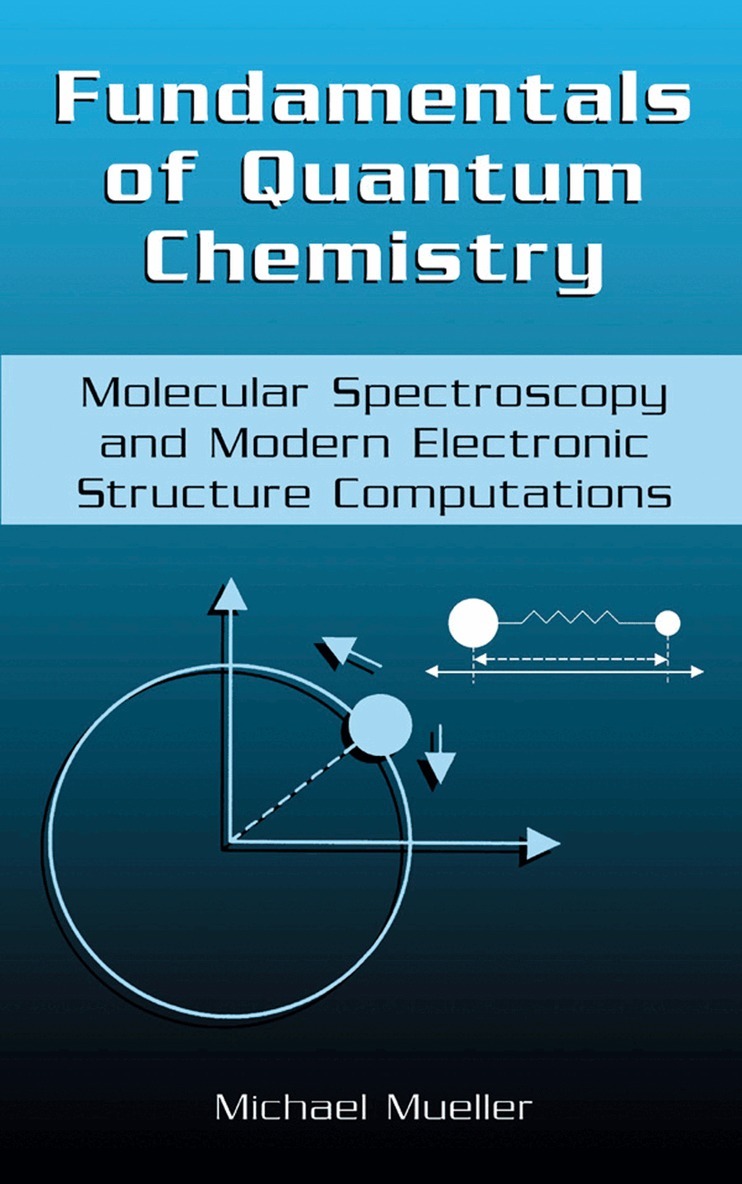
    Fundamentals of Quantum Chemistry

    Molecular Spectroscopy and Modern Electronic Structure Computations

    AvMichael P. Mueller

    Häftad, Engelska, 2013

    1 200 kr

    Beställningsvara. Skickas inom 10-15 vardagar. Fri frakt över 249 kr.

    Fler format och utgåvor

    Inbunden

    1 092 kr

    E-bok

    1 389 kr

    Beskrivning

    As quantum theory enters its second century, it is fitting to examine just how far it has come as a tool for the chemist. Beginning with Max Planck’s agonizing conclusion in 1900 that linked energy emission in discreet bundles to the resultant black-body radiation curve, a body of knowledge has developed with profound consequences in our ability to understand nature. In the early years, quantum theory was the providence of physicists and certain breeds of physical chemists. While physicists honed and refined the theory and studied atoms and their component systems, physical chemists began the foray into the study of larger, molecular systems. Quantum theory predictions of these systems were first verified through experimental spectroscopic studies in the electromagnetic spectrum (microwave, infrared and ultraviolet/visible), and, later, by nuclear magnetic resonance (NMR) spectroscopy. Over two generations these studies were hampered by two major drawbacks: lack of resolution of spectroscopic data, and the complexity of calculations. This powerful theory that promised understanding of the fundamental nature of molecules faced formidable challenges. The following example may put things in perspective for today’s chemistry faculty, college seniors or graduate students: As little as 40 years ago, force field calculations on a molecule as simple as ketene was a four to five year dissertation project.

    Produktinformation

    • Utgivningsdatum:2013-03-18
    • Mått:155 x 235 x 16 mm
    • Vikt:429 g
    • Format:Häftad
    • Språk:Engelska
    • Antal sidor:265
    • Upplaga:2001
    • Förlag:Springer-Verlag New York Inc.
    • ISBN:9781475775235

    Utforska kategorier

    • Fysikalisk kemi inom Naturvetenskap och teknik

    Recensioner i media

    'The textbook provides an excellent approach to teaching students about quantum mechanics with a chemical emphasis. Both the concepts and mathematics of elementary quantum mechanics are presented at an appropriate level for upper division undergraduates and first year graduate students. The combination of this introductory material with an in depth discussion of spectroscopy and electronic structure methods is particularly appropriate for chemistry majors and chemistry graduate students, for whom the application of such material is likely to be important in a future career in chemistry. The text is clear and well written, and the problems and examples are instructive and succeed in bringing in chemical systems right from the beginning.' R. Friesner, Professor of Chemistry 'Several unique features set this textbook apart from its congeners. The text is very comprehensive, covering subjects that range from elements of molecular spectroscopy to modern electronic structure calculations, yet concise enough to be suitable for a one-semester series of lectures. The material is presented in a modular fashion, facilitating both instruction and learning. Emphasizing the connections between basic theory and practical applications, this book is equally appropriate for introductory and terminal undergraduate courses. I strongly recommend it.' J. Cioslowski, Professor of Chemistry 'I would recommend this book as a good companion for most basic undergraduate courses in both quantum chemistry and molecular spectroscopy.' Chemistry in Britain, September 2001 ' Quantum Chemistry with Molecular Spectroscopy and Electronic Structure Computations is an excellent introduction to the discipline for advanced undergraduate students. True to its title, it emphasizes computational methods early in the text, with variation and perturbation methods being introduced in Chapter 4. The text is very clear and readable, but the book is complete enough to serve as a good reference. The end-of-chapter problems are challenging without being impossible, and are excellent for the undergraduate student audience. Difficult subjects, such as group theory, appropriate for a graduate course are omitted altogether. This is an excellent text for a senior-level course in quantum chemistry.' Daniel Jelski, Professor of Chemistry, Rose-Hulman Institute of Technology

    Innehållsförteckning

    • Classical Mechanics.- Fundamentals of Quantum Mechanics.- Rotational Motion.- Techniques of Approximation.- Particles Encountering a Finite Potential Energy.- Vibrational/Rotational Spectroscopy of Diatomic Molecules.- Vibrational and Rotational Spectroscopy of Polyatomic Molecules.- Atomic Structure and Spectra.- Methods of Molecular Electronic Structure Computations.