• Fri frakt över 249 kr
  • •
  • Snabba leveranser
  • •
  • Billiga böcker
Kundservice

Du är på sajten för privatpersoner.

Företag, bibliotek eller offentlig verksamhet?

Du handlar på classic.bokus.com, där alla dina funktioner finns intakta.
Till classic.bokus.com
Bokus logotyp. Gå till startsidan.
  • Erbjudanden
  • Nyheter
  • Student
  • Topplistor
  • Barn & ungdom
  • Bokus Play
  • E-böcker
  • Pocketböcker
  • Spel & pussel

10% rabatt på allt med kod: NYSTART10 →

Sidfot

Mina sidor

    Hjälp

    • Kundservice
    • Vanliga frågor och svar
    • Frakt och leverans
    • Retur vid ångerrätt
    • Reklamera vara
    • Betalning
    • Köpvillkor
    • Allmänna villkor
    • Information om webbplatsens tillgänglighet

    Om Bokus

    • Om oss
    • Pressrum
    • För studenter
    • För företag
    • För bibliotek och offentlig verksamhet
    • För leverantörer
    • Hållbarhet

    Populärt

    • Aktuella erbjudanden
    • Presentkort
    • Studentlitteratur
    • Nya böcker
    • Topplistor
    • Signerade böcker
    • Engelska böcker

    Inspiration

    • Boktips
    • BookTok
    • Populära bokserier
    • Barnbokskaraktärer
    • Populära författare
    Logotyp för Bokus
    Följ oss på Facebook (extern länk)Följ oss på Instagram (extern länk)Följ oss på YouTube (extern länk)Följ oss på TikTok (extern länk)
    bokus @ CookiesAnpassa cookiesIntegritetspolicyKöpvillkor
    Till Citymail hemsida (extern länk)Till Budbee hemsida (extern länk)Till Postnord hemsida (extern länk)Till Schenker hemsida (extern länk)Till Early Bird hemsida (extern länk)Till Walleys hemsida (extern länk)
    1. Historia och arkeologi
    2. Historia
    3. Amerikas historia

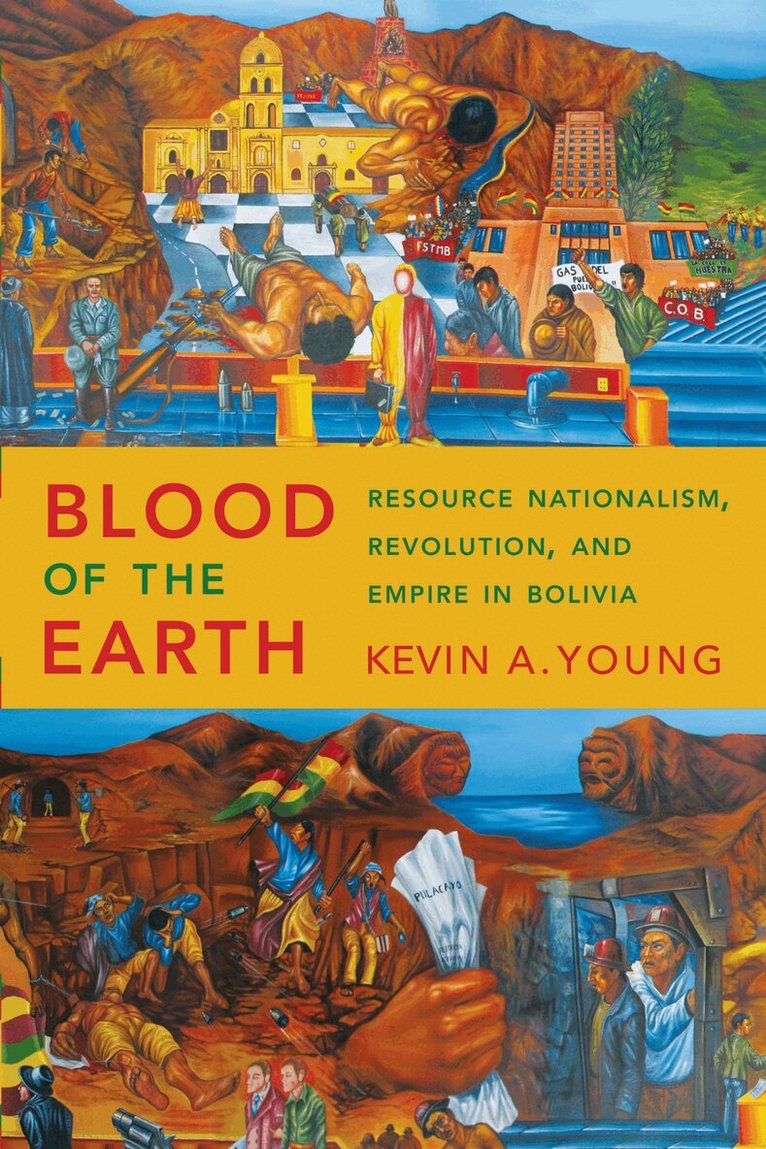
    Blood of the Earth

    Resource Nationalism, Revolution, and Empire in Bolivia

    AvKevin A. Young

    Inbunden, Engelska, 2017

    979 kr

    Beställningsvara. Skickas inom 10-15 vardagar. Fri frakt över 249 kr.

    Fler format och utgåvor

    Häftad

    303 kr

    Beskrivning

    Conflicts over subterranean resources, particularly tin, oil, and natural gas, have driven Bolivian politics for nearly a century. “Resource nationalism”-the conviction that resource wealth should be used for the benefit of the “nation”-has often united otherwise disparate groups, including mineworkers, urban workers, students, war veterans, and middle-class professionals, and propelled an indigenous union leader, Evo Morales, into the presidency in 2006. Blood of the Earth reexamines the Bolivian mobilization around resource nationalism that began in the 1920s, crystallized with the 1952 revolution, and continues into the twenty-first century.Drawing on a wide array of Bolivian and US sources, Kevin A. Young reveals that Bolivia became a key site in a global battle among economic models, with grassroots coalitions demanding nationalist and egalitarian alternatives to market capitalism. While US-supported moderates within the revolutionary regime were able to defeat more radical forces, Young shows how the political culture of resource nationalism, though often comprising contradictory elements, constrained government actions and galvanized mobilizations against neoliberalism in later decades. His transnational and multilevel approach to the 1952 revolution illuminates the struggles among Bolivian popular sectors, government officials, and foreign powers, as well as the competing currents and visions within Bolivia’s popular political cultures. Offering a fresh appraisal of the Bolivian Revolution, resource nationalism, and the Cold War in Latin America, Blood of the Earth is an ideal case study for understanding the challenges shared by countries across the Global South.

    Produktinformation

    • Utgivningsdatum:2017-02-14
    • Mått:152 x 229 x 22 mm
    • Vikt:454 g
    • Format:Inbunden
    • Språk:Engelska
    • Antal sidor:288
    • Förlag:University of Texas Press
    • ISBN:9781477311523

    Utforska kategorier

    • Amerikas historia inom Historia och arkeologi

    Mer om författaren

    Kevin A. Young is an assistant professor of history at the University of Massachusetts Amherst.

    Recensioner i media

    The importance of this book to contemporary conversations about extractivism in Bolivia cannot be overstated. (Latin American Perspectives) [Young] draws a complex and fascinating picture of the struggles over mining and oil from the Chaco War in the 1930s through the 1952 Revolution and the unraveling of the revolutionary state in the 1960s. (Against the Current) Young is to be congratulated on creating a comprehensive history of recent Bolivian history that also offers a new lens for interpreting Latin American populism. It is one of the finest examples of the recent, and very welcome, production of works on Latin American economic history. (The Americas) Young expertly contextualizes his discussion of resource nationalism with previous attempts to bring natural resources under governmental control...[A] compelling and wonderful book. (American Historical Review) Blood of the Earth makes a significant contribution to the historiography of the Bolivian revolution and provides new analytical insights into U.S. Cold War objectives in Latin America. (Diplomatic History) Blood of the Earth provides a compelling retelling of a Cold War story against the grain, in which the United States funded and tamed a revolution instead of intervening with force. (Hispanic American Historical Review) [Young's] detailed description of [the US government's public relations campaign aimed at taming resource nationalism in Bolivia] is certainly enlightening as it brings a hitherto unknown side of US interventions in Latin America to our attention. (Latin American Research Review) Young's concept of 'resource nationalism' casts a new interpretive light on the Bolivian political scene of the 1950s and 1960s. It also provides continuity between the political ferment that followed the Bolivian Revolution of 1952 and the popular mobilization that led to the election of Evo Morales in December 2005. (Canadian Journal of Latin American and Caribbean Studies) Blood of the Earth is an intelligent and informative book that will be of interest to students of Bolivian history and present times, and to those who wish to explore resource nationalism in the Bolivian context...the material makes an important contribution to the field of Bolivian studies and the writing style contributes to a pleasant reading. (Bulletin of Latin American Research)

    Innehållsförteckning

    • AcknowledgmentsList of AbbreviationsIntroduction: Natural Resources, Economic Visions, and US Intervention in Twentieth-Century Bolivia1. The Road to Resource Nationalism: Economic Ideas and Popular Coalitions in La Paz, 1927–19522. A New Type of Bolivian Economy: Competing Visions, 1952–19563. The Political Economy of Containment: Privatization, Austerity, and the MNR’s Shift to the Right, 1955–19644. The Battle for Men’s Minds: Economic Paradigms, Propaganda, and the Iconography of Revolution5. The Limits of Containment: Anti-Austerity and Resource Nationalism in La Paz Factories6. Oil and Nation: The Crusade to Save Bolivia’s HydrocarbonsEpilogue: Resource Nationalism and Popular Struggle in the Twenty-First CenturyAppendix: Professional Backgrounds of Key Middle-Class Participants in Economic Debates, 1940s–1960sNotesBibliographyIndex