• Fri frakt över 249 kr
  • •
  • Snabba leveranser
  • •
  • Billiga böcker
Kundservice

Du är på sajten för privatpersoner.

Företag, bibliotek eller offentlig verksamhet?

Du handlar på classic.bokus.com, där alla dina funktioner finns intakta.
Till classic.bokus.com
Bokus logotyp. Gå till startsidan.
  • Erbjudanden
  • Nyheter
  • Student
  • Topplistor
  • Barn & ungdom
  • Bokus Play
  • E-böcker
  • Pocketböcker
  • Spel & pussel

10% rabatt på allt med kod: NYSTART10 →

Sidfot

Mina sidor

    Hjälp

    • Kundservice
    • Vanliga frågor och svar
    • Frakt och leverans
    • Retur vid ångerrätt
    • Reklamera vara
    • Betalning
    • Köpvillkor
    • Allmänna villkor
    • Information om webbplatsens tillgänglighet

    Om Bokus

    • Om oss
    • Pressrum
    • För studenter
    • För företag
    • För bibliotek och offentlig verksamhet
    • För leverantörer
    • Hållbarhet

    Populärt

    • Aktuella erbjudanden
    • Presentkort
    • Studentlitteratur
    • Nya böcker
    • Topplistor
    • Signerade böcker
    • Engelska böcker

    Inspiration

    • Boktips
    • BookTok
    • Populära bokserier
    • Barnbokskaraktärer
    • Populära författare
    Logotyp för Bokus
    Följ oss på Facebook (extern länk)Följ oss på Instagram (extern länk)Följ oss på YouTube (extern länk)Följ oss på TikTok (extern länk)
    bokus @ CookiesAnpassa cookiesIntegritetspolicyKöpvillkor
    Till Citymail hemsida (extern länk)Till Budbee hemsida (extern länk)Till Postnord hemsida (extern länk)Till Schenker hemsida (extern länk)Till Early Bird hemsida (extern länk)Till Walleys hemsida (extern länk)
    1. Ekonomi och Ledarskap
    2. Företagsekonomi
    3. Redovisning och finansiering
    4. Redovisning

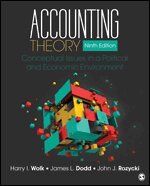
    Accounting Theory

    Conceptual Issues in a Political and Economic Environment

    AvHarry I. Wolk,James L. Dodd

    Inbunden, Engelska, 2016

    4 488 kr

    Beställningsvara. Skickas inom 3-6 vardagar. Fri frakt över 249 kr.

    Beskrivning

    This updated Ninth Edition of Accounting Theory: Conceptual Issues in a Political and Economic Environment continues to be one of the most relevant and comprehensive texts on accounting theory. Authors Harry I. Wolk, James L. Dodd, John J. Rozycki provide a critical overview of accounting as a whole as well as touch on the financial issues in economic and political contexts, providing readers with an understanding of how current United States accounting standards were derived and where we might be headed in the future. Readers will find learning tools such as questions, cases, problems and writing assignments to solidify their understanding of accounting theory and gain new insights into this evolving field.

    Produktinformation

    • Utgivningsdatum:2016-08-24
    • Mått:187 x 231 x 41 mm
    • Vikt:1 280 g
    • Format:Inbunden
    • Språk:Engelska
    • Antal sidor:672
    • Upplaga:9
    • Förlag:SAGE Publications
    • ISBN:9781483375021

    Utforska kategorier

    • Redovisning inom Ekonomi och Ledarskap

    Mer om författaren

    Harry I. Wolk (1930-2009) held a BS in economics from the Wharton School of the University of Pennsylvania and MBA and PhD degrees from Michigan State University. He was the author or co-author of approximately 25 journal articles, including publications in the Accounting Review, Journal of Accounting Research, Accounting Horizons, and the International Journal of Accounting. He was the lead author of seven editions of Accounting Theory: Conceptual Issues in a Political and Economic Environment. He previously taught at the University of Wisconsin–Milwaukee and was the Aliber Distinguished Professor of Accounting at Drake University, where he taught for 32 years. He also visited Creighton University, where he was John P. Begley Professor of Accounting. He was a member of the American Accounting Association and Financial Executives International, where he served as president of the Iowa Chapter. Outside of accounting, his interests were in following national and world affairs closely, listening to classical music, and following the fortunes of the Boston Red Sox, Boston Celtics, and the New England Patriots.James L. Dodd, Professor Emeritus of Accounting at Drake University, holds a BS in accounting from California State University–Fresno, an MBA from the University of South Alabama, and a PhD from the University of Georgia, with a major in accounting and a minor in information systems. Before entering academe, Dr. Dodd worked for 15 years in the shipbuilding, aircraft-engine, and diesel-engine filtration industries. His assignments at Litton, Teledyne, and Cummins included experience in industrial engineering, capital budgeting, profit planning, product pricing, cost accounting, long-range systems planning, and accounting controllerships at plant and corporate levels. He is a Fulbright Scholar alumnus, participating in academic exchanges with Norway (1999–2000) and Iceland (2007). His teaching and research include areas in accounting theory, fraud examination, and international accounting. On a personal level, he enjoys working with his hands, listening to bluegrass music, watching SEC sports, and volunteering as an AARP-IRS tax aide. He is a Southerner, born in Birmingham, Alabama, married to his college sweetheart for 48+ years; he has one daughter and two grandchildren.John J. Rozycki, Associate Professor of Finance at Drake University, holds a BS in biology from King’s College, an MBA from the University of Scranton, and a PhD from Penn State University, with a major in finance. Before pursuing his doctoral education, Dr. Rozycki worked in the health care planning and telecommunications industries. He teaches corporate finance and equity valuation. His professional interests are in equity and business valuation, corporate capital allocation decisions, financial planning, financing decisions, and financial statement analysis. He is a member of the CFA Institute, the CFA Society of Iowa, the Financial Management Association, and the Midwest Finance Association. He is a CFA charterholder. He was born in Wilkes-Barre, Pennsylvania, and is married with two sons. He is active in his church and enjoys the outdoors.

    Innehållsförteckning

    • Chapter 1: An Introduction to Accounting TheoryAccounting Theory and Policy MakingThe Role of Measurement in AccountingPlan of This BookAppendix 1-A: Valuation SystemsChapter 2: Accounting Theory and Accounting ResearchAccounting Research and Scientific MethodIs Accounting an Art or a Science?Directions in Accounting ResearchA Scientific Revolution in Accounting?Chapter 3: Development of the Institutional Structure of Financial AccountingAccounting in the United States Prior to 1930Formative Years, 1930-1946Postwar Period, 1946-1959Modern Period, 1959 to the PresentChapter 4: The Economics of Financial Reporting RegulationThe Case for Unregulated Markets for Accounting InformationThe Case for Regulated Markets for Accounting InformationImperfections of Accounting RegulationThe Regulatory ProcessEconomic Consequences of Accounting PolicyChapter 5: Postulates, Principles, and ConceptsPostulates and PrinciplesBasic Concepts Underlying Historical CostingEquity TheoriesAppendix 5-A: The Basic Postulates of Accounting (ARS 1)Appendix 5-B: A Tentative Set of Broad Accounting Principles for Business Enterprises (ARS 3)Chapter 6: The Search for ObjectivesASOBATAPB Statement 4The Trueblood Committee ReportSATTAUser Objectives and User DiversityChapter 7: The FASB’s Conceptual FrameworkThe FASB’s Conceptual FrameworkThe Conceptual Framework as a Codificational DocumentEmpirical Research on the Conceptual FrameworkAssessing the Conceptual FrameworkChapter 8: Usefulness of Accounting Information to Investors and CreditorsEarnings, Dividends, and Stock PricesResidual Income ModelsBackground on Risk and ReturnIntroduction to Capital Markets Research in AccountingThe Value of Accounting Information: Evidence From Return DataThe Value of Accounting Information: Evidence From Direct ValuationAccounting Data and CreditorsImportance of Earnings ForecastingEmpirical Research and Standard SettingChapter 9: Uniformity and Disclosure: Some Policy-Making DirectionsWhat Underlies the Choice Among Accounting Methods?UniformityThe Usefulness of Accounting AllocationsDisclosureImproving Accounting StandardsChapter 10: International AccountingNational Accounting DifferencesInternational Harmonization of Accounting StandardsChapter 11: The Balance SheetThe Relationship Between the Balance Sheet and the Income StatementAssetsLiabilitiesOwners′ EquityFinancial InstrumentsClassification in the Balance SheetAppendix 11-A: A Simple Example of a Weather DerivativeChapter 12: The Income StatementIncome DefinitionsRevenues and GainsExpenses and LossesFuture Events and Accounting RecognitionCurrent Operating Versus All-Inclusive IncomeNonoperating SectionsEarnings per ShareSpecial Subjects Concerning Income MeasurementEarnings ManagementIncome Statement DevelopmentsChapter 13: Statement of Cash FlowsThe Statement of Changes in Financial PositionThe Motivation for a Cash Flow StatementRequirements of the Cash Flow StatementClassification Problems of SFAS No. 95Analytical Usefulness of the Cash Flow StatementCash and Funds Flow ResearchImproving the SCFChapter 14: Income Taxes and Financial AccountingIncome Tax AllocationThe Asset–Liability Orientation of SFAS No. 109Empirical Research on Income Tax AllocationInternational Accounting Standards (IAS)Improving Accounting StandardsChapter 15: Pensions and Other Postretirement BenefitsOverview of Pension PlansDevelopment of Pension Accounting StandardsPostretirement Benefits Other Than PensionsInternational Accounting Standards (IAS)Improving Accounting StandardsAppendix 16-A: Illustration of Pension Expense Determination and Actuarial Funding MethodsChapter 16: LeasesThe Lease ContractThe Evolution of Lease Accounting StandardsFASB and IASB Joint Exposure Draft on Accounting for LeasesImproving Accounting StandardsChapter 17: Intercorporate Equity InvestmentsRelevant CircumstancesConsolidationThe Equity MethodThe Fair Value MethodDefining the Reporting EntityTranslation of Foreign OperationsIASB StandardsImproving Accounting StandardsAppendix 17-A: Special Purpose Entities, Variable Interest Entities, and the Downfall of Enron