• Fri frakt över 249 kr
  • •
  • Snabba leveranser
  • •
  • Billiga böcker
Kundservice

Du är på sajten för privatpersoner.

Företag, bibliotek eller offentlig verksamhet?

Du handlar på classic.bokus.com, där alla dina funktioner finns intakta.
Till classic.bokus.com
Bokus logotyp. Gå till startsidan.
  • Erbjudanden
  • Student
  • Topplistor
  • Barn & ungdom
  • Bokus Play
  • E-böcker
  • Ljudböcker
  • Pocketböcker
  • Spel & pussel

Upp till 25% på utvalda nyheter →

Sidfot

Mina sidor

    Hjälp

    • Kundservice
    • Vanliga frågor och svar
    • Frakt och leverans
    • Retur vid ångerrätt
    • Reklamera vara
    • Betalning
    • Köpvillkor
    • Allmänna villkor
    • Information om webbplatsens tillgänglighet

    Om Bokus

    • Om oss
    • Pressrum
    • För studenter
    • För företag
    • För bibliotek och offentlig verksamhet
    • För leverantörer
    • Hållbarhet

    Populärt

    • Aktuella erbjudanden
    • Presentkort
    • Studentlitteratur
    • Nya böcker
    • Topplistor
    • Signerade böcker
    • Engelska böcker

    Inspiration

    • Boktips
    • BookTok
    • Populära bokserier
    • Barnbokskaraktärer
    • Populära författare
    Logotyp för Bokus
    Följ oss på Facebook (extern länk)Följ oss på Instagram (extern länk)Följ oss på YouTube (extern länk)Följ oss på TikTok (extern länk)
    bokus @ CookiesAnpassa cookiesIntegritetspolicyKöpvillkor
    Till Citymail hemsida (extern länk)Till Budbee hemsida (extern länk)Till Postnord hemsida (extern länk)Till Schenker hemsida (extern länk)Till Early Bird hemsida (extern länk)Till Walleys hemsida (extern länk)
    1. Data och IT
    2. Programmeringsböcker

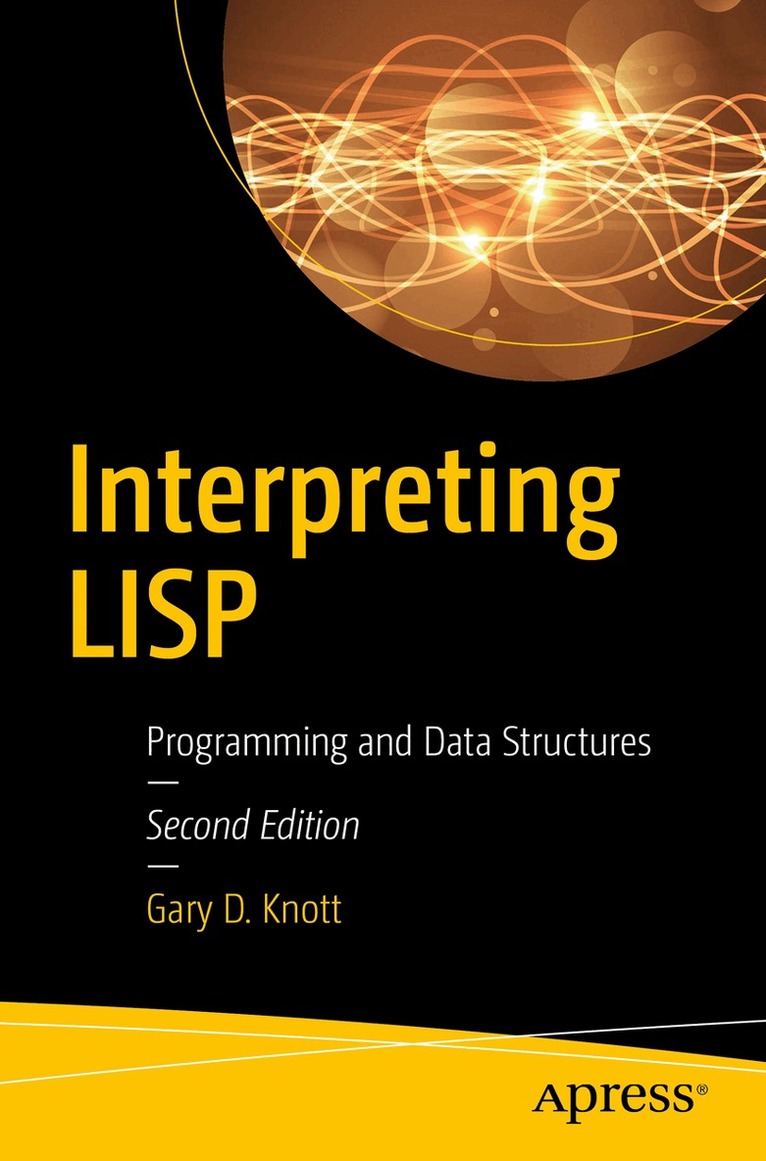
    Interpreting LISP

    Programming and Data Structures

    AvGary D. Knott

    Häftad, Engelska, 2017

    396 kr

    Beställningsvara. Skickas inom 10-15 vardagar. Fri frakt över 249 kr.

    Fler format och utgåvor

    E-bok

    488 kr

    Beskrivning

    Learn Lisp programming in a data structures context, including tables, functions, forms, expressions, typed-pointers, I/O, garbage collection and some applications. This short primer contains a careful description of the data structures manipulated by Lisp functions. These data structures and others, notably hash tables, are also used in constructing a Lisp interpreter.  Interpreting Lisp will be of special interest to those learning and using programming languages and computer architecture as well as data structures. This book will be useful to autodidacts, professional programmers, and computer enthusiasts in a wide variety of fields.What You'll LearnUse the atom table and the number table in Lisp Master expressions, typed pointers, arguments and results in typed pointers, and moreWrite lambda expressions in Lisp Bind actual values to formal arguments Develop games in LispWho This Book Is ForExperienced programmers new to Lisp.

    Produktinformation

    • Utgivningsdatum:2017-06-24
    • Mått:155 x 235 x 10 mm
    • Vikt:265 g
    • Format:Häftad
    • Språk:Engelska
    • Antal sidor:150
    • Upplaga:2
    • Förlag:APress
    • ISBN:9781484227060

    Utforska kategorier

    • Programmeringsböcker inom Data och IT

    Mer om författaren

    Gary Knott, PhD is founder/CEO of Civlized Inc., the makers of MLAB.  He is also a professor, expert consultant in mathematical models with emphasis on applications of interest  to the National Institute of Health (NIH).  He was a computer scientist and programmer for the NIH as well.

    Innehållsförteckning

    • 1. LISP.- 2. The Atom Table and the Number Table.- 3. Evaluation.- 4 Some Functions and Special Forms.- 5. S-Expressions.- 6. Typed-Pointers.- 7. Pictorial Notation.- 8. More Functions.- 9. Arguments and Results are Typed-Pointers.- 10. List Notation.- 11. More Special Forms.- 12. Defining Functions: λ-Expressions.- 13. More Functions.- 14. Defining Special Forms.- 15. The Label Special Form.- 16. The Quote Macro.- 17. More Functions.- 18. More About Typed-Pointers.- 19. Binding Actual Values to Formal Arguments.- 20. Minimal LISP.- 21. More Functions.- 22. Input and Output.- 23. Property Lists.- 24. What is LISP Good For?.- 25. Symbolic Differentiation.- 26. Game-Playing.- 27. The LISP Interpreter Program.- 28. Garbage Collection.- 29. LISP in C.