• Fri frakt över 249 kr
  • •
  • Snabba leveranser
  • •
  • Billiga böcker
Kundservice

Du är på sajten för privatpersoner.

Företag, bibliotek eller offentlig verksamhet?

Du handlar på classic.bokus.com, där alla dina funktioner finns intakta.
Till classic.bokus.com
Bokus logotyp. Gå till startsidan.
  • Erbjudanden
  • Nyheter
  • Student
  • Topplistor
  • Barn & ungdom
  • Bokus Play
  • E-böcker
  • Pocketböcker
  • Spel & pussel

10% rabatt på allt med kod: NYSTART10 →

Sidfot

Mina sidor

    Hjälp

    • Kundservice
    • Vanliga frågor och svar
    • Frakt och leverans
    • Retur vid ångerrätt
    • Reklamera vara
    • Betalning
    • Köpvillkor
    • Allmänna villkor
    • Information om webbplatsens tillgänglighet

    Om Bokus

    • Om oss
    • Pressrum
    • För studenter
    • För företag
    • För bibliotek och offentlig verksamhet
    • För leverantörer
    • Hållbarhet

    Populärt

    • Aktuella erbjudanden
    • Presentkort
    • Studentlitteratur
    • Nya böcker
    • Topplistor
    • Signerade böcker
    • Engelska böcker

    Inspiration

    • Boktips
    • BookTok
    • Populära bokserier
    • Barnbokskaraktärer
    • Populära författare
    Logotyp för Bokus
    Följ oss på Facebook (extern länk)Följ oss på Instagram (extern länk)Följ oss på YouTube (extern länk)Följ oss på TikTok (extern länk)
    bokus @ CookiesAnpassa cookiesIntegritetspolicyKöpvillkor
    Till Citymail hemsida (extern länk)Till Budbee hemsida (extern länk)Till Postnord hemsida (extern länk)Till Schenker hemsida (extern länk)Till Early Bird hemsida (extern länk)Till Walleys hemsida (extern länk)
    1. Skönlitteratur
    2. Litteraturvetenskap
    3. Litteraturvetenskap

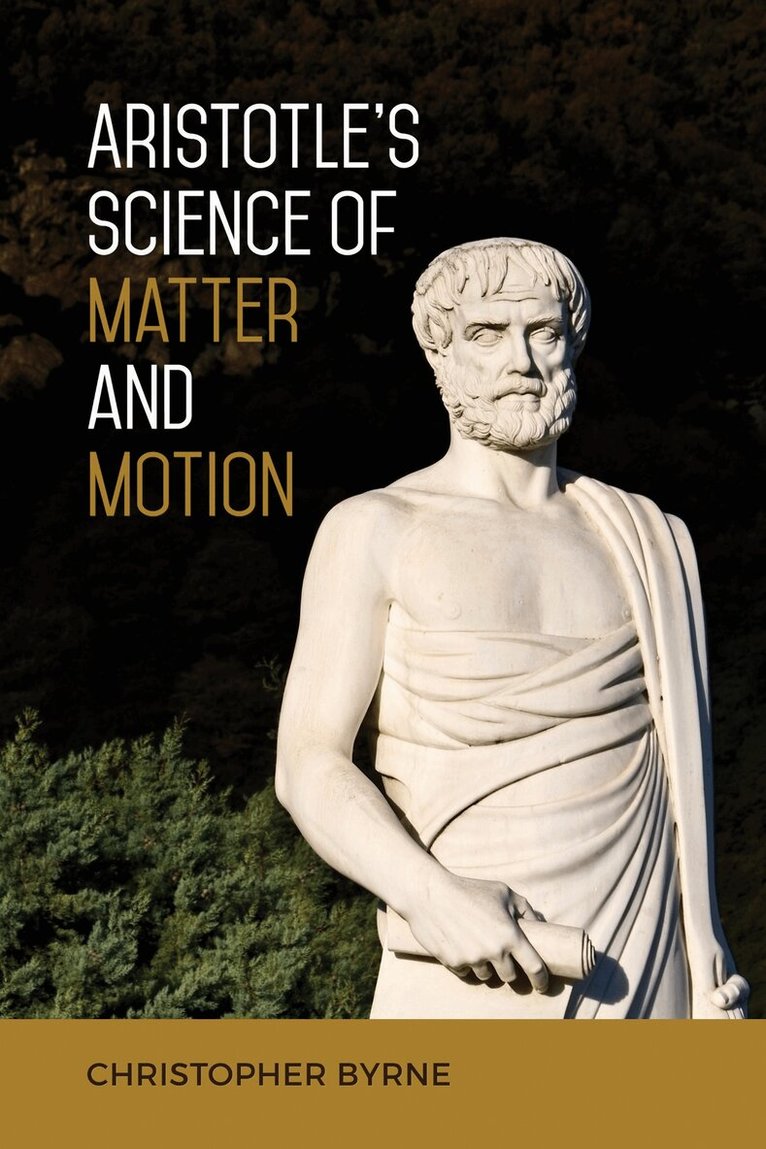
    Aristotle's Science of Matter and Motion

    AvChristopher Byrne

    E-bok
    Engelska, 2018

    835 kr

    Läs direkt i Bokus Reader – eller ladda ned till din enhet

    Fler format och utgåvor

    Inbunden

    653 kr

    E-bok

    837 kr

    Beskrivning

    Although Aristotle’s contribution to biology has long been recognized, there are many philosophers and historians of science who still hold that he was the great delayer of natural science, calling him the man who held up the Scientific Revolution by two thousand years. They argue that Aristotle never considered the nature of matter as such or the changes that perceptible objects undergo simply as physical objects; he only thought about the many different, specific natures found in perceptible objects.

    Aristotle’s Science of Matter and Motion’s focus is on refuting this misconception, arguing that Aristotle actually offered a systematic account of matter, motion, and the basic causal powers found in all physical objects. Author, Christopher Byrne sheds lights on Aristotle’s account of matter, revealing how Aristotle maintained that all perceptible objects are ultimately made from physical matter of one kind or another, accounting for their basic common features. For Aristotle, then, matter matters a great deal.

    Produktinformation

    • Utgivningsdatum:2018-08-08
    • Språk:Engelska
    • Antal sidor:208
    • Filformat:EPUB
    • Kopieringsskydd:LCP
    • ISBN:9781487519179
    • Förlag:University of Toronto Press

    Utforska kategorier

    • Litteraturvetenskap inom Skönlitteratur
    • Historia inom Historia och arkeologi
    • Filosofi inom Filosofi och religion

    Mer om författaren

    Christopher Byrne is an associate professor in the Department of Philosophy at St. Francis Xavier University.

    Innehållsförteckning

    • PrefaceAcknowledgments Introduction: The Case against an Aristotelian Physics1 Motion and Change in Perceptible Objects1.1 The Common Attributes of Perceptible Objects1.1.1 Perceptible Objects and Physical Contact1.1.2 Perceptible Objects and Motion1.1.3 Perceptible Objects and Change1.2 Motion and Natural Motion1.2.1 Motion and the Definition of Change 1.2.2 Motion and Place1.2.3 Motion and Inertial Motion2 E fficient Causality in Perceptible Objects2.1 General Principles of Efficient Causality2.1.1 Efficient Causality Belongs to Physical Agents2.1.2 Causation by Internal Parts2.1.3 Transmission Model of Causal Agency2.1.4 Causation by Commensurate Powers2.2 Mechanics and the Laws of Nature2.2.1 No Action at a Distance2.2.2 Proportion of Change to Physical Contact2.2.3 Spatial Dissipation of Causal Influence2.2.4 Combination of Causal Powers2.2.5 Necessity of Prior Motion2.2.6 P roportion between Cause and Effect2.2.7 Like Produces Like2.2.8 Universal Application and Experiments3 The Material Causes of Perceptible Objects3.1 The Definition of a Material Cause3.2 Perceptible Matter and the Division of the Sciences3.3 The Physical Requirements for Motion and Change3.3.1 The Substratum of Physical Interaction3.3.2 The Substratum of Locomotion3.3.3 The Substratum of Generation and Destruction4 The Material Elements and Prime Matter4.1 The Common Substratum of the Material Elements4.2 The Generation of the Material Elements5 Simple Physical Necessity in the Material Elements5.1 Simple versus Hypothetical Necessity5.2 Simple Teleological Necessity in the Elements5.3 Simple Non-Teleological Necessity in the Elements6 Simple Physical Necessity in Objects Made out of the Elements6.1 Simple Teleological Necessity in Perceptible Objects6.2 Simple Non-Teleological Necessity in Perceptible Objects6.3 Generation of Homogeneous Mixtures7 The Dual Nature of Perceptible Objects7.1 The Dual Nature of Physical Artefacts7.2 The Many Natures of Natural Substances7.3 The Difference between Natural Substances and Physical Artefacts7.4 The Unity of Natural Substances8 Matter and the Soul8.1 The Soul as the Actuality of the Body8.2 The Soul and Efficient Causality9 The Role of Teleological Explanation9.1 The Limits of Teleological Explanation9.2 The Compatibility of Natural Teleology with Non-Teleological Necessity9.3 The Dependence of Natural Teleology on Non-Teleological Necessity10 C onclusion: The Independence of the Material Cause10.1 The Material Cause and the Substratum of Generation10.2 The Material Cause and Potentiality10.3 The Material Cause and Definition10.4 The Material Cause and ChangeNotesWorks CitedIndex of Texts from Aristotle